
Interesting Things with JC #1503: "Gravity and Heavy Energy" – For most of history, gravity wasn’t debated. Things fell because that’s what they did. This episode looks at how height and position carry real consequences, and why something that isn’t moving can still do serious damage.
Curriculum - Episode Anchor
Gravity is not an abstract force invented by equations. It is a consistent rule of nature understood first through experience, later through testing, and finally through measurement. This episode explores how people before modern science understood gravity and energy through observation, construction, danger, and consequence. To include how those same rules scale from falling stones to forming stars.
Episode Title: Gravity and Heavy Energy
Episode Number: 1503
Host: JC
Audience: Grades 9–12, college intro, homeschool, lifelong learners
Subject Area: Physics, History of Science
Lesson Overview
This lesson examines how gravity and energy were understood before formal scientific equations, tracing the progression from Aristotle’s assumptions through Leonardo da Vinci’s observations, Galileo’s experiments, and Newton’s laws. Students analyze how position, height, and mass determine outcomes, introducing the concept of gravitational potential energy through historical storytelling rather than formulas.
Learning Objectives
Students will be able to:
Define gravity and energy as understood through historical observation rather than modern equations.
Compare Aristotle’s explanation of falling objects with Galileo’s experimental findings.
Analyze how position and height influence stored energy and consequences.
Explain how gravitational principles apply from everyday objects to stars and orbits.
Key Vocabulary
Gravity (GRAV-ih-tee) — The consistent interaction by which masses attract each other, observed historically through falling objects.
Energy (EN-er-jee) — From the Greek energia, meaning work or effort; the capacity to cause change through motion, heat, or force.
Mass (mass) — The amount of matter in an object, which determines how strongly it interacts gravitationally.
Acceleration (ak-sel-er-AY-shun) — The rate at which velocity changes, including the constant acceleration of falling objects near Earth.
Potential Energy (puh-TEN-shul EN-er-jee) — Stored energy due to position or height, even when an object is not moving.
Narrative Core
Open: A stone dropped from a tower in 1503 always fell. No one debated it. Experience was enough.
Info: Builders, laborers, and engineers relied on gravity daily without formulas, understanding danger through weight and height.
Details: Leonardo noticed motion depended on imbalance, Galileo disproved heaviness as the cause of falling speed, and Newton quantified gravity’s universal reach.
Reflection: Position itself carries consequence. What appears calm may hold immense potential for change.
Closing: These are interesting things, with JC.
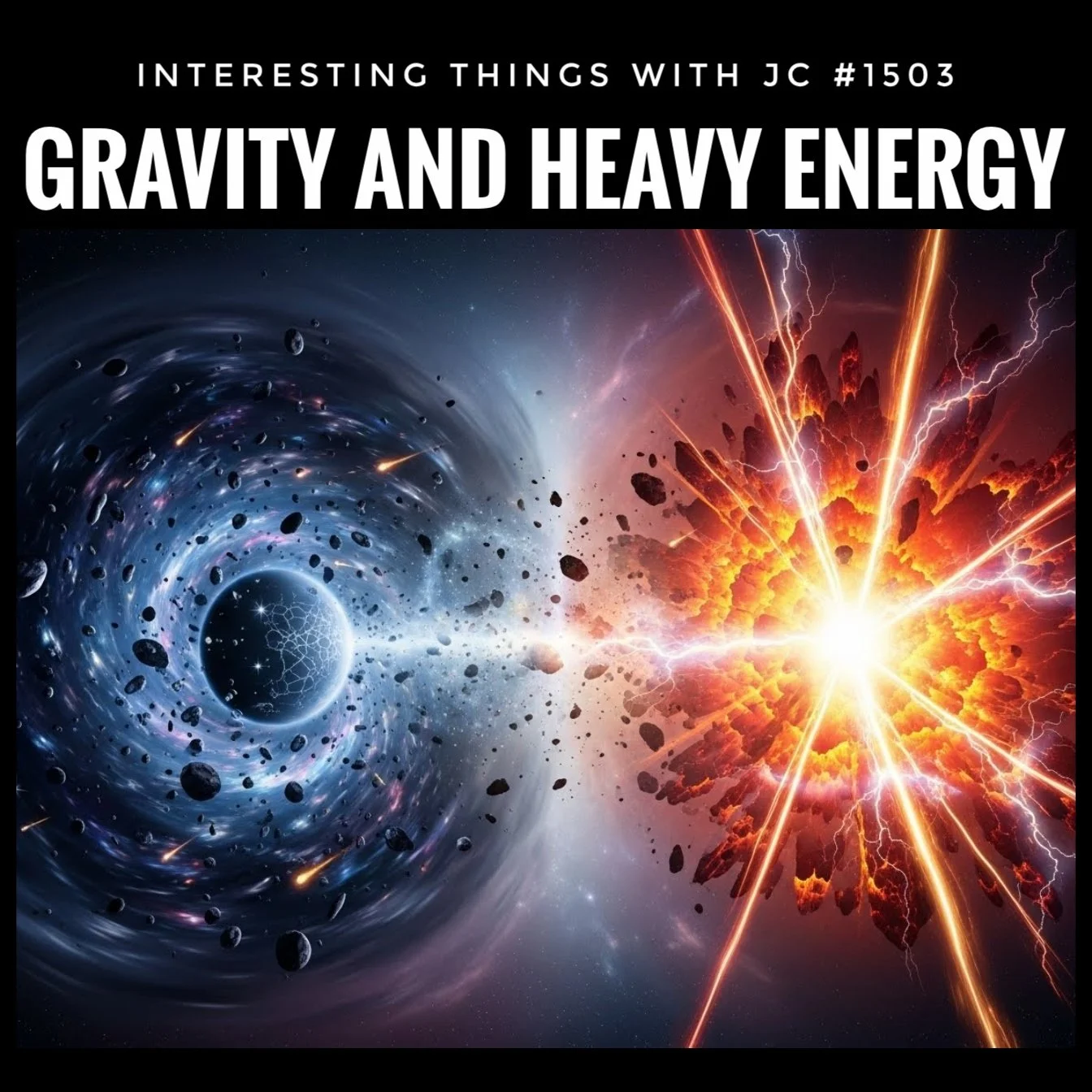
Promotional artwork for Interesting Things with JC #1503, Gravity and Heavy Energy. The image shows a dark space scene split down the middle. On the left, a blue-black swirling vortex pulls in rocks and debris. On the right, a bright orange explosion sends light and fragments outward. The contrast shows inward pull versus outward force, representing gravity and energy.
Transcript
Interesting Things with JC #1503: “Gravity and Heavy Energy”
In the year 1503, if someone dropped a stone from a tower, nobody argued about what would happen. It fell. It always had. You didn’t need proof. You saw it every day. Rocks fell. Tools slipped. Buckets dropped. Heavy things went down. That was just how the world worked.
That mattered because people back then didn’t have labs or formulas. What they had was experience. They built churches, bridges, walls, and fortifications by hand. If you misjudged weight, something cracked or collapsed. Sometimes someone underneath paid for it. Gravity wasn’t an idea. It was something you had to take into account.
Most of Europe still leaned on Aristotle, born in 384 BC. He taught that heavy objects fell faster because they were heavy. Not because something pulled them, but because they belonged closer to the Earth. Earth went down. Fire went up. Air sat in between. If you never tested it, that explanation worked well enough. And for nearly two thousand years, nobody really tested it.
Back then, gravity wasn’t something you could point to. It was simply how things behaved when you let go.
Even the word energy meant something different. It came from the Greek word energia (en-ER-jee-ah). It meant work. Effort. If a man lifted a stone weighing 50 pounds (22.7 kilograms), the effort was in his arms and back. Once the stone stopped moving, people assumed the work was done.
It wasn’t.
Put that same 50 pound stone on top of a wall 20 feet high (6.1 meters), and it just sat there. No sound. No motion. It looked harmless. But the effort it took to lift it hadn’t gone away. The stone carried that effort because of where it was. Height mattered. Position mattered. If it slipped, that effort would show up again all at once.
People didn’t have a term for that, but they understood it. They knew height made weight dangerous.
Leonardo da Vinci (LAY-oh-NAR-doh dah-VIN-chee) was alive in 1503 and paid attention to falling water, rolling weights, and collapsing loads. He sketched motion step by step. He wrote that movement came from imbalance. He could see that weight alone wasn’t the whole story. Height mattered too. Even without math, he understood that lifting something changed what could happen next.
About a hundred years later, Galileo Galilei (gal-ih-LAY-oh gal-ih-LAY) tested the old assumptions. He showed that heavy and light objects fall at the same rate when air isn’t slowing them down. A cannonball and a stone don’t race. They land together. Weight doesn’t control the fall. Gravity treats mass the same way.
That meant gravity wasn’t about heaviness. It was about how motion changes. Everything speeds up toward the ground at the same rate, about 32 feet per second squared (9.8 meters per second squared), no matter what it weighs.
Then in 1687, Isaac Newton put numbers to what people already knew from experience. He showed that everything with mass pulls on everything else. The Earth pulls on a stone. The stone pulls back on the Earth. The interaction goes both ways. The difference is scale. The Earth barely moves because it’s enormous.
From that point on, gravity could be measured instead of guessed at.
And that’s where this stops being only an Earth story.
The same rules apply far beyond the ground under our feet. A moon stays in orbit because it is always falling and never quite reaching what it’s falling toward. Its height and its sideways motion work together. Remove either one and the orbit ends.
One thing worth thinking about here is this. We usually talk about gravity as a cause, but most of what we see comes down to position. Change where something is, and everything that follows changes with it. The motion isn’t added later. It comes with the position itself.
Stars form the same way. Gravity pulls large clouds of gas inward over millions of years. As that happens, motion turns into heat. Heat raises pressure. When the conditions are right, nuclear fusion begins. A star doesn’t suddenly appear. It forms over time.
Gravity doesn’t trap energy. It sets the conditions for how energy changes.
Here’s the part people often miss.
Gravity doesn’t create energy. It doesn’t destroy it. Lift something and the effort stays tied to where that object is. Change its position and that effort turns into motion. Motion turns into heat, sound, fracture, light, or work. Nothing shows up from nowhere. Nothing disappears.
That’s heavy energy.
A boulder weighing one ton, 2,000 pounds (about 907 kilograms), sitting on a cliff 100 feet high (30.5 meters), looks calm. It isn’t moving. But its position matters. If it moves, everything involved happens at once.
The pattern is straightforward. Raise something higher and the effect increases. Make it heavier and it increases again. There’s no shortcut built into it.
At extreme scales, the same rules still apply. When mass and position line up in certain ways, outward paths stop making sense.
That leads to another useful thought. We tend to assume there’s always an “out,” some direction away from trouble. Nature doesn’t promise that. In some situations, the paths we expect just aren’t part of the setup anymore.
Light doesn’t fail because it’s weak. It fails because there is no longer a clear way out.
We use this every day. Water behind a dam isn’t powerful because it’s water. It’s powerful because of where it sits. When released, gravity turns height into motion, motion into rotation, and rotation into electricity. The power comes from the drop.
Back in 1503, nobody talked about joules or equations. But builders understood effort. They respected weight. They knew height turned calm things into dangerous ones. They learned, often the hard way, that something standing still can still cause damage if it’s in the wrong place.
Gravity has always been there. It works the same way every time.
Once that clicks, the lesson isn’t really about falling objects anymore. It’s about stored consequences. The same rule that drops a stone also shapes a star. Calm things can still carry force. Stable doesn’t mean safe. And when something finally moves, everything tied to it shows up at once.
These are interesting things, with JC.
Student Worksheet
Explain why people in 1503 trusted gravity without formal experiments.
Describe how height changes the danger of a heavy object.
Compare Aristotle’s and Galileo’s explanations of falling objects.
Give an example from daily life where position creates stored consequences.
Teacher Guide
Estimated Time
45–60 minutes
Pre-Teaching Vocabulary Strategy
Use physical demonstrations: place an object on the floor versus a shelf and discuss consequences.
Anticipated Misconceptions
Heavier objects fall faster.
Energy only exists when something is moving.
Discussion Prompts
Why might people resist testing ideas that seem “obvious”?
How does gravity connect everyday life to space?
Differentiation Strategies
ESL: Visual diagrams and sentence frames.
IEP: Oral responses or guided notes.
Gifted: Research historical experiments on gravity.
Extension Activities
Model gravitational potential energy using ramps or simulations.
Cross-Curricular Connections
Physics, engineering, astronomy, history.
Quiz
Q1. Why did people in 1503 not argue about falling objects?
A. They lacked imagination
B. Gravity was already measured
C. Everyday experience confirmed it
D. Aristotle proved it mathematically
Answer: C
Q2. Aristotle believed heavy objects fell faster because:
A. Air pushed them down
B. They belonged closer to Earth
C. Gravity pulled harder
D. Height did not matter
Answer: B
Q3. Galileo showed that falling speed depends on:
A. Weight
B. Shape
C. Air resistance, not mass
D. Material
Answer: C
Q4. Potential energy is best described as:
A. Energy in motion
B. Energy from heat
C. Stored energy due to position
D. Energy lost over time
Answer: C
Q5. A moon stays in orbit because it is:
A. Floating
B. Pulled equally in all directions
C. Always falling sideways
D. Weightless
Answer: C
Assessment
Explain how gravity turns position into motion.
Describe how the same gravitational rules apply to stars.
3–2–1 Rubric
3 = Accurate, complete, thoughtful
2 = Partial or missing detail
1 = Inaccurate or vague
Standards Alignment
NGSS HS-PS2-4
Analyze data to support Newton’s law of gravitation as applied to objects and orbits.
NGSS HS-PS3-1
Create explanations for how energy is conserved and transferred.
CCSS.ELA-LITERACY.RST.9-10.2
Determine central ideas of a scientific text.
UK National Curriculum – Physics (Forces)
Understanding gravity and motion through observation and explanation.
IB DP Physics Topic 2
Conceptual understanding of forces and energy without reliance on formulas alone.
Show Notes
This episode traces humanity’s understanding of gravity from lived experience to scientific measurement, showing how builders, thinkers, and scientists recognized the power of position long before equations existed. In the classroom, it helps students connect physics concepts to real-world intuition, historical development, and cosmic scale, reinforcing that science grows from observation grounded in reality. The framework follows the established structure outlined in the Reusable Curriculum Framework for Interesting Things with JC .
