Interesting Things with JC #1504: "The NCAA Football Playoff Bracket" – The outrage in 2025 wasn’t about one team getting in. It was about watching wins matter less than brands, records lose to ratings, and a system bend without needing to. When did winning stop being enough?
Curriculum - Episode Anchor
This episode examines how competitive systems can drift from clear, objective outcomes toward subjective decision-making when economic incentives and brand power influence results. Using the 2025 College Football Playoff controversy, students explore fairness, transparency, and system design in modern institutions.
Episode Title: Interesting Things with JC #1504: “The NCAA Football Playoff Bracket”
Episode Number: 1504
Host: JC
Audience: Grades 9–12, college intro, homeschool, lifelong learners
Subject Area: Media Literacy, Civics, Economics, Sports History
Lesson Overview
This lesson uses a real-world sports controversy to help learners analyze how records, rules, money, and perception interact in institutional decision-making. Students evaluate evidence, compare systems, and assess a proposed reform model, building skills in critical thinking, argumentation, and civic reasoning.
Learning Objectives
By the end of this lesson, students will be able to:
• Define how the College Football Playoff selection process works and what criteria are emphasized.
• Compare team records and selection outcomes to identify inconsistencies.
• Analyze how financial incentives and media partnerships can influence institutional decisions.
• Explain how a proposed 16-team playoff system could address perceived fairness issues.
Key Vocabulary
• Playoff Bracket (play-off brak-it) — The structured arrangement determining which teams compete and advance in postseason play.
• Conference Champion (kon-fer-ens cham-pee-un) — A team that wins its athletic conference title.
• Automatic Bid (aw-toh-mat-ik bid) — Guaranteed entry into a playoff based on predefined criteria.
• Eye Test (eye test) — A subjective evaluation based on perception rather than measurable results.
• Television Rights Deal (tel-uh-vizh-un rights deel) — A contract granting broadcasters the right to air sporting events for financial compensation.
Narrative Core
Open: The episode begins by presenting the raw records of Notre Dame, BYU, and Alabama, immediately highlighting the apparent mismatch.
Info: Listeners are given context about the College Football Playoff, conference power, and the role of major television contracts.
Details: The key tension emerges when Alabama is selected despite three losses, while teams with stronger records are excluded, raising questions about incentives and standards.
Reflection: The story broadens into a discussion about fairness, trust, and how systems reward some participants differently than others.
Closing: These are interesting things, with JC.
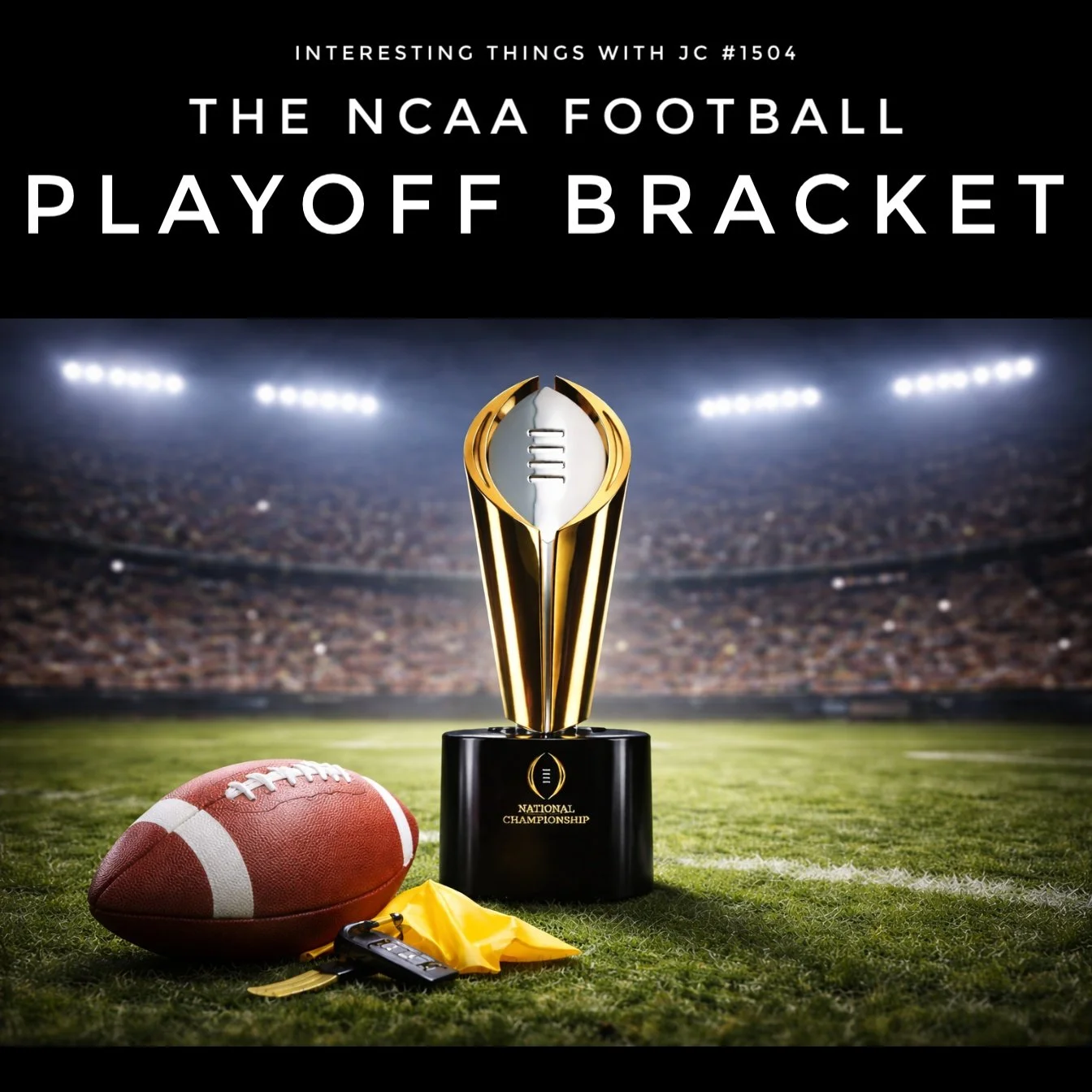
Promotional graphic for Interesting Things with JC episode #1504 titled “The NCAA Football Playoff Bracket.” The image shows a gold college football championship trophy standing on a football field under bright stadium lights. A brown leather football and a yellow penalty flag rest on the grass in the foreground. A large, blurred crowd fills the stadium in the background, emphasizing a high-stakes championship atmosphere.
Transcript
The 2025 College Football Playoff controversy wasn’t just about who got in. It was about how clear the mismatch had become.
The records were right there.
Notre Dame finished 10–2.
BYU finished 11–1.
Alabama finished 9–3.
Notre Dame and BYU were left out. Alabama got in.
That alone was enough to tick people off. But fans didn’t stop at the bracket. They looked at where the money goes.
The SEC has a long-term, multibillion-dollar TV deal with ESPN. The playoff itself airs on ESPN. Alabama is one of the biggest draws in the sport. None of that means anyone cheated. But it does explain how decisions lean when ratings are always in the background. When the same conference owns the best TV slots every week and postseason, they tend to get more slack.
That’s how three losses don’t end your season. That’s how the “eye test” starts to matter more than the record. That’s how winning stops being the whole point.
BYU won almost every game they played. Notre Dame took on a national schedule without a conference safety net. Alabama lost three times and still got the nod. Fans didn’t see bad luck. They saw everything lining up the same way it always does. TV deals, money, and rankings all pointing in one direction.
None of it had to happen.
There’s already a simple fix.
A sixteen-team playoff with automatic bids for every conference champion, set up like the NFL postseason.
There are ten FBS conferences. If you win your conference, you’re in. No arguing. No brand advantage. The other six spots go to the best teams that didn’t win their league. If Alabama earns one, fine. If not, they’re out. An 11–1 BYU never gets shut out. Conference titles actually mean something again.
And just as important, teams from leagues like the MAC finally get real respect. A school like Toledo, which wins a full NCAA Division I conference, gets a seat at the table the same way every NFL division champ does.
The money still works. More games mean more TV windows, more ads, more revenue. ESPN still makes its money. The difference is people trust the outcome. The system stops bending to protect names and starts rewarding results.
The anger in 2025 wasn’t about hating Alabama or the SEC. It was about seeing that some teams have to be almost perfect, while others get room to mess up. Expansion was supposed to make things fair. Instead, it showed how loose the standards still are.
Until every conference champion is guaranteed a spot, this argument isn’t going anywhere. Fans will keep stacking records next to each other and asking the same thing.
When did winning stop being enough?
These are interesting things, with JC.
Student Worksheet
List the final records of Notre Dame, BYU, and Alabama.
Why did fans believe the playoff selection felt unfair in 2025?
How does the “eye test” differ from record-based evaluation?
Describe the proposed 16-team playoff system in your own words.
Teacher Guide
Estimated Time
45–60 minutes
Pre-Teaching Vocabulary Strategy
Introduce key terms using sports examples students already understand, such as playoffs in professional leagues.
Anticipated Misconceptions
Students may assume all playoff selections are purely record-based. Clarify the role of committees and criteria.
Discussion Prompts
• Should financial considerations ever influence competitive outcomes?
• Is an automatic bid system more fair than committee selection?
Differentiation Strategies
ESL: Provide sentence starters and visual charts of records.
IEP: Allow verbal responses or guided notes.
Gifted: Challenge students to compare NCAA and NFL playoff structures.
Extension Activities
Have students design their own playoff system for a different sport.
Cross-Curricular Connections
Economics: Incentives and market forces
Civics: Institutional trust and governance
Math: Statistical comparison of records
Quiz
Q1. Which team finished the season 11–1?
A. Alabama
B. Notre Dame
C. BYU
D. Toledo
Answer: C
Q2. What factor beyond records is discussed as influencing playoff decisions?
A. Weather
B. Television revenue
C. Stadium size
D. Alumni donations
Answer: B
Q3. What does an automatic bid guarantee?
A. Home-field advantage
B. A television contract
C. Entry into the playoff
D. A championship
Answer: C
Q4. How many FBS conferences are mentioned?
A. Eight
B. Nine
C. Ten
D. Twelve
Answer: C
Q5. What question closes the episode?
A. Who deserves to win?
B. Is football fair?
C. When did winning stop being enough?
D. Should the SEC exist?
Answer: C
Assessment
Open-Ended Questions
Explain why the 2025 playoff selection caused widespread frustration.
Evaluate whether the proposed 16-team playoff would improve fairness.
3–2–1 Rubric
3 = Accurate, complete, thoughtful
2 = Partial or missing detail
1 = Inaccurate or vague
Standards Alignment
CCSS.ELA-LITERACY.RI.9-10.1
Citing textual evidence to analyze arguments presented in the episode.
CCSS.ELA-LITERACY.W.9-10.1
Writing arguments supported by evidence and reasoning.
C3 D2.Eco.9-12.1
Explaining how economic incentives influence decision-making.
ISTE 3
Evaluating information sources and identifying bias in media systems.
UK National Curriculum – Citizenship (Key Stage 4)
Understanding fairness, decision-making, and institutional accountability.
IB MYP Individuals and Societies
Analyzing systems and evaluating solutions to real-world problems.
Show Notes
This episode explores the 2025 College Football Playoff controversy by comparing team records with selection outcomes and examining how media contracts and revenue shape institutional decisions. JC argues that the frustration was not about any single team, but about a system that allows some programs more margin for error than others. By proposing a 16-team playoff with automatic bids for conference champions, the episode connects sports to broader lessons about fairness, trust, and system design, making it highly relevant for classroom discussions on civics, economics, and media literacy.