
1353: "Interglacial Period"
Interesting Things with JC #1353: "Interglacial Period" – We’re not at the end of an ice age. We’re in a brief warm pause. From orbit to solar cycles, Earth’s climate has rules, and we may be breaking them.
Curriculum - Episode Anchor
Episode Title: Interglacial Period
Episode Number: #1353
Host: JC
Audience: Grades 9–12, college intro, homeschool, lifelong learners
Subject Area: Earth Science, Climatology, Astronomy, Environmental History
Lesson Overview
Students will:
Define what an interglacial period is and describe its role in Earth’s climate system.
Compare the Holocene and Eemian interglacial periods with respect to climate, sea level, and CO₂ concentrations.
Analyze the Milankovitch cycles and assess their influence on past and future ice ages.
Explain the interaction between natural climate drivers and modern anthropogenic warming.
Key Vocabulary
Interglacial (in-ter-GLAY-shul) — A warm interval between ice ages. We currently live in one called the Holocene.
Milankovitch Cycles (mih-LAN-koh-vitch SIGH-kuls) — Periodic variations in Earth’s orbit and tilt that affect climate over tens of thousands of years.
Precession (pri-SESH-un) — A slow wobble in Earth’s rotation axis, altering the timing of seasons.
Eccentricity (ek-sen-TRIS-i-tee) — The shape of Earth’s orbit around the Sun, ranging from more circular to more elliptical over a 100,000-year cycle.
Maunder Minimum (MAWN-der MIN-i-mum) — A period of low solar activity from 1645–1715, linked to the coldest part of the Little Ice Age.
Narrative Core (Based on the PSF – Renamed Labels)
Open – The episode opens with the compelling idea that we're not post–ice age, but in a warm pause—an interglacial period.
Info – Introduces Earth's orbital changes—eccentricity, axial tilt, and precession—as key to understanding climate patterns.
Details – Highlights Serbian scientist Milutin Milankovitch’s work in connecting orbital mechanics to past glaciation.
Reflection – Discusses how current levels of greenhouse gases may override natural cooling cycles predicted by orbital patterns.
Closing – Ends with JC’s signature: “These are interesting things, with JC.”
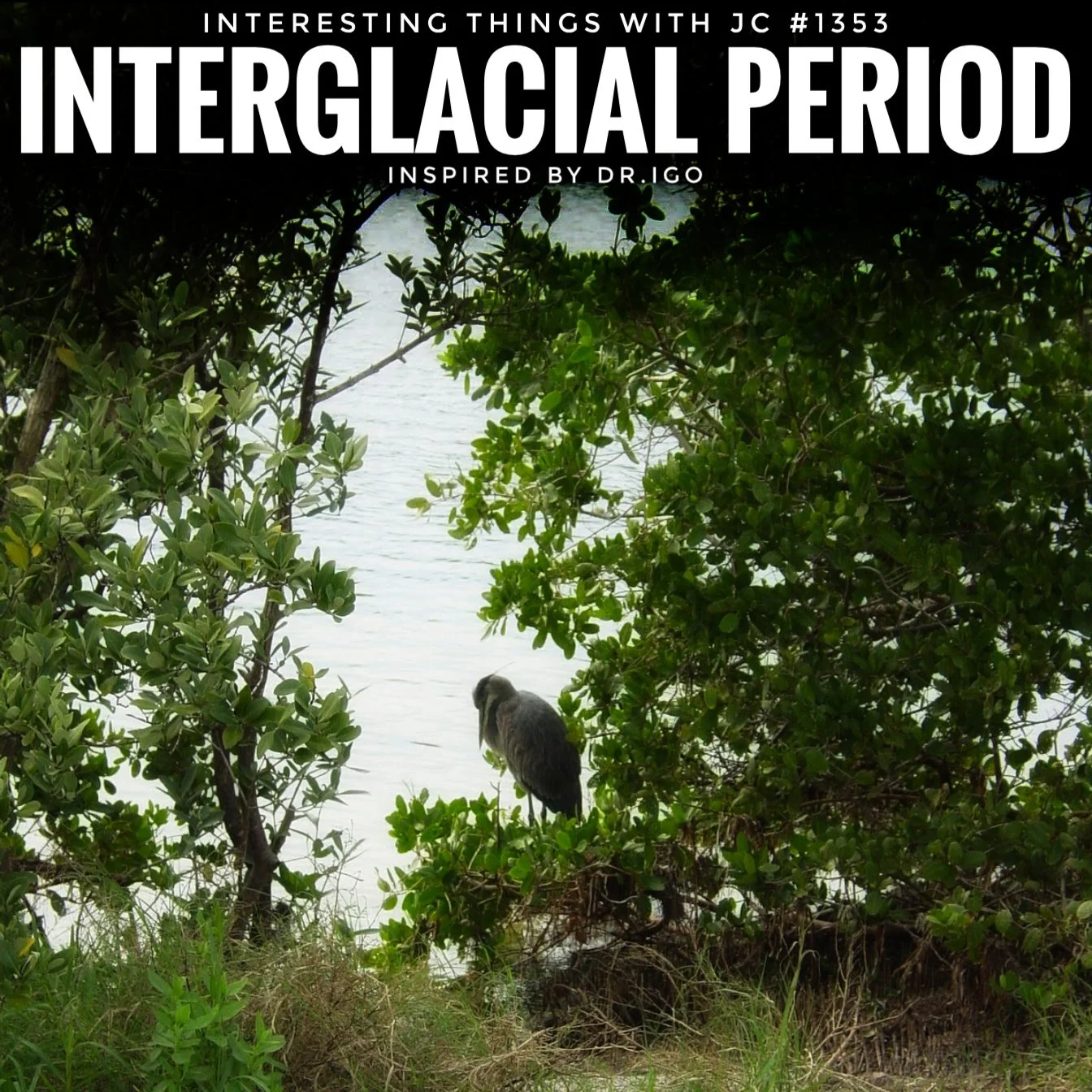
A solitary heron stands beneath thick mangrove foliage on the edge of a calm, pale green shoreline. Branches frame the bird in soft shadows as it rests near the waterline. The scene evokes a quiet pause in time, natural, still, and ancient. Text above reads: Interesting Things with JC #1353 – Interglacial Period. Inspired by Dr. Igo in bold white lettering across a black banner.
Transcript
We aren’t living in the end of an ice age. We’re living in a pause.
That pause is called an interglacial period—a warm stretch in a much longer cold pattern.
Earth cycles through ice ages roughly every 100,000 years. The reason isn’t random. It’s orbital. The planet’s path around the sun changes over time—sometimes more circular, sometimes more stretched. That cycle, called eccentricity, runs about every 100,000 years. Earth also wobbles like a top—a movement called precession. And the tilt of the axis changes slowly, shifting between about 22.1 and 24.5 degrees over 41,000 years. Right now, the tilt is about 23.4—and slowly decreasing.
More tilt means more extreme seasons. Less tilt favors colder summers—and more persistent snow. Combine all three orbital shifts, and you get the timing behind glaciation.
This idea was mapped out a century ago by Serbian scientist Milutin Milankovitch (mee-LOO-teen mee-LAHN-ko-vitch), who showed how sunlight patterns, over thousands of years, line up with ice age cycles in the geological record.
But orbit and tilt aren’t the only variables. The sun itself is not perfectly steady. Every 11 years or so, it pulses in energy output. Over centuries, it can quiet down. Between 1645 and 1715, solar activity dropped sharply during what’s now called the Maunder Minimum. It coincided with the coldest stretch of the “Little Ice Age”—when the Thames River in London froze during winter.
These natural rhythms—tilt, orbit, precession, and solar cycles—have together triggered every major ice age in Earth’s recent history.
Today, we’re in what geologists call the Holocene (HOH-luh-seen) interglacial. It began around 11,700 years ago, after the last glacial maximum. Back then, the Laurentide Ice Sheet covered most of Canada and much of the northern United States. That ice was over 2 miles (3.2 kilometers) thick. Sea levels were about 400 feet (122 meters) lower. The Bering Land Bridge connected Siberia to Alaska.
When the ice melted, the planet changed. Forests pushed north. Lakes filled. Shorelines redrew. And the climate leveled out—long enough for people to settle, plant crops, and build permanent life.
That warm stretch gave rise to calendars, farming, and cities. But it’s not guaranteed to last.
The interglacial before this one—the Eemian (EE-mee-an)—lasted about 15,000 years. It ended with the return of cold. Sea levels then were 20 to 30 feet (6 to 9 meters) higher than today. Carbon dioxide levels during the Eemian peaked around 280 parts per million. Today, they exceed 420.
By the natural orbital rhythm, Earth should be slowly trending cooler. Eccentricity is low. Axial tilt is decreasing. Solar output is average, but long-term patterns suggest a possible quiet phase ahead. Under normal conditions, glaciation could return in 10,000 to 20,000 years.
But we’re not under normal conditions.
No past ice age began with greenhouse gases this high. No cooling trend has had to overcome this much trapped heat.
So yes—Earth still tilts. The orbit still shifts. The sun still fades in and out. But what comes next depends on whether those forces are still strong enough to break through the warming we’ve added.
The Bering Land Bridge vanished beneath rising seas. One day it might rise again—or not.
Ice is never permanent. But it isn’t random either.
These are interesting things, with JC.
Student Worksheet
What are the Milankovitch cycles, and what do they explain about Earth’s climate?
How did the Eemian and Holocene interglacial periods differ in sea level and CO₂?
What is precession and how does it affect the Earth's seasons?
Why was the Maunder Minimum historically significant?
How does today’s CO₂ level compare to past interglacials, and what might this mean?
Teacher Guide
Estimated Time: 60–90 minutes
Pre-Teaching Vocabulary Strategy:
Use visuals and diagrams to introduce Milankovitch cycles.
Break vocabulary into word roots and connect to visuals of Earth's orbit.
Anticipated Misconceptions:
Belief that warming/cooling is always caused by human activity.
Misunderstanding of how orbital mechanics operate over long timescales.
Discussion Prompts:
Should we be more focused on current warming or the potential return of glaciation?
How does understanding past climate patterns help us think about the future?
Differentiation Strategies:
ESL: Provide illustrated vocabulary cards with multilingual definitions.
IEP: Use guided worksheets with sentence starters and visual aids.
Gifted: Assign research into other historical minima or interglacials.
Extension Activities:
Graph CO₂ levels over the last 800,000 years.
Simulate orbital changes using modeling clay and solar lamps.
Create a timeline comparing the Eemian and Holocene interglacials.
Cross-Curricular Connections:
Physics: Rotational motion and gravitational forces.
World History: Agricultural revolutions following climatic stabilization.
Environmental Science: Feedback loops and modern greenhouse effects.
Quiz
Q1. What is the term for the current warm period between ice ages?
A. Glacial Maximum
B. Holocene
C. Eemian
D. Maunder Minimum
Answer: B
Q2. Which factor is not part of the Milankovitch cycles?
A. Eccentricity
B. Solar flares
C. Axial tilt
D. Precession
Answer: B
Q3. During the Eemian interglacial, CO₂ levels were approximately:
A. 200 ppm
B. 280 ppm
C. 400 ppm
D. 500 ppm
Answer: B
Q4. What caused colder summers during glacial periods?
A. More extreme tilt
B. Higher eccentricity
C. Decreased axial tilt
D. Increased greenhouse gases
Answer: C
Q5. The Maunder Minimum is associated with:
A. Solar flares
B. Intense global warming
C. Minimal solar activity
D. Rising sea levels
Answer: C
Assessment
Explain how the Milankovitch cycles contribute to Earth's glacial and interglacial periods.
In your opinion, what are the implications of high atmospheric CO₂ on future ice age timing?
3–2–1 Rubric:
3 = Accurate, complete, thoughtful
2 = Partial or missing detail
1 = Inaccurate or vague
Standards Alignment
Next Generation Science Standards (NGSS)
HS-ESS2-4 – Analyze geoscience data to make the claim that Earth’s systems change over time.
HS-ESS1-4 – Use models to explain how variations in Earth’s orbit influence climate over long time periods.
Common Core (CCSS Science Literacy)
RST.11-12.1 – Cite specific textual evidence to support analysis of science texts.
RST.11-12.9 – Synthesize information from multiple sources about historical climate data.
C3 Framework (Social Studies)
D2.Geo.8.9-12 – Evaluate the impact of Earth's physical systems on human societies.
UK National Curriculum (AQA A-Level Geography)
3.1.1.4 Climate Change Past and Present – Understand long-term natural climate variation and its causes.
IB Diploma Programme – Environmental Systems and Societies
2.2 Systems and Models – Study Earth as a dynamic system affected by both natural and human factors.
Show Notes
In this episode of Interesting Things with JC, we explore the concept of interglacial periods and how they fit into the grand pattern of Earth’s climate history. JC delves into the mechanics of Earth’s orbit, tilt, and precession—known as the Milankovitch cycles—and how these cycles have governed glacial and interglacial periods for millions of years. We learn about the Holocene, our current warm period, and compare it with the previous Eemian interglacial, with an emphasis on CO₂ levels and sea level differences. The episode bridges paleoclimatology and modern concerns, posing important questions about whether Earth’s natural climate rhythms can overcome the warming influence of anthropogenic greenhouse gases. This episode is a valuable classroom resource for integrating Earth science, environmental history, and planetary systems thinking.
References
Berger, A. L. (1988). Milankovitch theory and climate. Reviews of Geophysics, 26(4), 624–657. https://doi.org/10.1029/RG026i004p00623
NASA. (2023). Milankovitch (Orbital) Cycles and Their Role in Earth's Climate. https://climate.nasa.gov/news/2948/
NSIDC. (2023). The Last Glacial Maximum. https://nsidc.org/cryosphere/glaciers/questions/maximum.html
IPCC. (2021). AR6 Climate Change 2021: The Physical Science Basis. https://www.ipcc.ch/report/ar6/wg1/
