1354: "John Michael 'Ozzy' Osbourne"
Interesting Things with JC #1354: "John Michael 'Ozzy' Osbourne" – He didn’t invent heavy metal, but he gave it a soul. From a Birmingham slum to global icon, Ozzy's voice was pain, prayer, and power.
Curriculum - Episode Anchor
Episode Title: “Ozzy Osbourne”
Episode Number: #1354
Host: JC
Audience: Grades 9–12, college intro, homeschool, lifelong learners
Subject Area: Music History, Cultural Studies, Psychology, Media Literacy
Lesson Overview
By the end of this lesson, students will be able to:
Define key biographical and musical terms related to Ozzy Osbourne's life and career.
Compare the cultural impact of Ozzy Osbourne with other figures in rock history.
Analyze how personal adversity influenced Osbourne's music and legacy.
Explain how environmental and historical context shaped the sound and themes of Black Sabbath.
Key Vocabulary
Dyslexic (dis-LEK-sik) — A condition affecting reading ability, evident in Ozzy’s early struggles with education and literacy.
The Devil’s Interval — A dissonant musical interval historically associated with tension and fear, used by Black Sabbath to evoke emotion.
Recidivism (ri-SID-uh-viz-um) — Returning to criminal behavior; Ozzy’s brief incarceration highlighted the potential consequences of youthful crime.
Crucifix (KROO-suh-fiks) — A symbol of Christian faith, reflecting Ozzy's complex relationship with religion and mortality.
Legacy (LEG-uh-see) — What someone leaves behind; Ozzy’s legacy is one of honesty, musical influence, and cultural endurance.
Narrative Core
Open: A vivid portrait of Ozzy’s upbringing in a working-class Birmingham neighborhood, emphasizing hardship and environment.
Info: Details of his early school struggles, mental health, exposure to The Beatles, and brushes with the law.
Details: The formation of Black Sabbath, the band's eerie sound, substance use, firing, and rebirth with Sharon Osbourne.
Reflection: Ozzy’s faith, family, resilience, and how he was honest about his flaws rather than hiding them.
Closing: “These are interesting things, with JC.”
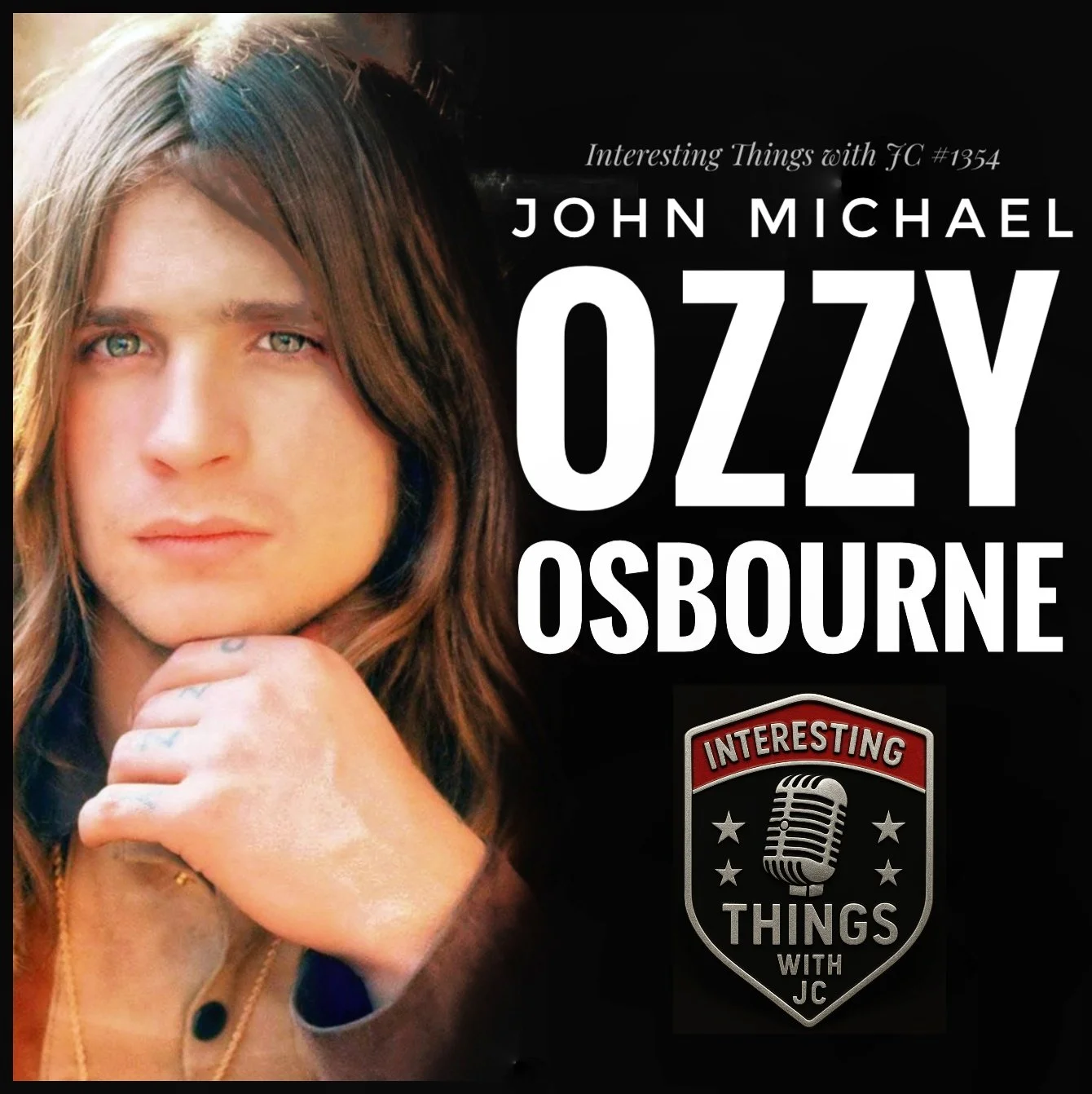
A portrait of a young Ozzy Osbourne with long hair and a contemplative expression. The text reads “John Michael Ozzy Osbourne” and includes the podcast title and logo at the bottom, showing a vintage-style microphone with stars and the words “Interesting Things with JC.”
Transcript
John Michael Osbourne was born on December 3, 1948, in Aston, Birmingham, England, a working-class district where the air carried the scent of burning coal and the hum of steel presses never really stopped.
His house had no indoor plumbing. Seven people shared two small bedrooms. Heat came from a single coal stove. His dad, Jack, worked night shifts at a tool factory. His mom, Lillian, assembled car parts. They didn’t have much, but there was structure, rules, a roof, and just enough to scrape by.
He was nicknamed “Ozzy” before he hit ten. He struggled in school. Dyslexic, hyperactive, punished more than helped. Teachers didn’t know what to do with a boy who couldn’t read but had perfect recall of songs after hearing them once. At age 14, overwhelmed and isolated, he tried to hang himself in the family home. The beam broke. He later called that moment a sign.
That same year, he heard The Beatles on a neighbor’s radio. "She Loves You" lit a fire in him. He didn’t just love the sound... he needed to make it. That record gave him direction.
He tattooed “O-Z-Z-Y” on his knuckles with a sewing needle and graphite. Not to be edgy, but because he wanted something of his own, something no one could take.
By 15, Ozzy had dropped out of school. He worked odd jobs, slaughterhouse, construction, horn tuning in a car factory. He tried stealing a TV once, got caught. His father refused to pay the fine, so Ozzy spent six weeks in Winson Green Prison. That stretch left a mark. He hated the cold, the silence. And it taught him that hard choices had real consequences.
In 1968, Ozzy answered a classified ad from guitarist Tony Iommi (EYE-oh-mee). They clicked. Along with bassist Geezer Butler and drummer Bill Ward, they started out under the name Earth. But after seeing a horror film on a marquee across the street from their rehearsal space, they changed the name to Black Sabbath.
The band’s sound was shaped by their surroundings... heavy, slow, dark. Like the city they came from. Their first album, recorded in just one day, used a musical interval known since medieval times as the “Devil’s Interval,” something dissonant that made listeners feel uneasy. Critics hated it. Listeners didn’t.
Ozzy’s voice wasn’t polished, but it cut through. He sounded like someone shouting through smoke and dust, fighting to be heard.
As the band exploded in the '70s, the pressure hit hard. Ozzy began drinking heavily. Cocaine, pills, anything to level out the noise. By 1979, he was fired from the very band he helped build. He said later, “I would’ve fired me too.”
He locked himself in a hotel room with a stockpile of drugs and stayed there for months. He thought he was finished.
Then came Sharon.
Sharon Arden, daughter of music manager Don Arden, stepped in. She got him back into the studio, paired him with guitarist Randy Rhoads, booked a tour, and rebuilt him from the ground up. Their collaboration gave birth to Blizzard of Ozz in 1980, featuring “Crazy Train,” “Mr. Crowley,” and a whole new chapter of his career.
Just two years later, Rhoads was killed in a tragic plane accident during the tour. Ozzy was devastated. He considered walking away for good... but he didn’t. He returned to music, and quietly, to prayer.
Ozzy never made public declarations about religion, but those close to him knew he always wore a crucifix. He kept one by his bedside. More than once, he asked priests to visit him before shows. After his near-fatal ATV crash in 2004, he said, “God must have plans for me, because I should’ve died more than once.”
He married Sharon in 1982. Together they raised three children and stayed married over 40 years, through addiction, relapse, recovery, and public spectacle. In 2002, MTV aired The Osbournes, and millions got to see what life was like behind the curtain. Not the chaos... but the small moments. Family dinners. Dogs barking. A father saying, “I love you” to his kids. A man trying to be present, even while wrestling with his past.
He once said, “The stuff I’ve done, I’m not proud of. But I’ve never pretended to be something I’m not.”
And that’s what made him stand out.
Ozzy Osbourne didn’t fake his pain. He didn’t polish his flaws. He carried them, put them on stage, screamed them into microphones. And in doing that, he gave people permission to face their own.
He released 13 albums with Black Sabbath and another 13 as a solo artist. Sold over 100 million records. Won a Grammy. Was inducted into the Rock & Roll Hall of Fame. And despite everything, despite every fall, he kept climbing back up.
He passed away, July 22, 2025, at the age of 76.
He’s not remembered for perfection. He’s remembered for honesty. For survival. For giving generations of misfits and outcasts someone to believe in.
Ozzy didn’t just make music... he made it matter.
These are interesting things, with JC.
Student Worksheet
What childhood experience first sparked Ozzy’s desire to become a musician?
Why was the “Devil’s Interval” significant to Black Sabbath’s sound?
What role did Sharon Osbourne play in reviving Ozzy’s career?
How did Ozzy’s upbringing in Birmingham shape his music?
Reflect on Ozzy’s quote: “I’ve never pretended to be something I’m not.” What does this reveal about his legacy?
Teacher Guide
Estimated Time: 1–2 class periods (50–90 minutes)
Pre-Teaching Vocabulary Strategy:
Use real-world clips and vocabulary maps to introduce “Devil’s Interval,” “dyslexia,” and “crucifix.” Discuss in context.
Anticipated Misconceptions:
Students may assume Ozzy’s musical path was instant or glamorized.
Misinterpreting “Devil’s Interval” as satanic rather than dissonant musical theory.
Discussion Prompts:
In what ways did Ozzy’s story mirror or differ from traditional success narratives?
How can personal pain and public performance coexist in music?
What ethical lines exist in presenting a public persona shaped by addiction?
Differentiation Strategies:
ESL: Visual timelines and translated lyric excerpts.
IEP: Scaffold with a cause-effect chart and vocabulary review.
Gifted: Explore lyrical analysis and write essays comparing Ozzy's music with Beethoven’s emotional expressiveness.
Extension Activities:
Build a playlist representing Ozzy’s life stages with explanatory annotations.
Write a eulogy or tribute speech celebrating his influence and complexity.
Research the evolution of music censorship and freedom of expression.
Cross-Curricular Connections:
Music Theory: Interval recognition, composition structure.
Sociology: Class and fame, media representation of addiction.
Ethics: Public redemption and celebrity responsibility.
History: Post-industrial England and 20th-century music trends.
Quiz
Q1. What event in 1964 profoundly influenced Ozzy’s decision to pursue music?
A. A concert he attended
B. Hearing “She Loves You” by The Beatles
C. A music teacher’s encouragement
D. Winning a singing contest
Answer: B
Q2. What instrument did Ozzy play in Black Sabbath?
A. Drums
B. Guitar
C. Bass
D. Vocals
Answer: D
Q3. Why was Ozzy fired from Black Sabbath in 1979?
A. Creative disagreements
B. Legal issues
C. Drug and alcohol abuse
D. Wanting to pursue pop music
Answer: C
Q4. What musical element was used in Black Sabbath’s first album to create an eerie sound?
A. Auto-tune
B. The Devil’s Interval
C. Synthesizers
D. Major chords
Answer: B
Q5. What did Ozzy say about his past mistakes?
A. “I regret nothing.”
B. “I’d do it all over again.”
C. “I’m not proud, but I never pretended to be something I’m not.”
D. “Perfection is overrated.”
Answer: C
Assessment
Analyze how Ozzy’s early life experiences shaped his music and public persona.
Compare Ozzy Osbourne’s career path with that of another rock icon (e.g., Freddie Mercury, Kurt Cobain, Joan Jett).
3–2–1 Rubric:
3 = Accurate, complete, thoughtful
2 = Partial or missing detail
1 = Inaccurate or vague
Standards Alignment
Common Core ELA:
CCSS.ELA-LITERACY.RI.11-12.3 — Analyze a complex set of ideas and explain how they interact over the course of a text.
CCSS.ELA-LITERACY.W.9-10.2 — Write informative/explanatory texts to examine a topic.
CCSS.ELA-LITERACY.SL.11-12.1 — Engage in collaborative discussions on complex texts and ideas.
C3 Framework for Social Studies:
D2.His.1.9-12 — Evaluate how historical context influenced personal experiences.
D2.Civ.7.9-12 — Analyze civic virtues in the context of public life and media.
CTE: Arts, A/V Technology & Communications:
ARTS.AV.CTE.6.1 — Analyze and apply the use of media and performance to tell stories and impact culture.
AQA / OCR / Cambridge (UK & Int’l):
AQA GCSE Music Component 2 — Understand the stylistic and cultural context of popular music.
OCR GCSE History B Thematic Study — Explore individuals and ideas shaping contemporary culture.
IB MYP Arts / Individuals & Societies:
MYP Criterion A & B — Inquiry and investigation into music’s cultural significance and personal impact.
Show Notes
This episode presents a rich, emotionally honest biography of Ozzy Osbourne—charting his unlikely path from a struggling, dyslexic teen in industrial Birmingham to a musical icon whose art was forged in personal pain. Through his story, students encounter themes of redemption, creative expression, and authenticity. It’s a powerful learning tool across music, sociology, and media studies, with wide relevance to classroom discussions on mental health, resilience, and cultural influence.
References
The Recording Academy. (n.d.). Ozzy Osbourne – Artist page. GRAMMY.com. Retrieved July 2025, from https://www.grammy.com/artists/ozzy-osbourne/4998
Rock & Roll Hall of Fame. (n.d.). Ozzy Osbourne. Retrieved July 2025, from https://rockhall.com/inductees/ozzy-osbourne/
Reilly, N. (2023, November 23). Ozzy Osbourne: How the Prince of Darkness defied the odds and found happiness. Rolling Stone UK. Retrieved July 2025, from https://www.rollingstone.co.uk/music/features/ozzy-osbourne-interview-rolling-stone-black-sabbath-34700/