1403: "September 10th, 2001"
Interesting Things with JC #1403: "September 10th, 2001" – It was just another Monday. Political scandal, lost trillions, an assassination, and a quiet war abroad, all vanished the next morning. The last ordinary day.
Curriculum - Episode Anchor
Episode Title
September 10th, 2001
Episode Number
Interesting Things with JC #1403
Host:
JC
Audience:
Grades 9–12, college intro, homeschool, lifelong learners
Subject Area:
History, Media Literacy, Civics, Global Studies
Lesson Overview
Students will:
Define significant global and national events that occurred on September 10, 2001.
Compare pre- and post-9/11 cultural, political, and social norms.
Analyze why certain news stories were overshadowed and how history is remembered.
Explain the broader significance of events that preceded the September 11 attacks.
Key Vocabulary
Audit (AW-dit) — A formal examination of an organization’s accounts; in the episode, the Department of Defense admitted to losing track of $2.3 trillion.
Merger (MUR-jur) — The combination of two companies into one; Halifax and the Bank of Scotland merged to create HBOS.
Assassination (uh-SASS-ih-NAY-shun) — The targeted killing of a public figure; Brazil’s mayor Antônio da Costa Santos was assassinated on this date.
Northern Alliance (NOR-thern uh-LY-ance) — A military coalition that opposed the Taliban in Afghanistan.
Ordinary (OR-dih-nair-ee) — Describes the seemingly normal state of life before a major historical disruption.
Narrative Core
Open – The episode begins by stating: “September 10th, 2001. The day before everything changed.”
Info – JC provides key news stories from that day, including political scandals, financial news, and global conflicts.
Details – Surprising facts emerge: a multi-trillion-dollar Pentagon discrepancy, a major bank merger, and an overseas assassination.
Reflection – JC highlights how easily history forgets the "last normal day" and how events are quickly overshadowed.
Closing – The episode ends with: “These are interesting things, with JC.”
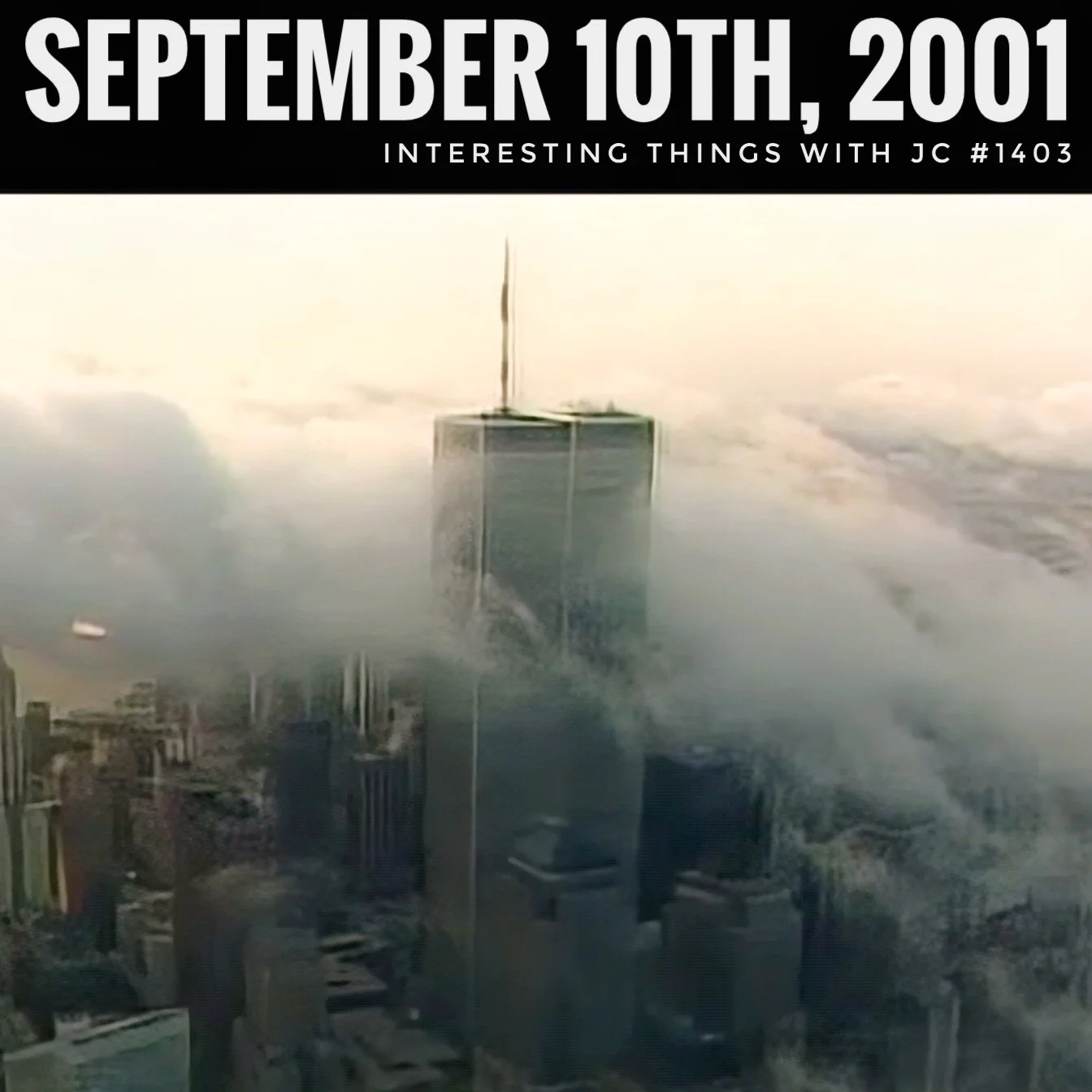
A foggy aerial view of the World Trade Center Twin Towers in New York City, taken on September 10, 2001. The towers rise above the clouds, with soft morning light illuminating the scene. The image is overlaid with the title "September 10th, 2001 – Interesting Things with JC #1403" in bold white letters at the top.
Transcript
September 10th, 2001. The day before everything changed.
If you picked up a paper that Monday, the big story wasn’t about terrorists. It was about Washington politics. Chandra Levy, a 24-year-old intern, had gone missing months earlier. Congressman Gary Condit was under fire, his career falling apart. On September 10th, nobody knew where Levy was. Her remains wouldn’t be found until the next year, in a park in Washington, D.C. A headline that had gripped the country was about to vanish overnight.
That same day at the Pentagon, Defense Secretary Donald Rumsfeld admitted the Defense Department couldn’t account for 2.3 trillion dollars. In today’s money, that’s over 4 trillion. The problem was never cleared up. What should’ve been front-page news got lost in what came next.
Over in London, two banks—Halifax and the Bank of Scotland—finished a merger that created HBOS, one of the biggest banking groups in Europe. At the time, it looked like a financial success story. Less than ten years later, the company nearly collapsed in the 2008 crash and had to be rescued.
In Brazil, the mayor of Campinas, Antônio da Costa Santos, was shot and killed. He’d built a reputation as a reformer, standing up against corruption. His killers were later convicted, but his murder left a mark on the country.
And in Afghanistan, the Northern Alliance battled the Taliban in Takhar province. More than a hundred Taliban fighters were killed, dozens taken prisoner. For most Americans, it barely registered. Within weeks, Afghanistan would become the main focus of U.S. foreign policy.
But for everyday folks, September 10th felt normal. You could walk through airports without taking your shoes off or throwing away a water bottle. Families toured landmarks without fences or armed guards. The World Trade Center was busy with another workday. It was just a Monday.
The next morning, all of that ended. The stories that filled the news—the scandal, the missing trillions, the merger, the assassination, the battle overseas—were all swept away by four hijacked planes and one date etched into memory.
September 10th, 2001. The last ordinary day.
These are interesting things, with JC.
Student Worksheet
What major political scandal was in the headlines on September 10, 2001?
How much money did the Department of Defense report as unaccounted for?
What was significant about the HBOS merger?
Who was Antônio da Costa Santos, and why was his assassination important?
Describe the situation in Afghanistan on September 10, 2001.
Teacher Guide
Estimated Time
45–60 minutes
Pre-Teaching Vocabulary Strategy
Introduce key vocabulary using a Frayer Model or word map activity.
Anticipated Misconceptions
Students may assume that no major news occurred before 9/11.
Students may conflate the Taliban with other regional groups or misunderstand the role of the Northern Alliance.
Discussion Prompts
Why do some events get remembered more than others?
Should the media have spent more time investigating the missing Pentagon funds?
How does hindsight change what we consider “important” news?
Differentiation Strategies
ESL: Use closed captions and visual vocabulary cards.
IEP: Offer sentence starters and graphic organizers.
Gifted: Assign an independent research project on another “forgotten day” in history.
Extension Activities
Write a “news broadcast” for the evening of September 10, 2001.
Compare media front pages from Sept. 10 and Sept. 12, 2001.
Create a “Timeline of Lost Headlines.”
Cross-Curricular Connections
Civics: Transparency and government accountability
Economics: Bank mergers and financial collapse
Media Literacy: Understanding how news cycles work
World History: Pre-9/11 geopolitics
Quiz
Q1. What was the main U.S. political scandal on September 10, 2001?
A. Enron collapse
B. Chandra Levy disappearance
C. Monica Lewinsky testimony
D. Pentagon protests
Answer: B
Q2. What financial issue did Donald Rumsfeld reveal?
A. Stock market crash
B. Unauthorized weapons sales
C. Missing trillions in Pentagon funds
D. Secret CIA prisons
Answer: C
Q3. Which two banks merged to form HBOS?
A. Lloyds and Santander
B. Barclays and Halifax
C. Halifax and Bank of Scotland
D. RBS and Bank of America
Answer: C
Q4. Where was Mayor Antônio da Costa Santos assassinated?
A. Rio de Janeiro
B. Campinas
C. São Paulo
D. Recife
Answer: B
Q5. Which group was fighting the Taliban in Afghanistan on Sept. 10, 2001?
A. NATO
B. Mujahideen
C. Al-Qaeda
D. Northern Alliance
Answer: D
Assessment
Why is September 10, 2001, considered “the last ordinary day”?
Choose one event from September 10, 2001, and explain why it matters in historical context.
3–2–1 Rubric
3 = Accurate, complete, thoughtful
2 = Partial or missing detail
1 = Inaccurate or vague
Standards Alignment
U.S. Standards
CCSS.ELA-LITERACY.RI.11-12.3 — Analyze complex ideas/events across a text and explain their development.
CCSS.ELA-LITERACY.RH.11-12.9 — Compare and contrast treatments of the same topic in different media.
C3.D2.His.14.9-12 — Analyze multiple and complex causes and effects in the past.
ISTE 1.3.D — Students explore real-world issues and problems to build knowledge.
International Standards
UK GCSE History (AQA, OCR, Edexcel): Analyze and evaluate historical interpretations and significance of past events.
IB DP History (Standard & Higher Level): Evaluate historical sources and their impact on public memory and narratives.
Cambridge IGCSE History (0470): Understand change, continuity, cause and consequence in key world events.
Show Notes
This episode of Interesting Things with JC explores a historical anomaly: the day before a seismic event. September 10, 2001, was filled with significant headlines that were instantly forgotten after the 9/11 attacks. From the U.S. political scandal surrounding Chandra Levy, to the Pentagon’s multi-trillion-dollar accounting issue, to major financial mergers and political violence abroad, this day serves as a case study in how news cycles and collective memory function. This episode invites classroom discussions on media, memory, and historical context, making it particularly relevant in civics, history, and media literacy curricula.
References:
ABC News. (2001, June 21). Timeline: Chandra Levy case. ABC News. https://abcnews.go.com/Politics/story?id=121163&page=1
Associated Press. (2023, September 8). No, the US government didn’t ‘mysteriously lose’ trillions of dollars [Fact check]. AP News. https://apnews.com/article/fact-check-us-government-trillions-lost-sept-11-670264168912
Bank of Scotland. (n.d.). Our heritage: Merger and acquisition. Bank of Scotland. https://www.bankofscotland.co.uk/about-us/our-heritage.html
CBS News. (2002, January 29). The war on waste. CBS News. https://www.cbsnews.com/news/the-war-on-waste/
CBS News. (2002, May 22). Key events in Chandra Levy case. CBS News. https://www.cbsnews.com/news/key-events-in-chandra-levy-case/
Folha de S. Paulo. (2001, September 11). Prefeito de Campinas é assassinado a tiros [Mayor of Campinas is assassinated by gunfire]. Folha de S. Paulo. https://www1.folha.uol.com.br/fsp/cotidian/ff1109200112.htm
Human Rights Watch. (2001, July). Crisis of impunity: Afghanistan’s civil war. Human Rights Watch. https://www.hrw.org/reports/2001/afghan2/Afghan0701-01.htm
Reuters. (2023, September 14). Rumsfeld did not reveal loss of $2.3 trillion the day before 9/11 [Fact check]. Reuters. https://www.reuters.com/fact-check/rumsfeld-did-not-reveal-loss-23-trillion-day-before-911-2023-09-14
The Guardian. (2015, November 19). HBOS timeline: The countdown to collapse. The Guardian. https://www.theguardian.com/business/2015/nov/19/hbos-timeline-countdown-collapse-lloyds-takeover
The New Yorker. (2001, October 15). The warlord. The New Yorker. https://www.newyorker.com/magazine/2001/10/22/the-warlord
The Wall Street Journal. (2001, June 14). Halifax, Bank of Scotland set date for merger, issue…. The Wall Street Journal. https://www.wsj.com/articles/SB992516002125775686
Wired. (2002, May 22). It’s Chandra. Wired. https://www.wired.com/2002/05/its-chandra