Interesting Things with JC #1404: "The Amateur Radio Operators of 9/11" – When modern tech failed, the old-school gear stepped in. In the smoke and silence of 9/11, amateur radio operators kept the city connected, and saved lives.
Curriculum - Episode Anchor
Episode Title: The Amateur Radio Operators of 9/11
Episode Number: 1404
Host: JC
Audience: Grades 9–12, college intro, homeschool, lifelong learners
Subject Area: History, Emergency Communication, Technology in Crisis, Civics, STEM Integration
Lesson Overview
Learning Objectives
Define the role of amateur (ham) radio in emergency communication scenarios.
Compare modern communication systems with amateur radio networks during crises.
Analyze how amateur radio operators contributed to rescue and recovery on 9/11.
Explain the relevance of decentralized communication in disaster preparedness.
Key Vocabulary
Amateur Radio (ˈæmətʃər ˈreɪdiˌoʊ) — A non-commercial radio service used by licensed operators for personal, emergency, and experimental communication. Example: Amateur radio filled critical communication gaps on 9/11.
Emergency Communications (ɪˈmɜrdʒənsi ˌkəmjuˈnɪkeɪʃənz) — Systems and protocols used to send information during crises when conventional networks fail. Example: Emergency communications were vital when official systems collapsed on 9/11.
Traffic (ˈtræfɪk) — In ham radio, this refers to the passing of formal messages. Example: Operators passed traffic between hospitals and aid stations.
ARRL (ˌeɪ ɑr ɑr ˈɛl) — The American Radio Relay League, the national association for amateur radio in the U.S. Example: The ARRL’s emergency system was active within minutes on 9/11.
Ground Zero (graʊnd ˈzɪəroʊ) — The site of the collapsed Twin Towers in New York City following the 9/11 attacks. Example: Hams operated near Ground Zero to relay updates.
Narrative Core (Based on the PSF)
Open — The story opens with the collapse of New York’s communication infrastructure on 9/11, creating an urgent void.
Info — Context is given about amateur radio as a hobby, and its ability to function independently from modern network systems.
Details — Specific examples are shared: operators relaying survivor reports, coordinating hospital supplies, supporting Red Cross logistics, and sustaining efforts for weeks.
Reflection — Highlights the unsung heroism and technical reliability of ham radio in a moment of national crisis.
Closing — "These are interesting things, with JC."
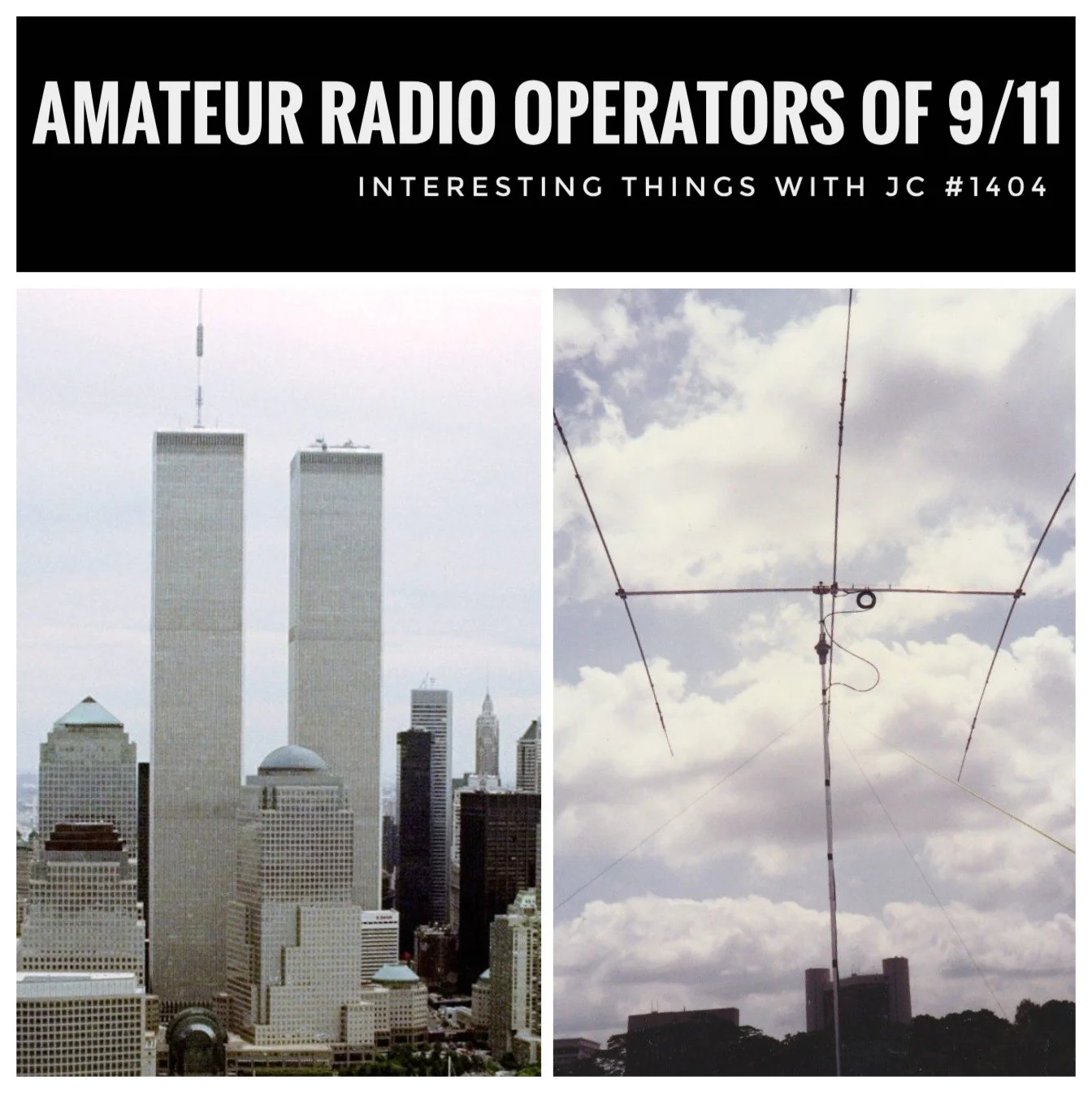
Split image with two photos. On the left, the Twin Towers of the World Trade Center rise above the New York City skyline before 9/11. On the right, a tall amateur radio antenna with cross-arms extends upward into a partly cloudy sky, symbolizing emergency communication.
This image is provided for educational use under fair use. It is not authorized for resale or commercial use. The podcast Interesting Things with JC and its curriculum are royalty-free and open-source for teachers, homeschoolers, lifelong learners, and public education, with respect to the families and communities impacted by 9/11.
Transcript
When the Twin Towers came down, New York’s communications went down with them. Cell phones jammed, landlines broke, and even police and fire radios had trouble cutting through. In that gap, it was amateur radio operators—ham operators—who stepped in.
Most folks think of ham radio as a hobby, talking across the world for fun. But the gear is simple, it runs off batteries, and it doesn’t need the big networks that fail in a crisis. On September 11, 2001, that made all the difference.
Hams relayed messages from Ground Zero, carrying word about survivors pulled from the rubble. They passed traffic between hospitals about bed space, blood supplies, and equipment. The Red Cross leaned on them to coordinate volunteers and aid.
The American Radio Relay League—ARRL—had its emergency system running within minutes. Operators in New York tied into stations in New Jersey and Connecticut, patching together a network when official lines went silent. One of them said later, “We filled the holes. If a message couldn’t get through by phone or radio, it went through us.”
This wasn’t new for ham operators. They’ve been the backup during hurricanes, earthquakes, and blackouts for decades. But 9/11 showed it on the biggest stage. In a city of millions, where high-tech systems collapsed, these independent radios kept the messages moving.
For weeks after the attacks, as crews worked the pile at Ground Zero, many operators kept their stations open, backing up relief efforts day and night. Their work didn’t make the evening news, but it saved time—and time saves lives.
On that day, when America’s most advanced systems went dark, it was the steady voices on ham radio that cut through.
These are interesting things, with JC.
Student Worksheet
What made amateur radio effective when other systems failed on 9/11?
Describe the role the ARRL played during the crisis.
How did ham operators assist hospitals and the Red Cross?
Why might ham radio be considered a "low-tech" but effective tool?
Write a short journal entry from the point of view of a ham operator on 9/11.
Teacher Guide
Estimated Time: 60–75 minutes (including discussion and worksheet)
Pre-Teaching Vocabulary Strategy:
Use a Frayer Model for “Amateur Radio,” “Traffic,” and “Emergency Communications.”
Provide real-world analogies (e.g., compare ham radio to walkie-talkies vs. smartphones).
Anticipated Misconceptions:
Students may believe ham radio is obsolete.
Students might assume only professionals can assist in emergencies.
Discussion Prompts:
What does this story reveal about the value of “old” technologies?
Can modern society benefit from having decentralized communication systems?
Differentiation Strategies:
ESL: Provide vocabulary in bilingual format where possible.
IEP: Use sentence starters or guided reading templates.
Gifted: Have students research and present how ham radio works and its licensing process.
Extension Activities:
Interview a local amateur radio club.
Simulate a classroom emergency communication drill using walkie-talkies or open-source software.
Create an infographic comparing different crisis communication methods.
Cross-Curricular Connections:
Physics: Radio wave transmission and frequency modulation
Civics: Volunteerism and civilian contributions to national emergencies
Technology/CTE: Emergency communication systems and disaster response planning
Quiz
Q1. What caused the main communication breakdown on 9/11?
A. Satellite failure
B. Internet collapse
C. Tower destruction and signal overload
D. Equipment hacking
Answer: C
Q2. What organization helped mobilize amateur radio operators?
A. FEMA
B. The FCC
C. NASA
D. ARRL
Answer: D
Q3. Which of the following is a benefit of ham radio during emergencies?
A. Requires internet access
B. Dependent on satellites
C. Operates off-grid with minimal infrastructure
D. Requires large computing power
Answer: C
Q4. What term is used for sending formal messages over ham radio?
A. Wavelength
B. Traffic
C. Protocol
D. Frequency
Answer: B
Q5. Why didn’t ham radio operations make the news after 9/11?
A. They were illegal
B. Their impact was small
C. Their work was behind the scenes
D. The radios didn’t work
Answer: C
Assessment
How did ham radio operators serve as essential communicators during the 9/11 crisis?
Why is it important to maintain and understand non-digital communication systems today?
3–2–1 Rubric
3 = Accurate, complete, thoughtful
2 = Partial or missing detail
1 = Inaccurate or vague
Standards Alignment
Common Core ELA
CCSS.ELA-LITERACY.RI.9-10.2 — Determine a central idea of a text and analyze its development.
Students analyze the central role of amateur radio operators in the episode narrative.CCSS.ELA-LITERACY.SL.9-10.1 — Initiate and participate effectively in a range of collaborative discussions.
Discussion prompts and group extensions foster this skill.
C3 Framework (Civics/History)
D2.His.14.9-12 — Analyze multiple and complex causes and effects in history.
Students evaluate systemic failures and ham radio’s role in response.D2.Civ.2.9-12 — Analyze the role of citizens in shaping policies and community responses.
Ham operators exemplify civic contribution in emergencies.
ISTE Standards (Technology)
ISTE 7b — Students use collaborative technologies to work toward a common goal.
Simulations and radio network modeling align with this standard.
CTE: Information Technology Career Cluster
IT-FSD-5 — Identify emerging communication systems and their use in real-world settings.
Explores amateur radio as a critical communication method.
International Alignment
UK National Curriculum KS4 Citizenship — Understand roles of voluntary groups in society.
Ties to the role of amateur radio operators during national emergencies.IB MYP Individuals & Societies: Criterion B (Investigating) — Apply research and explain the impact of events.
Students examine historical narratives with depth and factual analysis.
Show Notes
In this powerful episode of Interesting Things with JC, listeners learn how amateur radio operators became silent heroes on 9/11, stepping in when advanced communications failed. As landlines, cell phones, and emergency networks went down, these licensed hobbyists—trained for emergencies—linked first responders, hospitals, and relief organizations with reliable, battery-powered communications. This story provides an engaging lens for understanding decentralized technology, civic responsibility, and the hidden infrastructure behind crisis response. In the classroom, it highlights the importance of community resilience, technical knowledge, and interdisciplinary problem-solving.
References
American Radio Relay League. (2001). ARRL Responds to 9/11. Retrieved from https://www.arrl.org/files/file/WTC.pdf
Federal Communications Commission. (2002). Amateur Radio Service. Retrieved from https://www.fcc.gov/wireless/bureau-divisions/mobility-division/amateur-radio-service
National Commission on Terrorist Attacks Upon the United States. (2004). The 9/11 Commission Report. Retrieved from https://www.9-11commission.gov/report/
QRZ.com. (n.d.). Ham Radio and 9/11: Personal Stories from the Scene. Retrieved from https://forums.qrz.com