1562: "The Helios Laser"
Interesting Things with JC #1562: "The Helios Laser" – A $4 million missile… or a beam of light. On the deck of USS Preble, the U.S. Navy flipped the cost of war with 60 kilowatts of focused energy traveling at the speed of light. For the first time, naval firepower depends on power generation, not ammunition.
Curriculum - Episode Anchor
Episode Title: "The Helios Laser"
Episode Number: 1562
Host: JC
Audience: Grades 9–12, Intro College, Homeschool, Lifelong Learners
Subject Area: Physics, Engineering, Military Technology, Energy Systems
Lesson Overview
This lesson explores how the U.S. Navy’s HELIOS laser system works, why it was installed aboard USS Preble, and how directed energy is changing modern naval defense. Students will examine real-world physics concepts like electromagnetic energy, thermal transfer, and systems integration.
Students will be able to:
• Define directed-energy weapons and describe how solid-state fiber lasers operate.
• Compare traditional missile interceptors with laser-based systems in cost and logistics.
• Analyze how weather and atmospheric conditions affect laser performance.
• Explain how HELIOS integrates with the Aegis combat system and ship power systems.
Key Vocabulary
• Directed Energy (də-REK-təd EN-er-jee) — A system that delivers energy as electromagnetic waves (like a laser) instead of firing physical ammunition.
• Solid-State Fiber Laser (SAH-lid state FY-ber LAY-zer) — A laser that uses optical fibers doped with rare-earth elements (such as ytterbium) to amplify light into a powerful, focused beam.
• Spectral Beam Combining (SPEK-trəl BEEM kuhm-BY-ning) — A process that merges multiple laser beams of slightly different wavelengths into one stronger, high-quality beam.
• Thermal Blooming (THER-muhl BLOO-ming) — When a laser heats the air it travels through, causing distortion and reduced effectiveness.
• Aegis Combat System (EE-jis) — The Navy’s integrated radar and weapons control system used to track and engage threats.
• Soft Kill — Disabling a target’s sensors or electronics without completely destroying it.
• Hard Kill — Physically damaging or destroying a target by heating it until components fail or ignite.
Narrative Core
Open –
In 2022, the U.S. Navy installed its first operational high-energy laser on a frontline warship.
Info –
HELIOS was mounted on USS Preble, an Arleigh Burke-class destroyer, under a $150 million Lockheed Martin contract awarded in 2018. The system produces up to 60 kilowatts of power and integrates directly with the Aegis combat system.
Details –
The laser uses ytterbium-doped fiber modules combined into a single coherent beam. It can disable drones at distances up to about 6 miles. It operates in both soft kill and hard kill modes. Live tests confirmed drone engagements in fiscal year 2024 and during a 2025 counter-drone exercise.
Reflection –
Naval defense used to depend almost entirely on ammunition. Now it also depends on electrical power generation and cooling capacity. Directed energy shifts the cost equation and changes how ships defend themselves.
Closing –
These are interesting things, with JC.
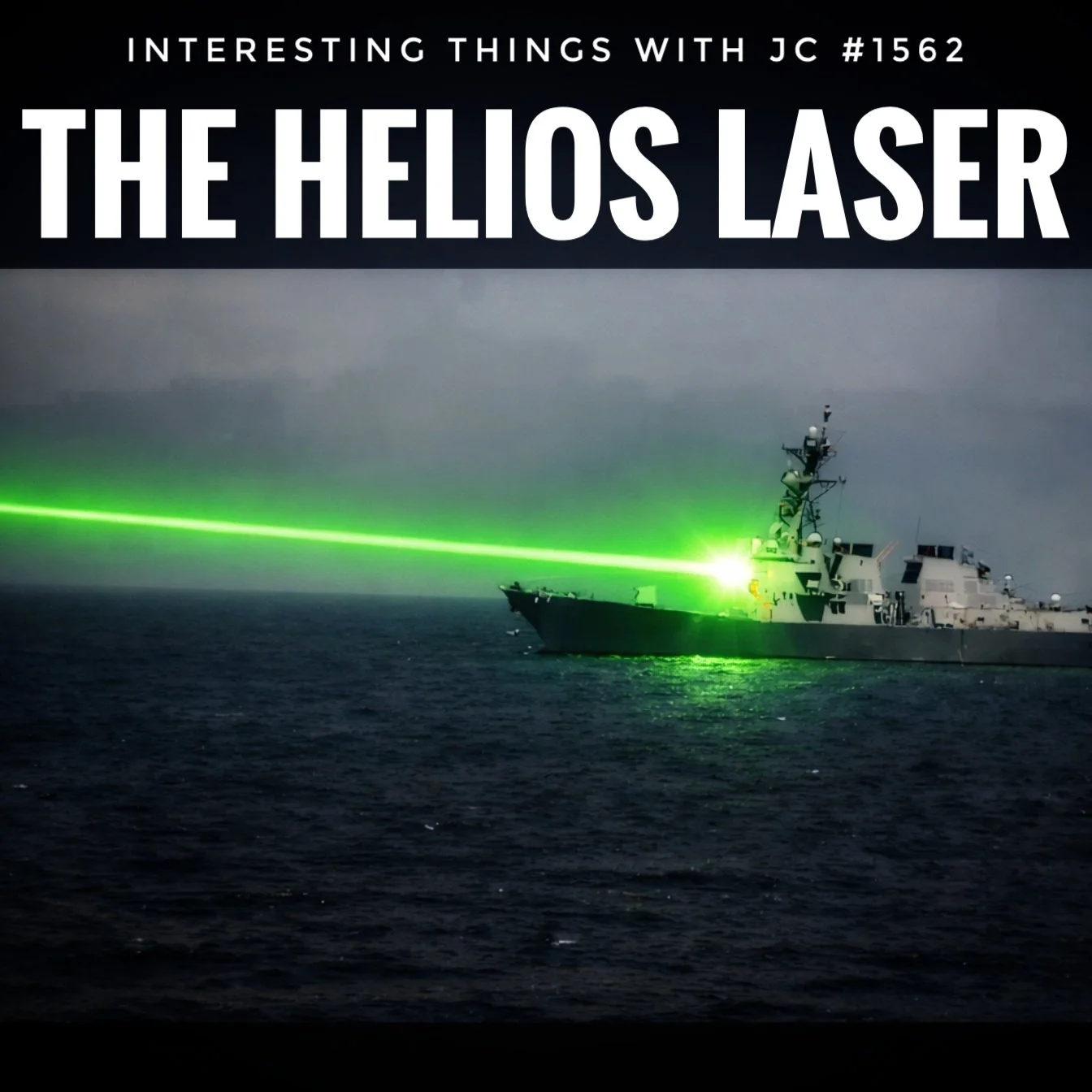
Promotional image for “Interesting Things with JC #1562 – The Helios Laser.” The top of the image features bold white text on a dark background reading, “INTERESTING THINGS WITH JC #1562” and “THE HELIOS LASER.” Below the text, a U.S. Navy guided-missile destroyer sails on open ocean under a cloudy sky. A bright green laser beam is shown projecting from the ship’s forward deck across the water, illuminating part of the ship’s hull and the surrounding sea. The scene suggests a high-energy laser weapon being fired at sea.
Transcript
Interesting Things with JC #1562: "Helios Laser"
In 2022 the U.S. Navy completed installation of its first operational high-energy laser on a frontline warship, following a $150 million contract awarded to Lockheed Martin in 2018 and land-based testing prior to at-sea delivery.
The ship was USS Preble, an Arleigh Burke-class guided-missile destroyer 509 feet long (155 meters) with full-load displacement of about 9,200 tons (8,345 metric tons). On her forward deck sits HELIOS (High Energy Laser with Integrated Optical-dazzler and Surveillance).
HELIOS demonstrated output at up to 60 kilowatts (60,000 watts) through a solid-state fiber laser architecture. Multiple kilowatt-class fiber lasers doped with ytterbium ions operate at slightly different wavelengths; spectral beam combining merges them into one coherent, high-quality beam that maintains tight focus over distance. Planned upgrades aim to scale output to 120–150 kilowatts by adding fiber modules.
The system integrates directly with the Aegis combat system (EE-jis), using SPY-1 radar and fire-control to cue and hold the beam on target. Power comes from gas-turbine generators; seawater cooling loops dissipate waste heat, since most unused energy at high power becomes heat that must be continuously removed.
A Standard Missile-6 costs roughly $4 million per round and is limited by vertical launch cells. A laser shot consumes ship fuel for electricity and cooling. No munitions are expended. The coherent photon beam travels at 186,282 miles per second (299,792 kilometers per second), effective to about 6 miles (9.6 kilometers), though atmospheric absorption, scattering, and thermal blooming reduce performance in rain, fog, or high humidity.
HELIOS operates in two modes. Soft kill uses lower energy levels to overload or permanently damage electro-optical systems such as drone cameras, infrared seekers, or targeting sensors. Hard kill sustains the beam on a target, depositing thermal energy that rapidly raises surface temperatures until electronics fail, fuel ignites, or structural materials weaken and fracture.
USS Preble began at-sea integration testing in 2022. Live-fire demonstrations confirmed capability, including a drone engagement in fiscal year 2024 and the neutralization of four drones during a 2025 counter-unmanned aerial systems exercise at sea.
Small drones cost thousands of dollars. Interceptors cost millions. Directed energy flips the cost equation, creating a close-in defense limited primarily by power generation and cooling capacity while preserving vertical launch cells for ballistic or hypersonic threats.
Rain, fog, and thermal blooming limit range. Lasers complement rather than replace kinetic interceptors.
For generations, naval firepower depended on ammunition carried aboard ship.
Now it also depends on sustained electrical power at sea.
These are interesting things, with JC.
Student Worksheet
• Explain how spectral beam combining increases laser strength and focus.
• Compare the cost of a Standard Missile-6 to a HELIOS laser shot.
• Identify two environmental factors that reduce laser effectiveness and explain why.
• Describe the difference between soft kill and hard kill modes.
• Why does HELIOS help preserve vertical launch cells for other threats?
Teacher Guide
Estimated Time: 45–60 minutes
Pre-Teaching Vocabulary Strategy:
• Introduce electromagnetic spectrum and coherent light with simple diagrams.
• Review basic thermodynamics concepts (heat transfer, energy conversion).
Anticipated Misconceptions:
• Students may think lasers replace all missiles.
• Students may assume lasers are unlimited in range.
• Students may believe light does not interact with air.
Discussion Prompts:
• How does directed energy change naval strategy?
• What engineering challenges exist in cooling a 60 kW system at sea?
• Does lower cost per shot change military decision-making?
Differentiation Strategies:
• ESL: Provide labeled visuals and vocabulary support sheets.
• IEP: Chunk transcript into guided reading sections.
• Gifted: Research power-scaling from 60 kW to 150 kW and evaluate engineering limits.
Extension Activities:
• Calculate energy output for a 3-second 60 kW burst.
• Model atmospheric scattering using physics equations.
Cross-Curricular Connections:
• Physics: Electromagnetic radiation and energy transfer.
• Engineering: Systems integration and power generation.
• Economics: Cost comparison and resource allocation.
Quiz
Q1. What is HELIOS’s demonstrated output power?
A. 6 kilowatts
B. 60 kilowatts
C. 600 kilowatts
D. 150 kilowatts
Answer: B
Q2. HELIOS integrates with which combat system?
A. Patriot
B. THAAD
C. Aegis
D. Iron Dome
Answer: C
Q3. What reduces laser performance in fog or humidity?
A. Magnetic disruption
B. Atmospheric absorption and scattering
C. Solar radiation
D. Radar interference
Answer: B
Q4. Soft kill primarily targets what?
A. Ship hulls
B. Missile engines
C. Sensors and electronics
D. Armor plating
Answer: C
Q5. Why is HELIOS considered cost-effective?
A. It uses no electricity
B. It replaces radar
C. It does not expend traditional ammunition
D. It increases missile storage
Answer: C
Assessment
Open-Ended Questions:
Explain how HELIOS changes the cost equation of naval defense.
Describe how atmospheric conditions impact laser effectiveness and why that matters operationally.
3–2–1 Rubric
3 — Accurate, complete, and clearly explained with supporting details
2 — Partially accurate with minor missing details
1 — Inaccurate, vague, or incomplete response
Standards Alignment
NGSS HS-PS4-1 — Use mathematical representations to support claims about electromagnetic radiation.
Connection: Students analyze laser propagation and energy transfer.
NGSS HS-PS3-3 — Design and evaluate systems for energy transfer.
Connection: HELIOS power generation and cooling systems.
CCSS.ELA-LITERACY.RST.11-12.2 — Determine central ideas of technical texts.
Connection: Analysis of transcript and technical explanation.
CCSS.ELA-LITERACY.RST.11-12.7 — Integrate quantitative information expressed in text.
Connection: Interpreting kilowatts, range, and cost comparisons.
ISTE 4: Innovative Designer — Students use technology principles to solve real-world problems.
Connection: Evaluating directed-energy engineering solutions.
UK AQA A-Level Physics (Waves & Optics) — Electromagnetic waves and laser coherence.
Connection: Beam combining and atmospheric interaction.
Show Notes
In this episode, JC explores the U.S. Navy’s HELIOS high-energy laser system installed aboard USS Preble. The episode explains how a 60-kilowatt solid-state fiber laser can disable or destroy drones using concentrated electromagnetic energy instead of traditional ammunition. Students learn how spectral beam combining works, why cooling systems are critical, and how HELIOS integrates with the Aegis combat system. The discussion also highlights cost comparisons between multimillion-dollar missile interceptors and electrically powered laser shots. This topic connects physics principles to real-world engineering and demonstrates how emerging technology is reshaping naval defense strategies. It is highly relevant to STEM education, energy systems engineering, and applied physics.
References
Lockheed Martin. (2018, March 1). Lockheed Martin receives $150 million contract to deliver integrated high energy laser weapon systems to U.S. Navy. https://news.lockheedmartin.com/2018-03-01-Lockheed-Martin-Receives-150-Million-Contract-to-Deliver-Integrated-High-Energy-Laser-Weapon-Systems-to-U-S-Navy
Lockheed Martin. (2022, August 18). Lockheed Martin delivers integrated multi-mission laser weapon system to the Navy. https://news.lockheedmartin.com/2022-08-18-Lockheed-Martin-Delivers-Integrated-Multi-Mission-Laser-Weapon-System-to-the-Navy
Katz, J. (2022, January 11). Destroyer Preble to get Lockheed high-energy laser in 2022. Breaking Defense. https://breakingdefense.com/2022/01/destroyer-preble-to-get-lockheed-high-energy-laser-in-2022
Burgess, R. R. (2022, March 31). HELIOS laser weapon system delivered for installation on USS Preble. Seapower. https://seapowermagazine.org/helios-laser-weapon-system-delivered-for-installation-on-uss-preble/
Office of the Director, Operational Test and Evaluation. (2025). FY 2024 annual report. U.S. Department of Defense. https://www.dote.osd.mil/Portals/97/pub/reports/FY2024/other/2024Annual-Report.pdf?ver=WLJFmx7nkeDHIuvrtKyfGQ%3d%3d
The War Zone. (2026, February 2). USS Preble used HELIOS laser to zap four drones in expanding testing. https://www.twz.com/sea/uss-preble-used-helios-laser-to-zap-four-drones-in-expanding-testing