1577: "Thin Mints"
Interesting Things with JC #1577: "Thin Mints" – Before the green box, it was a cookie with an identity crisis. One small mint wafer got renamed, reshuffled, and standardized...until it became the knock that starts a sale, a goal, and a story at the door. Thanks to Sheri for the story suggestion!
Curriculum - Episode Anchor
Episode Title: Thin Mints
Episode Number: 1577
Host: JC
Audience: Grades 9–12, college intro, homeschool, lifelong learners
Subject Area: U.S. history (20th century), entrepreneurship, marketing/branding, consumer economics, informational text analysis
Lesson Overview
Learning Objectives
Define how brand standardization works and identify examples from the Girl Scout cookie program.
Compare regional vs. national product naming and explain how licensing can create variation.
Analyze quantitative claims (boxes sold, percentages, weights) and verify whether conclusions follow from the data given.
Explain how a long-running youth program can evolve its operations (production, nutrition changes, sales methods) while keeping a familiar product identity.
Key Vocabulary
Standardization (stan-der-dih-ZAY-shun) — Making something consistent across places or groups; in the episode, “Thin Mints” became a single national name instead of many regional names.
Licensing (LY-sen-sing) — Allowing approved companies to produce a product under an organization’s brand; the Girl Scouts licensed commercial bakers to scale cookie sales.
Regional branding (REE-juh-nuhl BRAN-ding) — Different names or marketing in different areas; the same cookie circulated under multiple names because contracts were regional.
Catalog (KAT-uh-log) — An official list of products offered; the chocolate-mint cookie entered the Girl Scout cookie lineup in 1939.
Reformulation (ree-for-myuh-LAY-shun) — Changing a recipe while keeping the product recognizable; the episode notes a change to remove trans fats.
Flagship product (FLAG-ship PRAH-duhkt) — The best-known, most representative item a brand is associated with; Thin Mints are described as the top seller and “flagship.”
Entrepreneurial program (on-truh-pruh-NUR-ee-uhl PROH-gram) — An organized effort to build business skills; the cookie sale is presented as a large-scale girl-led business experience.
Narrative Core
Open:
A familiar cookie is revealed to have started under a different name in 1939: “Cooky Mints.”
Info:
The Girl Scouts were founded in 1912 by Juliette Gordon Low in Savannah, Georgia.
During the Great Depression era, cookie selling expanded locally; later, commercial licensing increased consistency and scale.
Details:
Multiple regional bakers and contracts led to one cookie appearing under several names over time (Chocolate Mint, Cookie Mint, Thin Mint).
By 1959, “Thin Mints” becomes the standardized national name, reflecting a shift to unified branding.
Two licensed bakers produce today’s Thin Mints with slight recipe differences, while the overall form stays consistent.
Large-scale sales statistics are used to estimate the mass of Thin Mints sold in a strong season.
Reflection:
A small, consistent product becomes a repeated “first” for many scouts: first sale, first goal, first conversation at a door—skills passed across generations.
Closing:
These are interesting things, with JC.
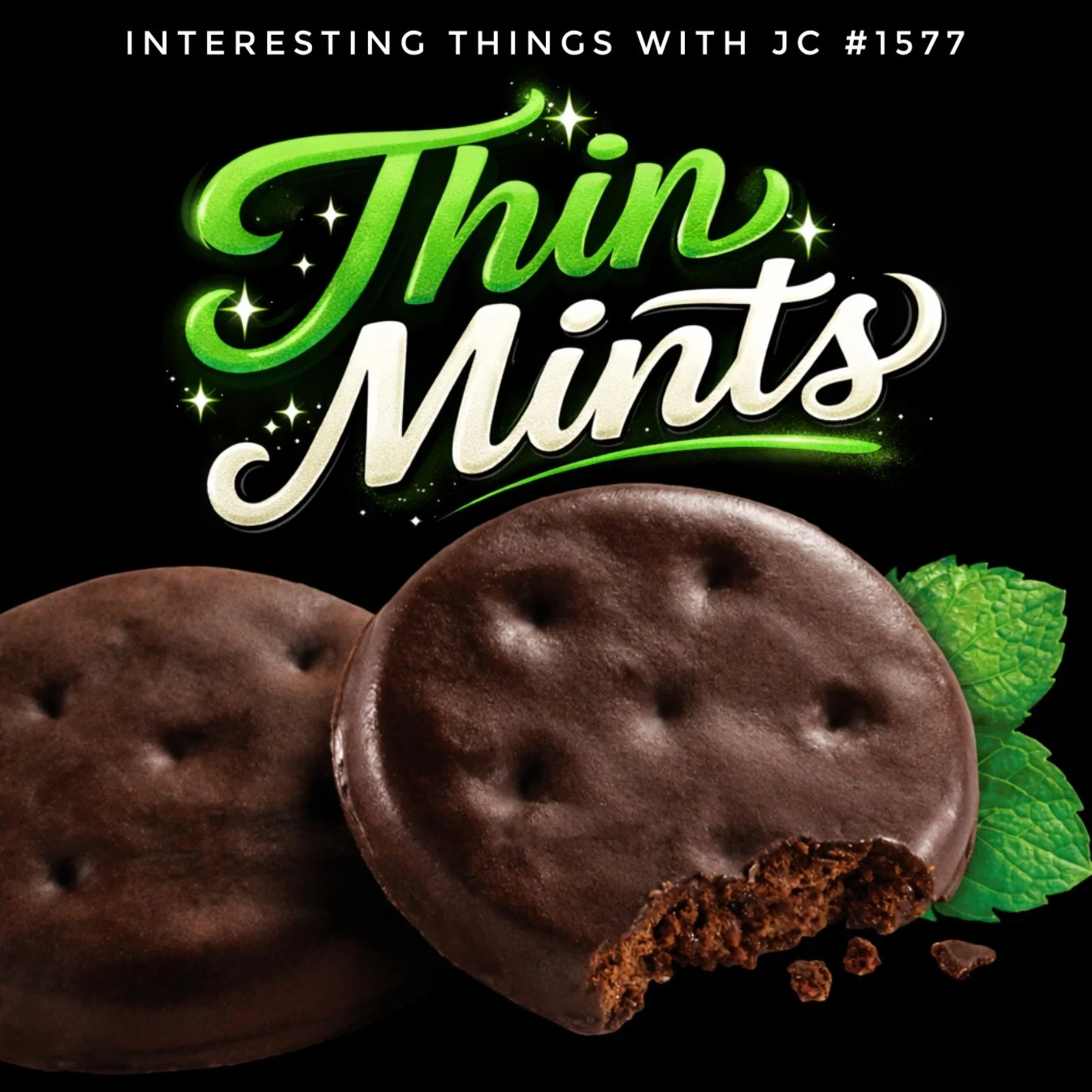
Podcast cover reading “Interesting Things with JC #1577” and “Thin Mints,” with two chocolate-mint cookies (one bitten) and mint leaves on a black background.
Transcript
Interesting Things with JC #1577: "Thin Mints"
In 1939, a chocolate-covered mint cookie appeared in the Girl Scout lineup under a different name.
It was called “Cooky Mints.”
The Girl Scouts of the United States of America had been founded in 1912 by Juliette Gordon Low in Savannah, Georgia. By 1933, during the Great Depression, scouts were baking cookies at home and selling them locally. In 1935, the organization began licensing commercial bakers to bring consistency and scale. Four years later, in 1939, the chocolate-mint cookie entered the catalog.
But it didn’t stay stable.
Because multiple regional bakeries held contracts, the same cookie circulated under different names: “Chocolate Mint,” “Cookie Mint,” “Thin Mint.” By 1951, “Chocolate Mints” appeared in official materials. In 1959, the plural “Thin Mints” became the standardized national name. That year marked the shift from scattered regional branding to a unified national identity.
The cookie itself was simple: a crisp wafer disk about 1.5 inches in diameter, roughly 3.8 centimeters, coated in a thin layer of chocolate with a mint finish. Portable. Durable. Easy to stack in cardboard cases and sell door to door.
Today, Thin Mints are produced by two licensed bakers, ABC Bakers and Little Brownie Bakers. Their recipes differ slightly in texture and mint intensity, but the form remains consistent. The green box signals winter across the country.
As of recent seasons, the Girl Scout cookie program has sold more than 200 million boxes annually in the United States. Thin Mints consistently rank as the top seller, often accounting for about 25 percent of total sales. That suggests roughly 50 million boxes of Thin Mints in a strong season.
The next closest competitor, typically Peanut Butter Sandwich cookies commonly known as Do-si-dos, generally trails several percentage points behind, reinforcing Thin Mints’ position as the clear flagship of the lineup.
Each box weighs about 9 ounces, approximately 255 grams. Multiply 50 million boxes by 9 ounces, and you approach 28 million pounds, or about 12.7 million kilograms, of Thin Mints moving through American neighborhoods in just a few weeks.
In 2005, the recipe was reformulated to remove trans fats, aligning with updated nutrition standards while preserving the familiar taste.
From “Cooky Mints” in 1939 to standardized “Thin Mints” in 1959, the name evolved. The production system matured. The sales methods adapted from paper order forms to digital tracking.
The cookie stayed the same size, about 1.5 inches, 3.8 centimeters across.
And for more than 85 years, that small circle has marked a first sale, a first goal met, a first conversation at a neighbor’s door. Mothers once sold them. Now daughters do. The skills transfer forward even as the tools change.
A small chocolate-mint wafer became the flagship of the largest girl-led entrepreneurial program in the United States.
These are interesting things, with JC.
Student Worksheet
Timeline task: List the cookie names mentioned (in order) and write one sentence explaining why multiple names existed at the same time.
Math check: Using the episode’s “strong season” estimate (50 million boxes × 9 ounces), show the steps that lead to “about 28 million pounds.” Then convert pounds to kilograms and compare with “about 12.7 million kilograms.”
Evidence check: What does it mean for a claim to be “supported by official materials”? Identify which statements in the episode sound like they come from an official source vs. an estimate.
Short response: Explain how standardizing a name (like “Thin Mints”) can strengthen a national brand identity.
Creative prompt: Write a 6–8 sentence mini-ad for Thin Mints that uses at least three vocabulary words from this lesson.
Teacher Guide
Estimated Time
45–60 minutes (single class period)
Optional extension: +30 minutes (research verification or mini-presentations)
Pre-Teaching Vocabulary Strategy
“Frayer Model Lite”: Students choose 3 terms (standardization, licensing, reformulation) and fill in: definition, example from episode, non-example, and a quick sketch/icon.
Anticipated Misconceptions
“If the cookie had multiple names, it must have been multiple different cookies.” (Clarify: licensing and regional branding can rename similar products.)
“All sales numbers are exact.” (Clarify: the episode mixes documented figures with reasonable estimates derived from percentages and weights.)
“Recipe changes always change taste dramatically.” (Clarify: reformulation often targets ingredients while trying to preserve consumer experience.)
Discussion Prompts
Why might a national organization allow regional variation for years before standardizing?
When does a calculated estimate become persuasive—and when does it become misleading?
How do product design traits (durable, stackable, consistent size) connect to door-to-door sales success?
Differentiation Strategies: ESL, IEP, gifted
ESL: Provide a matching activity (term → simple definition → episode example sentence). Allow oral responses for Worksheet #2.
IEP: Give a partially completed timeline template and a conversion chart (ounces↔pounds↔kilograms).
Gifted: Ask students to propose a “standardization plan” memo: keep two bakers but unify messaging—what stays flexible, what must be identical?
Extension Activities
Source triangulation: Students verify two claims using reputable sources (organization site, major publication, encyclopedia).
Marketing comparison: Compare Thin Mints’ brand elements (color, seasonality, “limited-time”) to another seasonal product.
Cross-Curricular Connections
Math: Unit conversions, estimation, percent-of-total reasoning.
Business/CTE: Branding, supply chain licensing, product consistency.
ELA: Informational text, claims and evidence, narrative structure in nonfiction.
U.S. History: Great Depression era home production vs. industrial scaling.
Quiz
Q1. Which name did the episode say was used for the cookie in 1939?
A. Chocolate Mints
B. Cooky Mints
C. Thin Mint
D. Cookie Mint
Answer: B
Q2. Why did the cookie circulate under multiple names?
A. The recipe was secret
B. Different countries required different labels
C. Multiple regional bakeries held contracts
D. The cookie was only sold online
Answer: C
Q3. What does “standardized national name” mean in this episode?
A. A name used only in one city
B. A name chosen by local troops only
C. A single name used consistently across regions
D. A name changed every year
Answer: C
Q4. If Thin Mints are about 25% of 200 million boxes, what is a reasonable estimate for Thin Mints sold?
A. 5 million
B. 25 million
C. 50 million
D. 100 million
Answer: C
Q5. What change did the episode describe happening to the recipe in 2005?
A. Added extra mint
B. Removed trans fats
C. Made the cookies larger
D. Switched to a white box
Answer: B
Assessment
Explain how licensing can lead to both consistency and variation at the same time. Use at least two details from the episode.
Evaluate the episode’s “28 million pounds” estimate: is it reasonable, and what assumptions does it depend on?
3–2–1 Rubric (for each question)
3 = Accurate, complete, thoughtful; uses specific episode evidence and clear reasoning
2 = Partially accurate; missing a key detail or the reasoning is unclear
1 = Inaccurate or vague; minimal support from the episode
Standards Alignment
Common Core ELA (Grades 9–10 / 11–12)
CCSS.ELA-LITERACY.RI.9-10.2 / RI.11-12.2 — Determine central ideas and summarize; students extract the episode’s main claims (history, naming, standardization).
CCSS.ELA-LITERACY.RI.9-10.8 / RI.11-12.8 — Evaluate argument and evidence; students separate documented facts from calculated estimates.
CCSS.ELA-LITERACY.W.9-10.1 / W.11-12.1 — Write arguments with evidence; students defend whether the quantitative reasoning is convincing.
CCSS.ELA-LITERACY.SL.9-10.1 / SL.11-12.1 — Collaborative discussion; students debate standardization vs. regional branding benefits.
C3 Framework (Social Studies)
D2.His.1.9-12 — Evaluate how historical events shape later developments; connects Depression-era fundraising to long-term national systems.
D2.Eco.1.9-12 — Explain how incentives and markets influence choices; connects product design, demand, and fundraising outcomes.
D2.Eco.2.9-12 — Analyze economic decisions and tradeoffs; explores why licensing and standardization might be chosen.
ISTE Standards (Students)
ISTE 3 (Knowledge Constructor) — Students gather and evaluate sources to verify claims (names/dates, sales figures, recipe changes).
ISTE 6 (Creative Communicator) — Students create a mini-ad or memo using accurate information and audience-aware messaging.
CTE (Entrepreneurship / Marketing, cluster-aligned)
Entrepreneurship: Business Concepts — Apply concepts of branding, product positioning, and customer engagement using Thin Mints as a case study.
Marketing: Branding and Promotion — Analyze how packaging, consistency, and naming drive recognition and repeat purchasing.
International Equivalents (content-based, non-ideological)
England: GCSE English Language (Reading) — Analyze nonfiction texts and evaluate claims/evidence using the episode as an informational source.
England: GCSE Business — Branding, product, and operations decisions; licensing and standardization as business strategy.
IB DP Language A: Language and Literature — Analyze rhetoric, structure, and evidence in a nonfiction narrative.
Cambridge IGCSE Business Studies — Marketing mix and branding decisions; consistency vs. local variation in product strategy.
Show Notes
This episode traces the long branding journey of the Girl Scouts’ best-known cookie, explaining how a chocolate-mint wafer introduced in 1939 under the name “Cooky Mints” gradually moved through multiple regional names before “Thin Mints” became the standardized national label by 1959. It connects history (early cookie sales and the shift to licensed commercial bakers) to modern operations, showing how two licensed bakers can produce slightly different versions while keeping a consistent identity. The episode also models practical quantitative reasoning by using annual box totals, a common share estimate for Thin Mints, and per-box weight to estimate the total mass of cookies moving through communities in a season—useful for teaching media literacy, evidence vs. inference, and real-world math.
References
ABC Bakers. (n.d.). Fun facts! Retrieved March 1, 2026, from https://www.abcbakers.com/abc-bakers/fun-facts/
Girl Scouts of the USA. (n.d.). Girl Scout cookie history. Retrieved March 1, 2026, from https://www.girlscouts.org/en/cookies/about-girl-scout-cookies/cookie-history.html
Encyclopaedia Britannica. (2026, January 21). Girl Scout Cookies | Flavors, history, fundraising, & facts. https://www.britannica.com/topic/Girl-Scout-Cookies
ABC News. (2015, February 18). Girl Scout cookie fans may have to wait because of Thin Mints shortage. https://abcnews.go.com/Lifestyle/girl-scout-cookie-fans-wait-thin-mints/story?id=29049847
Time. (2015, January 16). Girl Scout Cookies: The evolution of the Thin Mint and more. https://time.com/3670380/girl-scout-cookie-history/
Fox News. (2007, February 25). Trans fats removed from Girl Scout cookies. https://www.foxnews.com/story/trans-fats-removed-from-girl-scout-cookies
The Spokesman-Review. (2005, December 21). Organization zeroing in on healthier Girl Scout cookie. https://www.spokesman.com/stories/2005/dec/21/organization-zeroing-in-on-healthier-girl-scout/
Food & Wine. (2017, June 23). Girl Scout cookies taste different depending on where you buy them. https://www.foodandwine.com/news/girl-scout-cookies-taste-different-depending-where-you-buy-them