1578: Neil Sedaka
Interesting Things with JC #1578: "Neil Sedaka" – A Brooklyn kid with classical discipline turned teenage heartache into gold records, survived the British Invasion, and rebuilt himself across decades. When the industry changed formats, he did not fade. He rewrote the melody. Some songs do not just chart. They endure.
Curriculum - Episode Anchor
Episode Title: Neil Sedaka
Episode Number: 1578
Host: JC
Audience: Grades 9–12, college intro, homeschool, lifelong learners
Subject Area: Music History, Media Literacy, U.S. Cultural History, Songwriting & Composition
Lesson Overview
Learning Objectives
Students will be able to:
Define key music-industry terms (e.g., Brill Building, British Invasion, Hot 100, songwriter catalog) as used in the episode.
Explain how Sedaka’s classical training supported his pop songwriting structure and longevity.
Analyze how industry shifts (e.g., the British Invasion, format changes from vinyl to streaming) affected artists’ careers and strategies.
Compare two chart lives of the same composition using the two hit versions of “Breaking Up Is Hard to Do.”
Key Vocabulary
Brill Building (bril BIL-ding) — A New York City office building strongly associated with mid-century professional pop songwriting; the episode places Sedaka’s early career in this scene.
Billboard Hot 100 (BIL-bord hot WUN-hun-dred) — A U.S. singles chart ranking popular songs; the episode references multiple Sedaka Hot 100 peaks and No. 1 hits.
British Invasion (BRI-tish in-VAY-zhun) — The mid-1960s surge of UK acts in U.S. charts and radio that reshaped American pop careers; the episode cites it as a turning point for Sedaka.
Single (7-inch, 45 rpm) (SIN-guhl; SEV-en inch; for-tee-FIVE ar-pee-EM) — A common vinyl format for one main song per side; the episode uses it to describe the 1959 recording era.
Re-recording (new arrangement) (ree-ri-KOR-ding) — Making a new studio version of an existing song; the episode highlights Sedaka’s slower remake returning to the Top 10.
Record of the Year (GRAMMY) (REK-erd uv thuh yeer) — A major Recording Academy award recognizing a single’s overall production and performance; the episode notes “Love Will Keep Us Together” winning this honor.
Catalog (KAT-uh-lawg) — The body of work by an artist/songwriter; the episode frames Sedaka’s catalog as extensive and long-lived.
Narrative Core
Open: A young Brooklyn musician in 1959 presses “teenage heartache into vinyl,” introducing Neil Sedaka at the piano and setting a vivid, time-stamped scene.
Info: Sedaka’s upbringing, Juilliard prep training, and professional songwriting pathway through the Brill Building ecosystem establish why his melodies were unusually structured for teen pop. (Variety)
Details: Major hits (“Oh! Carol,” “Breaking Up Is Hard to Do”) give way to the British Invasion’s industry disruption; Sedaka adapts, relocates, and later returns with a comeback that includes a rare Top 10 re-recording of the same song.
Reflection: The episode argues that strong composition can outlast changing formats and trends—from 45s to streaming—because the underlying musical “build” remains sound.
Closing: These are interesting things, with JC.
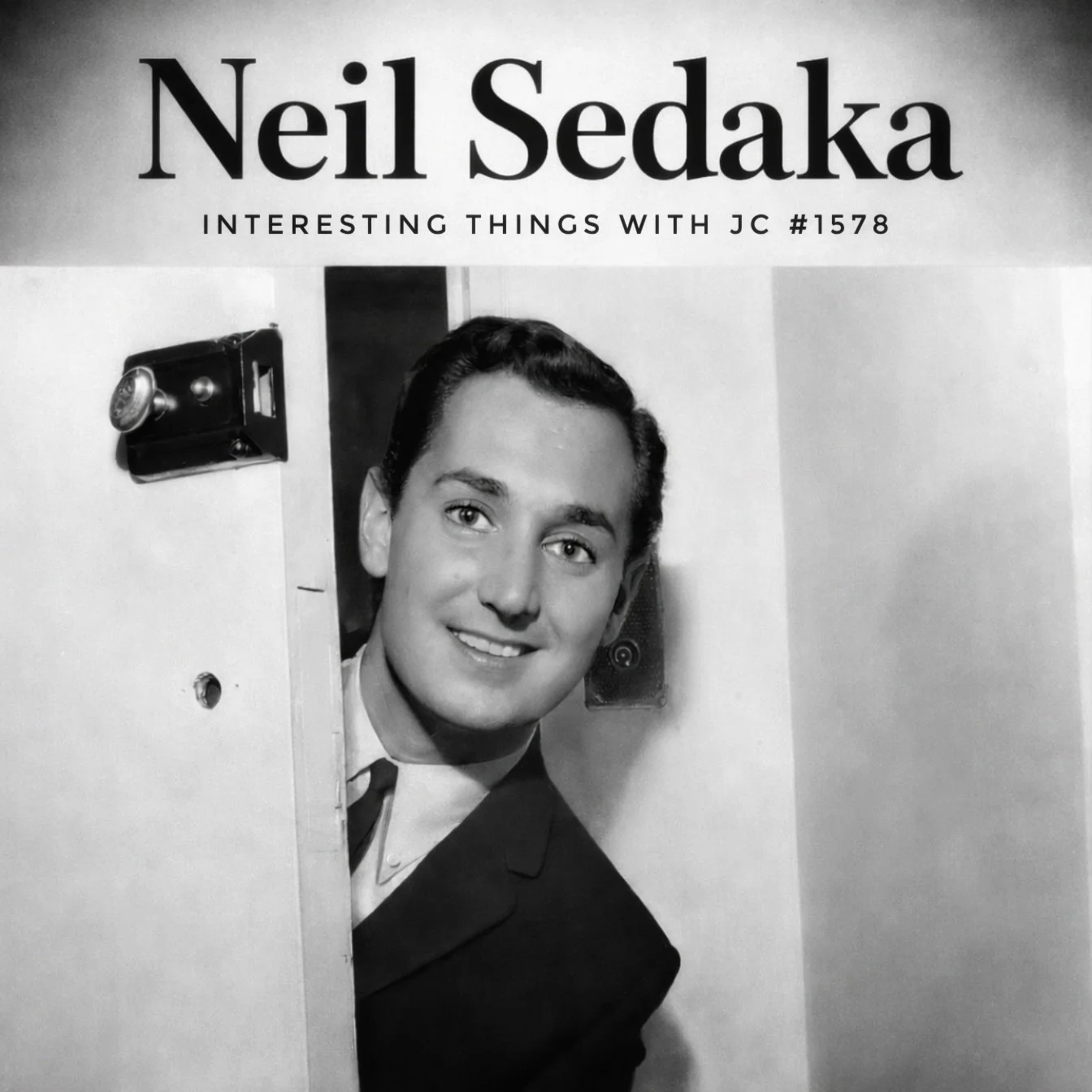
Neil Sedaka promotional cover image for Interesting Things with JC #1578, featuring a black-and-white portrait of a smiling young Neil Sedaka peeking from behind a door, with the title “Neil Sedaka” and “INTERESTING THINGS WITH JC #1578” text at the top.
Transcript
Interesting Things with JC #1578: “Neil Sedaka”
In 1959, inside a small New York recording studio, a 20-year-old from Brooklyn leaned over an upright piano. The keys were worn smooth from practice. A microphone stood about 3 feet away, just under 1 meter, and a seven-inch record spun at 45 revolutions per minute.
He pressed teenage heartache into vinyl.
His name was Neil Sedaka.
Born March 13, 1939, in Brighton Beach, Brooklyn, he was the son of a taxi driver and a mother who insisted on discipline. At age 8, he won a scholarship to the Preparatory Division of the Juilliard School in New York City. He studied counterpoint and classical form before most musicians learned three chords.
At Manhattan’s High School of Music & Art, he met Carole King. By the late 1950s, both were writing professionally inside the Brill Building at 1619 Broadway in Manhattan, an office building roughly 11 stories tall, about 120 feet high, or 36.5 meters. Sedaka, alongside lyricist Howard Greenfield, wrote “Stupid Cupid,” a Top 20 hit in 1958 for Connie Francis. He was barely out of his teens.
In 1959, he wrote “Oh! Carol” for Carole King. It climbed to No. 9 on the Billboard Hot 100 and sold over one million copies, gold certification in an era when that meant one million physical singles, each 7 inches across, about 17.8 centimeters. King answered with her own “Oh! Neil.” Two classmates. Two architects of American songwriting.
Then came “Calendar Girl” in 1960. “Happy Birthday Sweet Sixteen” in 1961. And in 1962, “Breaking Up Is Hard to Do” reached No. 1 in the United States. Unlike many teen idols, Sedaka wrote his own material. His melodies were tight. Structured. Economical. Classical training translated into radio efficiency.
Then 1964 changed the landscape. The British Invasion, led by The Beatles, pushed many American pop acts off playlists almost overnight.
Sedaka adapted.
He relocated to the United Kingdom in the late 1960s and rebuilt. In 1972, he recorded “Solitaire,” later covered by Elvis Presley in 1976. In 1974, “Laughter in the Rain” reached No. 1 in the United States. In 1975, he accomplished something almost unheard of. He re-recorded “Breaking Up Is Hard to Do” as a slow ballad. It returned to the Top 10 more than a decade after the original hit.
Same composition. Two different decades. Two separate chart lives.
That same year, another Sedaka composition found new life. “Love Will Keep Us Together,” which he co-wrote with Howard Greenfield in 1973, became a No. 1 hit in 1975 for Captain & Tennille and won the Grammy Award for Record of the Year. Even when his own voice was not on the record, his structure carried it.
Across more than 60 years, Sedaka wrote or co-wrote over 500 songs. His catalog sold tens of millions of records worldwide, first on vinyl, then cassette tapes measuring roughly 4 inches by 2.5 inches, 10.2 by 6.4 centimeters, then compact discs 4.7 inches across, 12 centimeters, and eventually through digital streaming.
He was inducted into the Songwriters Hall of Fame in 1983.
On February 27, 2026, Neil Sedaka passed away in Los Angeles at age 86, just weeks before his 87th birthday.
He witnessed the entire arc of the modern music industry, from the Brill Building’s narrow hallways to global streaming platforms.
Through every shift, the constant was composition.
A Brooklyn kid with classical discipline who proved that melody, when built correctly, can survive format changes, market shifts, and even silence.
These are interesting things, with JC.
Student Worksheet
Answer in 2–4 sentences each (unless prompted otherwise):
The episode describes Sedaka as “classically trained.” What skills or habits from classical training might help someone write effective pop songs?
What was the “British Invasion,” and how did it change the career landscape for American pop artists?
Explain why re-recording “Breaking Up Is Hard to Do” as a slow ballad is unusual. What does it suggest about songwriting vs. arrangement?
Choose one format shift mentioned (vinyl → cassette → CD → streaming). How could that shift change how music is marketed or discovered?
Creative prompt: Write a short “liner note” (5–7 sentences) that introduces a modern artist’s comeback using the same story pattern as this episode.
Teacher Guide
Estimated Time
45–60 minutes (or two 30-minute periods)
Pre-Teaching Vocabulary Strategy
Quick “word-to-scene” match: put key terms on the board (Brill Building, Hot 100, British Invasion, re-recording). Students connect each to the exact sentence/scene in the transcript that shows meaning in context.
Anticipated Misconceptions
“A hit song is only about the singer.” Clarify the separate roles of songwriter, arranger, producer, and performer.
“If a song is old, it can’t chart again.” Discuss re-releases, re-recordings, and covers—same composition, different market moment.
“Charts measure ‘best’ music.” Emphasize charts reflect popularity and distribution, not purely artistic quality.
Discussion Prompts
What does the episode suggest is “constant” in music across decades? Do you agree?
Why might classical structure translate well into short, radio-friendly songs?
How is a songwriter’s success different from a performer’s success?
Differentiation Strategies: ESL, IEP, Gifted
ESL: Provide sentence frames (“The British Invasion changed… because…”). Allow bilingual vocabulary cards.
IEP: Offer an audio replay of one paragraph at a time; reduce worksheet to 3 questions with oral responses allowed.
Gifted: Add an extension: compare two versions of the same song (tempo, mood, audience, chart context) using a structured analysis template.
Extension Activities
Media literacy: Students research how charts are compiled today vs. the 1960s (sales, radio, streaming) and present a short comparison.
Music: Map the “story arc” of a pop song (verse/chorus/bridge) and compare to the episode’s narrative arc.
Local history connection: Students find a local building/venue tied to a creative industry and write a “Brill Building-style” mini profile.
Cross-Curricular Connections
History: Postwar U.S. youth culture, 1960s transatlantic pop exchange, technology’s impact on culture.
Math: Unit conversions and scale (rpm, inches to cm, feet to meters) embedded in the episode.
ELA: Analyzing author’s craft, imagery, and structure in informational narrative writing.
Resource Note
This curriculum follows the reusable framework provided here:
Quiz
Q1. What professional songwriting hub does the episode place Sedaka in during the late 1950s?
A. Motown Studios
B. The Brill Building
C. Abbey Road
D. Sun Studio
Answer: B
Q2. Which song does the episode say reached No. 1 in the U.S. in 1962?
A. Calendar Girl
B. Oh! Carol
C. Breaking Up Is Hard to Do
D. Solitaire
Answer: C
Q3. What major trend in 1964 is described as reshaping U.S. pop playlists?
A. Disco
B. Grunge
C. The British Invasion
D. Hip-hop’s rise
Answer: C
Q4. Why is Sedaka’s 1975 slow version of “Breaking Up Is Hard to Do” notable?
A. It used no instruments
B. It was his first recording ever
C. The same composition returned to the Top 10 in a new arrangtten for a movie soundtrack
Answer: C
Q5. Which recording won the GRAMMY for Record of the Year (as mentioned in the episode)?
A. “Love Will Keep Us Together” (Captain & Tennille version)
B. “Oh! Neil”
C. “Happy Birthday Sweet Sixteen”
D. “Stupid Cupid”
Answer: A
Assessment
Open-Ended Questions
Using evidence from the transcript, explain how Sedaka’s training and early career setting shaped his songwriting approach.
Evaluate the episode’s claim that “composition” can outlast format changes. Use at least two examples from the episode to support your reasoning.
3–2–1 Rubric (for each question)
3 = Accurate, complete, thoughtful (uses multiple specific details from the transcript; clear explanation and strong reasoning)
2 = Partial or missing detail (uses one detail or summarizes generally; reasoning present but limited)
1 = Inaccurate or vague (few/no details; unclear or incorrect reasoning)
Standards Alignment
Common Core State Standards (CCSS) – ELA
CCSS.ELA-LITERACY.RI.9-10.2 — Determine central ideas and summarize; students track the episode’s main claim about composition and longevity.
CCSS.ELA-LITERACY.RI.11-12.3 — Analyze how ideas develop; students connect training, industry shifts, and comeback strategy across the narrative.
CCSS.ELA-LITERACY.SL.9-10.1 — Collaborative discussion; students debate how trends and technology affect creative careers.
CCSS.ELA-LITERACY.W.9-10.2 — Informative/explanatory writing; students produce a short analysis comparing versions, formats, or career phases.
National Core Arts Standards (NCAS) – Music
MU:Re7.2.HS — Analyze how elements (tempo, form, style) shape response; students compare fast vs. ballad versions conceptually.
MU:Re8.1.HS — Interpret meaning and intent; students explain how arrangement choices change emotional impact.
MU:Cn11.0.HS — Relate musical ideas to societal and historical context; students link the British Invasion to U.S. pop changes.
C3 Framework – Social Studies
D2.His.1.9-12 — Evaluate how historical events shape choices; students examine how 1960s market shifts affected artists.
D2.His.14.9-12 — Analyze multiple factors in change/continuity; students trace continuity of composition across changing media.
ISTE Standards for Students
1.3 Knowledge Constructor — Curate credible sources on chart history, awards, and industry shifts to support claims.
1.6 Creative Communicator — Present a clear, audience-aware mini “comeback profile” or comparison presentation.
International Equivalents (Content-Based, Non-Political)
UK National Curriculum (KS4 Music: Performing, Composing, Appraising) — Students appraise stylistic differences and explain musical purpose in historical context.
Cambridge IGCSE Music (Listening/Appraising focus) — Students identify and discuss musical characteristics and how context influences musical outcomes.
IB DP Music (Inquiry and analysis of music in context) — Students investigate how industry context and musical decisions shape reception over time.
Show Notes
This episode follows Neil Sedaka from a 1959 New York studio into the professional songwriting world centered at the Brill Building, then through the industry shock of the British Invasion and into a rare, high-profile comeback. Students can use the story to understand how creative work is shaped by training (classical study), institutions (professional songwriting offices and charts), and technology (formats from 45s to streaming). It also provides a clean case study for distinguishing composition from arrangement: the same song can succeed in different decades when reimagined for new audiences. Key factual anchors for classroom use include Sedaka’s early chart success, his later No. 1 comeback era, the GRAMMY recognition of a Sedaka/Greenfield composition via Captain & Tennille, and documented details about the Brill Building’s location and cultural role.
References
Associated Press. (2026, February 27). Neil Sedaka, the singer-songwriter behind dozens of hits of the 1960s and ’70s, dies at age 86. AP News. https://apnews.com/article/c1002e2c903a458380d2078a47ab75b5
Billboard. (2026). Neil Sedaka: Chart history and selected Hot 100 peaks. Billboard. https://www.billboard.com/artist/neil-sedaka/
Billboard. (2026). Forever No. 1: Neil Sedaka, “Breaking Up Is Hard to Do.” Billboard. https://www.billboard.com/music/chart-beat/neil-sedaka-breaking-up-is-hard-to-do-forever-number-one-1236189514/
Landmarks Preservation Commission. (2010). The Brill Building: Designation report (1619 Broadway). NYC.gov (PDF). https://www.nyc.gov/html/records/pdf/govpub/5437brill_building.pdf
Official Charts Company. (n.d.). “Oh Carol” – Neil Sedaka (UK chart history). OfficialCharts.com. https://www.officialcharts.com/songs/neil-sedaka-oh-carol/
The Recording Academy. (2020, May 8). GRAMMY Rewind: Captain & Tennille win Record of the Year for “Love Will Keep Us Together.” GRAMMY.com. https://www.grammy.com/news/grammy-rewind-watch-captain-tennille-win-record-year-1976-grammys
Songwriters Hall of Fame. (2026). Remembering Neil Sedaka (1983 Inductee). Songhall.org. https://www.songhall.org/news/remembering-neil-sedaka