1579: "Dorsey’s Art Gallery and the Man Who Opened the Door"
Interesting Things with JC #1579: "Dorsey’s Art Gallery and the Man Who Opened the Door" – A modest storefront on a Brooklyn block became something rare: a place where anyone could walk in and see history on the walls. Lawrence P. Dorsey didn’t just frame paintings, he opened the art world to a neighborhood.
Curriculum - Episode Anchor
Episode Title: Dorsey’s Art Gallery and the Man Who Opened the Door
Episode Number: 1579
Host: JC
Audience: Grades 9–12, college intro, homeschool, lifelong learners
Subject Area: U.S. history (local history), visual arts, community studies, media literacy
Lesson Overview
Students examine how one neighborhood art space in Flatbush, Brooklyn helped widen access to fine art and supported Black artists and collectors.
The lesson uses the episode as a case study in how “cultural institutions” can exist outside major museums—and how storytelling can preserve local history.
3–4 measurable learning objectives using action verbs:
Define “community-based cultural institution” and describe how Dorsey’s Fine Art Gallery functioned as one.
Explain how galleries can shape who gets access to art, artists, and collecting.
Analyze how the episode connects individual biography (Lawrence P. Dorsey) to broader historical themes (post–WWII life, neighborhood life, and access to culture).
Compare the roles of a museum, a commercial gallery, and a neighborhood gallery using evidence from the transcript.
Key Vocabulary
Gallery (GAL-uh-ree) — A space where art is displayed and often sold; in this episode, a storefront gallery open to walk-ins.
Logistics (loh-JIS-tiks) — The planning and coordination of supplies and movement; Dorsey learned this as an Army supply sergeant.
Migration (my-GRAY-shun) — The movement of people from one place to another; Jacob Lawrence’s Migration Series depicts the Great Migration.
Linocut (LIN-oh-kut) — A printmaking method where an image is carved into linoleum, inked, and printed on paper.
Collector (kuh-LEK-ter) — A person who acquires and keeps artworks; Dorsey encouraged everyday people to begin collecting.
Community benefit (kuh-MYOO-nuh-tee BEN-uh-fit) — An event or activity that raises money or support for local needs (like schools and charities).
Narrative Core
Open – A plain brick storefront in 1970 Brooklyn becomes an unexpected “art room” that matters.
Info – Lawrence P. Dorsey’s background: Depression-era youth, college study, WWII Army service, and postwar work that shaped his skills and outlook.
Details – Dorsey opens a gallery inside a framing shop and keeps it welcoming to walk-ins, featuring major Black artists and building local collectors; the gallery is recognized as a long-running Black-owned art space and later honored with an NYC street co-naming.
Reflection – Art history isn’t only made in marble museums; it can grow in everyday neighborhoods when someone chooses to open the door.
Closing – These are interesting things, with JC.
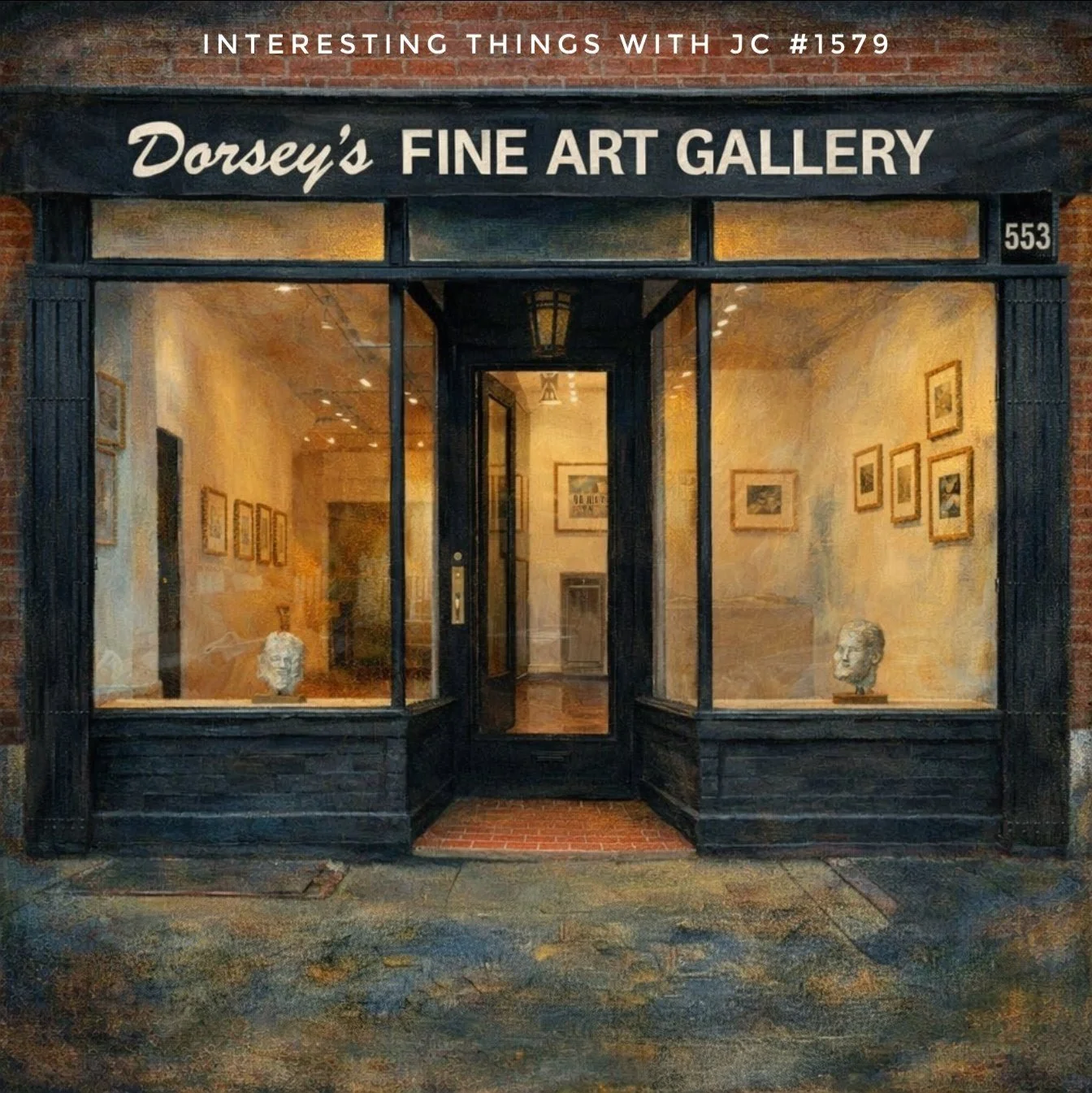
Front view of a brick storefront labeled “Dorsey’s Fine Art Gallery.” Large display windows show a warmly lit interior with framed artwork on the walls and small sculpted heads near the window corners. A glass door stands slightly open at center, and the street number “553” appears on the right side. Text across the top reads “INTERESTING THINGS WITH JC #1579.”
Transcript
Interesting Things with JC #1579: "Dorsey’s Art Gallery and the Man Who Opened the Door"
In 1970, on Rogers Avenue in the Flatbush neighborhood of Brooklyn, New York, a narrow brick storefront became one of the most important art rooms in the city.
From the outside, the building looked like many others on the block. Two stories of brick built around 1922. A simple commercial space at street level. Barely thirty feet wide, about 9 meters across.
Nothing about it suggested art history.
But inside, something different was happening.
Paintings leaned against the walls. Frames rested on worktables. The smell of fresh cut wood from the framing shop mixed with oil paint and varnish. People from the neighborhood wandered in off the street, sometimes just curious, and stayed longer than they expected.
The man behind the counter was Lawrence P. Dorsey.
Dorsey was born in St. Louis, Missouri in 1919. He grew up during the Great Depression, when steady work was hard to find and most families were simply trying to get through the week.
As a young man he attended LeMoyne Owen College (luh MOYN oh WIN) in Memphis, Tennessee for about two years, studying journalism before the Second World War interrupted everything.
Like millions of Americans of his generation, Dorsey entered the United States Army. He served in Europe as a supply sergeant.
That job may not sound glamorous, but it was essential. During the war, a reinforced United States Army division could consume more than 600 tons of supplies in a single day, about 544 metric tons. Fuel. Ammunition. Food. Spare parts. Medical gear.
If the supplies did not arrive, the army did not move.
Keeping those systems running required patience, organization, and attention to detail.
Dorsey learned logistics.
After the war he worked a variety of jobs, including time as a head waiter on cruise ships. While traveling, he began buying small pieces of art whenever he could afford them.
By 1953 he had settled in Brooklyn, New York, like many veterans looking to build a steady life.
In 1970, Dorsey bought a small picture framing shop on Rogers Avenue. But he did not just want to frame paintings.
He wanted to show them.
So he opened Dorsey’s Fine Art Gallery inside that same storefront.
At the time, many galleries in Manhattan operated like private clubs. Collectors needed connections. Artists needed introductions. Walking in off the street was not always welcome.
Dorsey believed art should belong to regular people.
In his gallery, anyone could walk through the door. No appointment. No gatekeeper.
It would become one of the longest continuously operating Black owned art galleries in New York City.
And the artists on those walls mattered.
One of them was Jacob Lawrence.
Lawrence became famous for a remarkable body of work known as the Migration Series, painted between 1940 and 1941. The series contains exactly sixty panels, each measuring 12 by 18 inches, about 30 by 46 centimeters.
Together they tell the story of millions of African Americans leaving the rural South and moving north to cities like Chicago, Detroit, and New York.
Lawrence believed history could be painted.
Dorsey believed people should see it.
Another artist connected to the gallery was Elizabeth Catlett (KAT let), a sculptor and printmaker whose career bridged the United States and Mexico.
Catlett often worked in linocut prints. The process is simple but demanding. An artist carves an image into a sheet of linoleum, cutting away everything that should not print. Ink is rolled across the surface, and paper is pressed onto it to transfer the image.
Every line has to be cut by hand.
The gallery also showed work by Ernest Crichlow (KRITCH loh), a painter who worked alongside Harlem Renaissance artists such as Charles Alston.
Crichlow painted ordinary life. Mothers waiting at bus stops. Children walking home from school. Small moments that most galleries ignored.
Dorsey believed those moments mattered.
But what made the gallery special was not just the art.
It was what Dorsey taught people.
If someone came in with only a few hundred dollars, he showed them prints or smaller works they could afford. If a collector had more to spend, he explained how to look at a painting. Balance. Color. Condition. Craftsmanship.
Over time, people in the neighborhood began collecting art themselves.
Another tradition grew out of the gallery every winter.
Dorsey held informal holiday auctions where paintings were sold to raise money for neighborhood schools and charities. Many pieces sold for two hundred to five hundred dollars at the time, roughly one thousand to three thousand dollars today depending on the year.
In that small room, art was not just decoration.
It was part of the community.
Customers remembered Dorsey sitting behind the counter wrapping paintings in brown paper while talking about artists the way someone else might talk about old friends.
He ran the gallery for nearly four decades.
When Lawrence P. Dorsey passed away in 2007 at the age of eighty eight, the small storefront he opened had already become a neighborhood institution.
In 2011, the City of New York officially renamed a section of Rogers Avenue between Fenimore Street and Hawthorne Street.
Today the street sign reads Lawrence P. Dorsey Way.
Founded by Lawrence P. Dorsey in 1970, the gallery is now managed by his granddaughter, Naima Wood (NY EE muh Wood), who continues the family’s work in that same Brooklyn storefront.
New York is famous for billion dollar art auctions and galleries where paintings sell for millions.
But Dorsey’s place represented something older and deeply American.
A veteran comes home.
He buys a small shop.
He studies the work of others.
And he builds a place where culture belongs to anyone who walks through the door.
Sometimes the history of art does not begin in marble museums.
Sometimes it begins in a neighborhood storefront, where one determined shop owner decides that good work deserves a wall.
These are interesting things, with JC.
Student Worksheet
Short answer: What problem did Lawrence P. Dorsey see in the way many galleries operated, and how did he respond to it?
Short answer: Describe two details from the episode that show the gallery was connected to the neighborhood (not just to wealthy collectors).
Evidence prompt: What is one claim the episode makes about Jacob Lawrence, Elizabeth Catlett, or Ernest Crichlow? Quote or paraphrase the line that supports it.
Creative prompt: Write a 150–200 word “gallery label” for an imaginary exhibition called “Art in a Storefront,” using Dorsey’s gallery as the setting.
Compare/contrast: In a T-chart, list how a “private club” gallery differs from Dorsey’s open-door approach.
Teacher Guide
Estimated Time
One class period (45–60 minutes) for listening excerpts + discussion + worksheet
Optional second period for extension activity (community mapping or visual analysis)
Pre-Teaching Vocabulary Strategy
Quick “Frayer Model” for linocut, logistics, and collector (definition, example, non-example, sketch).
Show one image of a linocut print (projected) and have students identify carved-line traits before defining the term.
Anticipated Misconceptions
“Galleries are only for rich people.” Clarify different types: commercial, nonprofit, neighborhood/community galleries.
“Supply sergeant means non-essential.” Use the episode’s framing: logistics directly affects outcomes.
“Local history isn’t ‘real’ history.” Emphasize evidence, documentation, and civic recognition.
Discussion Prompts
What does “open door” access change for artists? For audiences?
Why might a framing shop be a practical starting point for a gallery?
How do storytelling details (smell of wood, brown paper wrapping) shape our understanding of a place?
Differentiation Strategies: ESL, IEP, gifted
ESL: Provide a vocabulary bank with sentence frames (“Dorsey believed art should… because…”).
IEP: Offer a guided notes template with fill-in blanks for dates, people, and key ideas.
Gifted: Add a source-comparison mini task: students read a short external article about the gallery and evaluate what the episode emphasizes vs. the article.
Extension Activities
Local Culture Map: Students identify 3 cultural spaces in their community (library, mural, small theater, studio) and explain who they serve.
Curator Challenge: Students design a mini-exhibit plan (theme, 5 works—real or hypothetical, audience, and access plan).
Civic Recognition Study: Research how honorary street names work in NYC or your city, and what they signal about community memory.
Cross-Curricular Connections: (e.g., physics, sociology, ethics)
Sociology: Social networks and “gatekeeping” in cultural institutions.
Economics/Math: Inflation reasoning using the episode’s art-price comparisons (practice estimating ranges rather than exact figures).
Art: Printmaking and visual storytelling (sequence, repetition, rhythm).
Internal framework reference used:
Quiz
Q1. Where was Dorsey’s Fine Art Gallery located?
A. Midtown Manhattan
B. Rogers Avenue in Flatbush, Brooklyn
C. Queens near Corona Avenue
D. Downtown Los Angeles
Answer: B
Q2. What was Lawrence P. Dorsey’s role in World War II, according to the episode?
A. Fighter pilot
B. War correspondent
C. Supply sergeant
D. : C
Q3. Jacob Lawrence’s Migration Series is described as containing how many panels?
A. 12
B. 30
C. 50
D. 60
Answer: D
Q4. In a linocut, what does the artist do first?
A. Paints directly on paper with ink
B. Carves an image into linoleum
C. Photographs a sculpture
D. Glazes a ceramic tile
Answer: B
Q5. What is one major idea emphasized about Dorsey’s gallery?
A. It required appointments to enter
B. It was only for professional collectors
C. It welcomed walk-ins and everyday community members
D. It refused to sell affordable works
Answer: C
Assessment
Open-ended prompts:
Explain how Lawrence P. Dorsey’s personal experiences (before and after WWII) helped him build and sustain a community-centered gallery. Use at least three details from the transcript.
Argue whether Dorsey’s Fine Art Gallery should be considered a “cultural institution” comparable in importance to larger museums. Support your claim with evidence from the episode and at least one outside source.
3–2–1 rubric (for each question):
3 = Accurate, complete, thoughtful (clear claim, multiple specific transcript details, strong explanation)
2 = Partial or missing detail (some evidence, but limited explanation or unclear connection)
1 = Inaccurate or vague (minimal evidence, major errors, or unsupported opinion)
Standards Alignment
CCSS.ELA-LITERACY.RI.9-10.2 — Determine a central idea of an informational text; students identify the episode’s central message about access to art and community institutions.
CCSS.ELA-LITERACY.RI.9-10.3 — Analyze how the author unfolds events; students trace how Dorsey’s biography leads to the gallery’s impact.
CCSS.ELA-LITERACY.SL.9-10.1 — Initiate and participate in collaborative discussions; students use discussion prompts to cite evidence and respond to peers.
CCSS.ELA-LITERACY.W.9-10.1 — Write arguments supported by evidence; students defend whether a neighborhood gallery counts as a major cultural institution.
C3 Framework (NCSS) D2.His.1.9-12 — Evaluate how historical events and developments shaped people’s lives; students connect WWII service/postwar migration to local institution-building.
C3 Framework (NCSS) D2.His.4.9-12 — Analyze complex interactions in historical contexts; students examine gatekeeping, neighborhood change, and cultural access.
C3 Framework (NCSS) D2.Civ.2.9-12 — Analyze how people use institutions to address problems; students consider how Dorsey used a gallery to widen access and support community causes.
NCAS (Visual Arts) VA:Re7.1.HSI — Analyze how responses to art are influenced by context; students discuss how a storefront gallery changes who engages with art.
NCAS (Visual Arts) VA:Re8.1.HSI — Interpret intent and meaning in artistic work; students interpret how Jacob Lawrence’s series tells history visually.
NCAS (Visual Arts) VA:Cn10.1.HSI — Synthesize knowledge of social, cultural, and historical context; students connect art, community, and the Great Migration narrative.
ISTE Standards for Students 3 (Knowledge Constructor) — Students gather and evaluate sources about the gallery and street co-naming to build an evidence-based summary.
ISTE Standards for Students 6 (Creative Communicator) — Students create a curator label or mini-exhibit plan tailored to an intended audience.
Merged international equivalents (content-focused):
UK National Curriculum (Art & Design, KS4 guiding expectations) — Develop critical understanding of artists and contexts; students study how art connects to community history and access.
Cambridge IGCSE Art & Design (0400) Assessment Objectives (AO understanding/context + personal response) — Students demonstrate understanding of artists’ work in context and communicate informed responses through writing and discussion.
IB DP Visual Arts (Comparative Study + Contextual understanding) — Students analyze artworks and their cultural contexts and compare how institutions shape interpretation and access.
Show Notes
In this episode, JC tells the story of Lawrence P. Dorsey and the small Rogers Avenue storefront in Flatbush, Brooklyn that became Dorsey’s Fine Art Gallery in 1970. The narrative highlights how Dorsey, shaped by Depression-era life, WWII logistics work, and years of jobs that demanded discipline and people skills, built an “open door” gallery model that welcomed neighborhood walk-ins, guided first-time collectors, and supported community causes through local benefit auctions.
The episode also connects the gallery’s mission to major artists and ideas in American art, including Jacob Lawrence’s sixty-panel Migration Series and the printmaking tradition associated with artists like Elizabeth Catlett.
In class, the episode works as a practical case study in how culture is preserved and expanded outside major museums: students can analyze access, gatekeeping, local institutions, and how historical storytelling makes community history visible. Key facts used for classroom verification include the gallery’s founding date (1970), its ongoing Black-owned legacy, and New York City’s 2011 honorary street co-naming designating “Lawrence P. Dorsey Way” on Rogers Avenue between Fenimore Street and Hawthorne Street.
References
Dorsey’s Fine Art Gallery. (n.d.). About Dorsey’s Fine Art Gallery. https://dorseysfineartgallery.com/about-1
New York City Council. (2011). Int 0590-2011: Street co-naming—Lawrence P. Dorsey Way (Rogers Avenue between Fenimore Street and Hawthorne Street). https://legistar.council.nyc.gov/LegislationDetail.aspx?GUID=A94708AF-7730-440D-A8A8-B350F74EF739&ID=917834
TheGrio. (2023, February 27). Dorsey’s Fine Art Gallery: New York’s oldest Black-owned gallery space. https://thegrio.com/2023/02/27/dorseys-fine-art-gallery-new-yorks-oldest-black-owned-gallery-space/
Museum of Modern Art. (n.d.). Jacob Lawrence: The Migration Series (educator resource). https://www.moma.org/momaorg/shared/pdfs/docs/learn/courses/Lawrence_Migration.pdf
National Gallery of Art. (2025, May 15). Who is Elizabeth Catlett? 12 things to know. https://www.nga.gov/stories/articles/who-elizabeth-catlett-12-things-know
Historic Districts Council. (n.d.). Dorsey’s Fine Art Gallery (Six to Celebrate). https://6tocelebrate.org/site/dorseys-fine-art-gallery/