1580: "Camp Century"
Interesting Things with JC #1580: "Camp Century" – In the early Cold War, the U.S. Army built a town inside the Greenland ice sheet, powered by a portable nuclear reactor and hidden beneath miles of Arctic ice. What began as a remote research station carried a secret far larger than the frozen world surrounding it.
Curriculum - Episode Anchor
Episode Title: Camp Century
Episode Number: 1580
Host: JC
Audience: Grades 9–12, college intro, homeschool, lifelong learners
Subject Area: Cold War history, engineering/technology, Earth science (glaciology & climate proxies), media literacy (classified vs. public narratives)
Lesson Overview
3–4 measurable learning objectives using action verbs:
Define key features of Camp Century (location, purpose, tunnel design, nuclear power source) using evidence from the transcript.
Compare the public scientific mission of Camp Century with the classified military goals of Project Iceworm.
Analyze how ice-sheet motion affected engineering decisions and led to the project’s closure.
Explain how radar remote sensing can detect buried structures and why that matters for environmental monitoring today.
Key Vocabulary
Greenland Ice Sheet (GREEN-lund ICE sheet) — A massive body of land ice covering much of Greenland that flows slowly under its own weight.
Synthetic Aperture Radar (sin-THET-ik AP-er-cher RAY-dar) — Radar that builds detailed images by combining signals collected over time as an aircraft moves.
UAVSAR (you-AV-sar) — An airborne radar system used by NASA to map Earth features, including ice layers.
PM-2A (pee-em two A) — A portable U.S. Army nuclear reactor used to generate power and heat at remote sites like Camp Century.
Project Iceworm (EYE-s-wurm) — A Cold War-era plan studied by U.S. planners to potentially hide and move missiles within tunnels under Greenland’s ice.
Ice sheet flow (EYE-sheet floh) — The gradual movement of ice that can deform tunnels and structures over time.
Narrative Core (Based on the PSF – use renamed labels)
Open – How the story hooks the listener.
A nearly mile-thick “frozen desert” in Greenland with extreme cold and wind—then the reveal: the U.S. Army built a town inside the ice.
Info:
Camp Century’s location relative to Pituffik (formerly Thule Air Base), and the trench-and-arch method used to create buried tunnels.
The base functions like an underground town: housing, services, and constant artificial light and heated air.
Details:
Power from the PM-2A portable nuclear reactor; the base also enabled deep ice-core drilling that remains valuable for climate research.
The classified layer: Camp Century as a testbed for Project Iceworm.
The failure point: ice-sheet motion steadily deformed tunnels—engineering reality beat strategic ambition.
Reflection:
Camp Century shows how environment shapes geopolitics and technology—and why today’s monitoring focuses on what remains buried (materials and waste) and whether meltwater could ever reach it.
Closing:
These are interesting things, with JC.
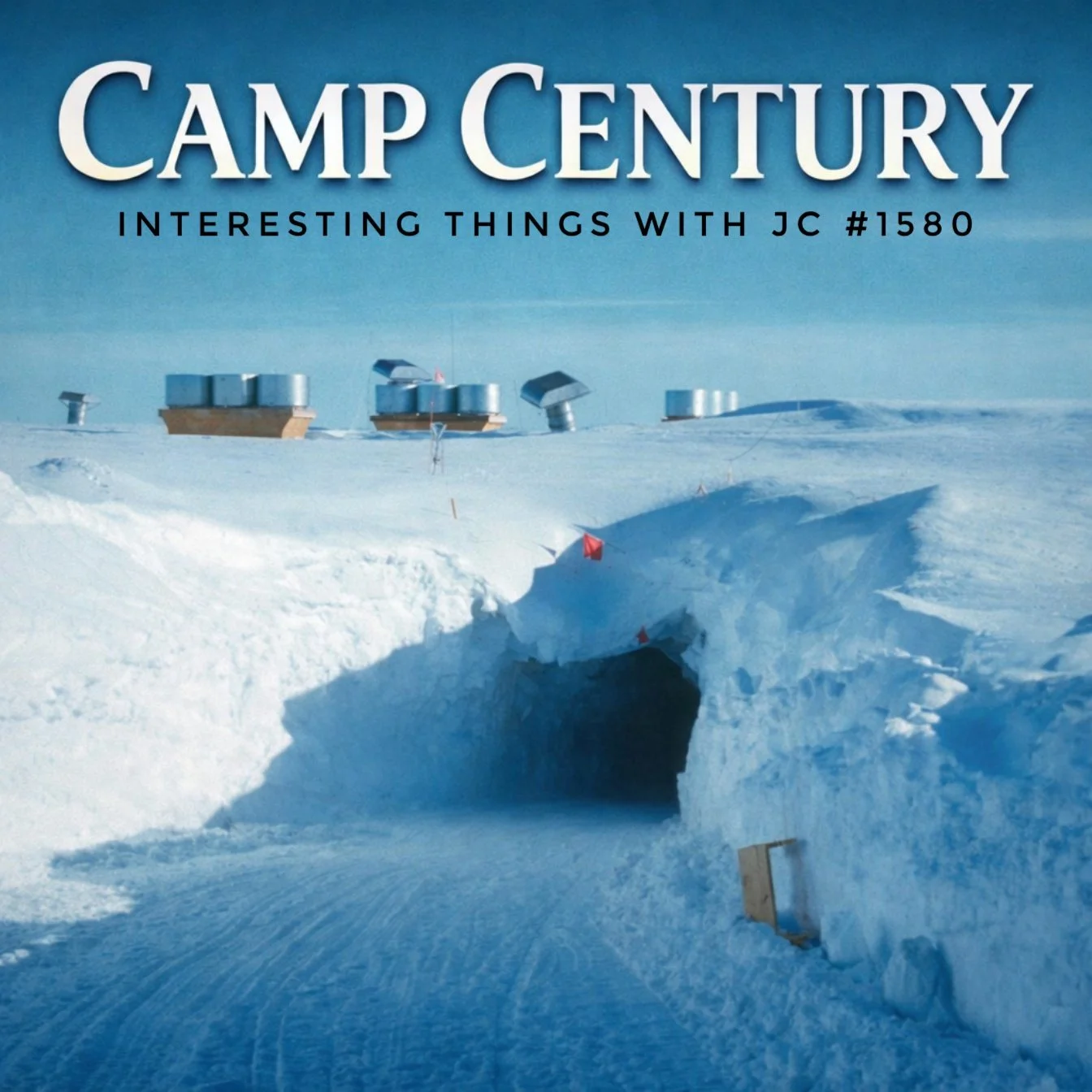
Camp Century podcast cover art showing a snowy Greenland ice landscape with a dark tunnel entrance carved into the ice in the foreground and small blue structures on the horizon under a pale blue sky. Large title text reads “Camp Century,” with smaller text below: “Interesting Things with JC #1580.”
Transcript
Interesting Things with JC #1580: "Camp Century"
In the early years of the Cold War, American soldiers stood on a frozen desert nearly a mile thick. No trees. No soil. Only ice stretching across northern Greenland. Beneath their boots lay a sheet of ice covering about 656,000 square miles, roughly 1.7 million square kilometers. Winter temperatures could drop to minus 70 degrees Fahrenheit, minus 57 degrees Celsius. Winds sometimes reached more than 125 miles per hour, about 201 kilometers per hour.
In 1959, the United States Army decided to build a town there.
Not on the ice.
Inside it.
The place was called Camp Century.
The base sat on the Greenland Ice Sheet about 127 miles, or 205 kilometers, east northeast of Pituffik Space Base in Greenland. The Greenlandic name Pituffik, pronounced pee TOO fik, marks the site once known as Thule Air Base. From that remote Arctic installation, the U.S. Army Corps of Engineers began cutting trenches into the ice cap.
Large snow trenches were cut using rotary snow cutters mounted on military vehicles. Steel arches were placed over the trenches and snow was pushed back on top. This created a tunnel system buried beneath the ice.
By the early 1960s Camp Century contained about 21 tunnels stretching roughly 9,800 feet, close to 3 kilometers. Inside those corridors stood prefabricated buildings that housed about 200 soldiers, engineers, and scientists.
The underground town included dormitories, a kitchen and cafeteria, a small hospital, laundry rooms, a communications center, a recreation hall, a chapel, and a barbershop.
Life there was unusual. Outside, Arctic storms and long polar nights covered the ice sheet. Inside the tunnels, fluorescent lights stayed on and heated air moved through the passageways while people worked and slept beneath the ice.
Power came from a portable nuclear reactor called the PM 2A. It was designed to supply electricity, heat, and hot water to remote military bases where fuel deliveries were difficult.
The reactor components weighed about 400 tons, roughly 363 metric tons, when shipped north. After assembly in 1960, the reactor powered Camp Century for more than three years.
Officially the base operated as a scientific research station. Scientists drilled deep into the ice sheet to study layers of ancient snowfall. Between 1963 and 1966 one drilling project reached about 4,560 feet deep, roughly 1,390 meters. Those ice cores are still used to study Earth’s past climate.
The research program also supported a classified military study.
The plan was called Project Iceworm.
U.S. planners examined the possibility of building a hidden tunnel network under the Greenland ice sheet stretching about 2,500 miles, roughly 4,000 kilometers. Rail systems would move nuclear missiles through the tunnels.
As many as 600 modified Minuteman intercontinental ballistic missiles could be hidden under the ice and moved regularly so enemy forces could not locate them.
If war began, the missiles could launch from beneath the Arctic ice.
Camp Century served as the test. If engineers could maintain tunnels and support human activity under the ice sheet, the larger missile network might be possible.
The ice revealed the problem.
The Greenland ice sheet moves. It flows slowly under its own weight. Measurements at Camp Century showed the tunnels were gradually changing shape. Walls pushed inward. Ceilings sagged. Corridors narrowed as the ice pressed against the structures.
The ice was always moving.
Permanent tunnels could not survive those conditions. Engineers determined the missile network would not remain stable. Project Iceworm was abandoned in the mid 1960s.
Camp Century closed in 1967. The nuclear reactor was removed, but most of the base remained in place. Over time snowfall buried the tunnels deeper beneath the ice sheet.
For decades the underground base disappeared.
In April 2024 NASA scientists flew over the region in a Gulfstream III aircraft using UAVSAR radar to map the ice sheet. The radar detected geometric shapes below the surface.
They were the outlines of Camp Century.
The tunnels and structures remain preserved under more than 100 feet of ice, about 30 meters deep.
Some materials remain buried at the site today, including construction debris, diesel fuel, and small amounts of low level radioactive waste. Scientists from the Geological Survey of Denmark and Greenland monitor the region.
Measurements show snowfall continues to bury the site deeper each year. Models project the debris field could lie about 190 to 210 feet below the surface, roughly 58 to 64 meters, by the year 2100. Meltwater penetration above the site reaches about 3.6 feet, roughly 1.1 meters.
Camp Century was a nuclear powered town built beneath a moving ice sheet to test a hidden missile network during the Cold War.
In 1959 soldiers stood on a frozen plain and began cutting a city into the ice beneath their feet.
That city remains buried under Greenland today.
These are interesting things, with JC.
Student Worksheet
Short-answer: Describe how Camp Century’s tunnel system was constructed inside the ice.
Short-answer: What was the public purpose of Camp Century, and what classified project was it connected to?
Short-answer: Explain (in your own words) why the ice sheet’s movement made long-term tunnels unreliable.
Creative prompt: Write a “field log” entry from a scientist or engineer living in Camp Century, including at least three accurate details from the episode.
Media literacy: Identify two moments in the transcript where the narrator contrasts what people were told versus what was classified.
Teacher Guide
Estimated Time
45–60 minutes (single class) or 2 sessions (research + discussion extension)
Pre-Teaching Vocabulary Strategy
“Three-Column Preview”: Term / What I think it means / Evidence from the transcript that confirms or corrects my guess.
Anticipated Misconceptions
“Ice is stationary” → Clarify ice-sheet flow and deformation over time.
“Radar only sees the surface” → Clarify how radar can image subsurface layers and structures.
“Camp Century was only a missile base” → Emphasize dual-use: scientific drilling plus military testing.
Discussion Prompts
What engineering problems appear when your “ground” is slowly moving?
Why might a government label a project as “scientific” while testing military goals?
What responsibilities exist today for materials left behind under the ice? (Keep discussion evidence-based and non-partisan; focus on environmental monitoring and risk assessment.)
Differentiation Strategies: ESL, IEP, gifted
ESL: Provide a labeled diagram of “tunnel + steel arch + snow cover,” plus sentence frames (“Camp Century was built by… because…”).
IEP: Offer shortened question sets (choose 2 of 4), and allow oral responses or graphic organizers.
Gifted: Assign a source-comparison task: NASA Earth Observatory explanation of the 2024 radar view vs. a Cold War overview of Iceworm.
Extension Activities
Science extension: Model deformation—use a slow “pressure” demo (foam + weights) to mimic gradual tunnel squeeze.
Research extension: Students summarize how GEUS models predict burial depth and meltwater infiltration by 2100.
Mapping extension: Plot approximate relative positioning (Pituffik to Camp Century) and discuss logistical constraints in polar environments.
Cross-Curricular Connections: (e.g., physics, sociology, ethics)
Physics/Engineering: Structural stress, creep, and material limits under constant pressure.
Earth Science: Ice-core climate proxies and stratified snowfall layers.
Civics/History: Cold War strategy and secrecy; how classification shapes public narratives (fact-based analysis only).
Quiz
Q1. What was Camp Century built inside?
A. A mountain cave
B. The Greenland Ice Sheet
C. A coastal cliff
D. A desert canyon
Answer: B
Q2. Which power source supplied electricity and heat to Camp Century?
A. Wind turbines
B. Coal generators
C. The PM-2A portable nuclear reactor
D. Hydroelectric dams
Answer: C
Q3. What was the name of the classified missile-tunnel concept studied alongside Camp Century?
A. Operation Deep Freeze
B. Project Iceworm
C. Project Bluebook
D. Operation Paperclip
Answer: B
Q4. Why was the larger tunnel-and-missile plan considered impractical?
A. The ice was too warm year-round
B. The ice sheet flowed and deformed the tunnels
C. The tunnels were flooded by seawater
D. The bedrock was too soft to drill
Answer: B
Q5. What technology helped reveal outlines of Camp Century from the air in 2024?
A. Sonar
B. Thermal cameras only
C. Synthetic aperture radar (UAVSAR)
D. Magnetic compass surveys
Answer: C
Assessment
Open-ended Q1: Using evidence from the transcript, explain how Camp Century combined scientific research with Cold War military planning.
Open-ended Q2: Explain how ice-sheet flow affy and led to the end of Camp Century and/or Project Iceworm.
3–2–1 rubric:
3 = Accurate, complete, thoughtful (uses multiple specific details from the transcript; clear cause/effect)
2 = Partial or missing detail (some correct facts, but limited evidence or unclear reasoning)
1 = Inaccurate or vague (few facts, misconceptions, or unsupported claims)
Standards Alignment
NGSS HS-ESS2-2 — Analyze geoscience data to make claims about Earth’s surface changes (ice-sheet movement, deformation evidence).
NGSS HS-ESS2-5 — Plan/analyze data on factors that cause climate variation (ice cores as records of past climate).
NGSS Science and Engineering Practices: Analyzing and Interpreting Data — Interpret radar-derived images and modeled projections (burial depth, meltwater infiltration).CCSS.ELA-LITERACY.RH.9-10.2 — Determine central ideas of a historical text (public research station vs. classified military aims).
CCSS.ELA-LITERACY.RH.11-12.6 — Evaluate authors’ purposes and perspectives (how secrecy and framing shape interpretation).C3 D2.His.4.9-12 — Analyze complex causes and effects in historical events (Cold War strategy + engineering constraints).
C3 D2.His.14.9-12 — Analyze multiple and complex factors that shaped historical outcomes (technology, environment, logistics).ISTE 3.1d — Build knowledge by actively exploring real-world issues and problems using digital tools (radar remote sensing as a real case).
ISTE 3.3b — Evaluate accuracy, perspective, and credibility of sources (comparing government/scientific reporting and later disclosures).
International Equivalents (content-based, non-ideological)
UK National Curriculum (KS4) History: challenges for Britain, Europe and the wider world 1901–present — Cold War context and its global strategic dimensions (case study: Greenland).
Cambridge IGCSE History (0470): The Cold War — Superpower rivalry; secret planning and strategic basing decisions.
IB DP History: Cold War (Superpower tensions and rivalries) — Evidence-based analysis of Cold War strategies and consequences (environmental/engineering constraints as a factor).
AQA GCSE Geography: Physical landscapes / UK & global environmental challenges (skills focus) — Interpreting physical-process evidence (ice dynamics) and using models/data to predict change (aligned to GEUS-style modeling discussions).
Show Notes
Camp Century was a real Cold War-era U.S. Army installation built within the Greenland Ice Sheet, using a trench-and-arch tunnel system to create an underground “town” that supported soldiers, engineers, and scientists. While the base was presented as a research station, supporting ice-core drilling that remains important for reconstructing past climate, it also served as a test site connected to Project Iceworm, a classified concept exploring whether missiles could be hidden and moved through a vast tunnel network beneath the ice.
The effort collided with a basic geophysical truth: ice sheets flow and deform, gradually squeezing and warping tunnels until stable long-term infrastructure becomes impractical. Modern remote sensing has renewed attention on the site; NASA’s airborne radar mapping in April 2024 produced unusually detailed imagery of Camp Century’s buried layout, and ongoing scientific work (including GEUS modeling) focuses on how deeply the site will remain buried and whether meltwater infiltration could interact with remaining debris in the future.
References
Hansen, K. (2024, November 25). New View of the “City Under the Ice”. NASA Earth Observatory. https://science.nasa.gov/earth/earth-observatory/new-view-of-the-city-under-the-ice-153616/
U.S. Army Corps of Engineers. (n.d.). Army Nuclear Power Program – Experimental Reactors (PM-2A at Camp Century). https://www.usace.army.mil/About/History/Exhibits/Nuclear-Power-Program/Experimental/
Geological Survey of Denmark and Greenland (GEUS). (2021, March 23). Camp Century is staying under the ice. https://eng.geus.dk/about/news/news-archive/2021/march/camp-century
Time. (2019, May 9). The U.S. Wanted to Hide Nukes in Arctic Ice Tunnels. The Plan Blew Up in Their Faces. https://time.com/5585149/arctic-nuclear-history/
Smithsonian Magazine. (2024, December 2). NASA Radar Detects Abandoned Site of Secret Cold War Project in Greenland—a ‘City Under the Ice’. https://www.smithsonianmag.com/smart-news/nasa-radar-detects-abandoned-site-of-secret-cold-war-project-in-greenland-a-city-under-the-ice-180985550/