1600: "Wernher von Braun"
Interesting Things with JC #1600: "Wernher von Braun" – He helped build the road to the Moon, but that road began in war and human suffering. This episode follows the brilliance, ambition, and cost behind one of the most complicated figures in modern history.
Curriculum - Episode Anchor
Episode Title: Wernher von Braun
Episode Number: 1600
Host: JC
Audience: Grades 9–12, college intro, homeschool, lifelong learners
Subject Area: History, Space Science, Engineering, Ethics, Media Literacy
Lesson Overview:
This lesson examines the life and legacy of Wernher von Braun through two documented realities: his leadership in rocketry that helped make lunar exploration possible, and his central role in a wartime system tied to the V-2 program, forced labor, and civilian death. Students study how scientific achievement, military application, and moral responsibility can coexist in a single historical figure. Von Braun was born on March 23, 1912, in Wirsitz, then in Germany; later worked on the German Army’s rocket program at Peenemünde; surrendered to U.S. forces in May 1945; helped lead the team behind Explorer 1 and Redstone-era work in the United States; became the first director of NASA’s Marshall Space Flight Center in 1960; and contributed to the Saturn V program that powered Apollo missions to the Moon.
Students will also evaluate the human cost of the V-2 program. The United States Holocaust Memorial Museum identifies Dora-Mittelbau as the center of a forced-labor camp system connected to V-2 production, and historical estimates commonly place prisoner deaths around 20,000. That makes the moral questions in this episode essential to serious historical study, not optional add-ons.
Define how rocketry developed from experimental science into military and space technology.
Compare the V-2 rocket program with later U.S. rocket programs such as Redstone, Explorer 1, and Saturn V.
Analyze how historical context shapes the legacy of scientists and engineers.
Explain how this episode connects scientific innovation to ethical responsibility and historical evidence.
Key Vocabulary:
Rocketry (ROCK uh tree) — The science and engineering of designing, building, and launching rockets. In this episode, rocketry moves from theory to warfare and then to space exploration.
Peenemünde (PAY nuh moon duh) — The German rocket research and testing center where the V-2 program scaled rapidly during the 1930s and 1940s.
V-2 rocket (VEE two) — The A-4 ballistic missile developed by Nazi Germany, later recognized as a major technological step in rocketry as well as a weapon used against civilians.
Mittelbau-Dora (MIT uhl bow DOR uh) — The concentration camp system tied to underground V-2 production, where prisoners were subjected to brutal forced labor conditions.
Operation Paperclip (op uh RAY shun PAY per klip) — The U.S. program that brought German scientists, including von Braun, to the United States after World War II.
Explorer 1 (ex PLOR er one) — The first U.S. satellite, launched on January 31, 1958, which helped discover the Van Allen radiation belts.
Saturn V (SAT urn five) — The launch vehicle developed for Apollo-era missions; it stood 363 feet tall and generated about 7.5 million pounds of thrust at liftoff.
Legacy (LEG uh see) — The lasting historical impact of a person’s actions. In this episode, von Braun’s legacy includes both technological breakthroughs and moral controversy.
Narrative Core:
Open – The episode begins by framing von Braun as a man standing “at the edge of two worlds,” immediately introducing tension between war and exploration.
Info – The script provides biographical background, early fascination with astronomy, influence from Hermann Oberth, and von Braun’s self-training in mathematics to understand rocket science. NASA notes that Oberth’s 1923 book helped motivate von Braun to master calculus and trigonometry.
Details – The core facts move through the Army rocket program, Peenemünde, the V-2, forced labor at Mittelbau-Dora, Operation Paperclip, Redstone, Explorer 1, Marshall Space Flight Center, Saturn V, and Apollo 11.
Reflection – The episode asks listeners to hold two truths at once: scientific progress can coexist with grave human harm, and technical brilliance does not erase moral responsibility.
Closing – These are interesting things, with JC.
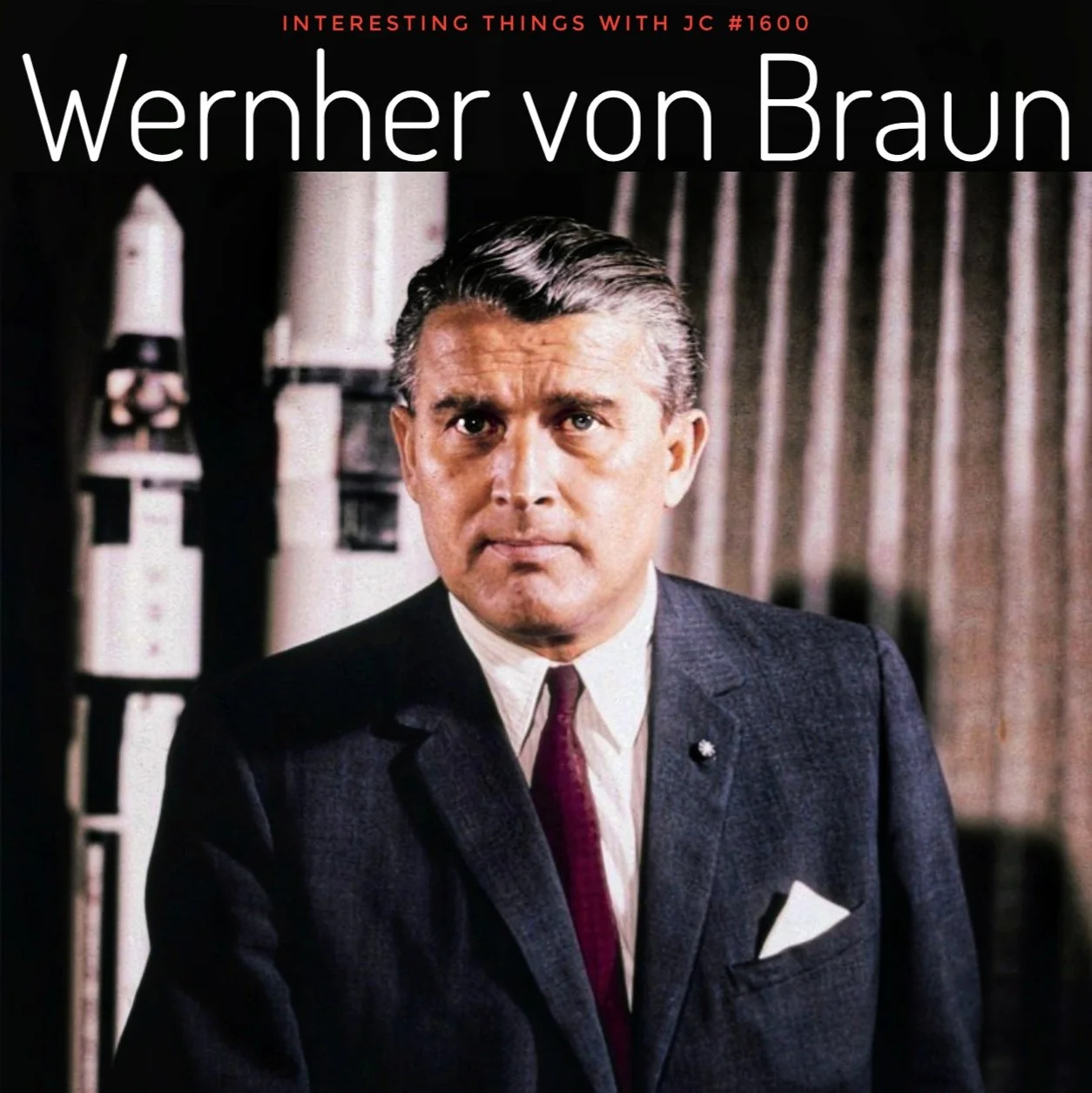
Cover art for Interesting Things with JC #1600: Wernher von Braun, featuring a formal portrait of von Braun in a dark suit with rockets in the background.
Transcript:
Interesting Things with JC #1600: "Wernher von Braun"
He stood at the edge of two worlds.
One built for war… the other reaching for the Moon.
Wernher von Braun (VAIR ner fon BROWN) was born on March 23, 1912, in Wirsitz, Germany (VEER zits, JER muh nee), then part of the German Empire. His family was aristocratic, educated, and tied to government service. His father served as a minister during the Weimar Republic. But the young boy’s focus was not political power. It was upward.
At age 13, his mother gave him a telescope. That moment redirected his life. Around that same time, he discovered the work of Hermann Oberth (HER mahn OH bert), a pioneer in rocket science. Oberth’s 1923 book, “Die Rakete zu den Planetenräumen” (DEE rah KEH tuh tsoo den plah NAY ten roy men), laid out the mathematics of space travel. Von Braun struggled through it. His math skills were not strong at first, so he trained himself until they were. Rocketry leaves no room for guesswork. Every calculation is critical.
By 1930, he joined the Verein für Raumschiffahrt (feh RINE fyoor ROWM shif fahrt), the Society for Space Travel. Within two years, the German Army saw military value in what had begun as experimentation. In 1932, at just 20 years old, von Braun started working under Captain Walter Dornberger (VAL ter DORN ber ger) on rocket development.
By 1937, operations moved to Peenemünde (PAY nuh moon duh), a research facility covering about 25 square miles (65 square kilometers) along the Baltic coast. There, the work scaled rapidly. The objective was no longer theory. It was production.
The result was the A 4 rocket, later known as the V 2.
It burned liquid oxygen and alcohol, generating about 56,000 pounds of thrust (249 kilonewtons). It stood 46 feet tall (14 meters), weighed about 27,600 pounds (12,500 kilograms), and carried a warhead of roughly 2,200 pounds (1,000 kilograms). It could travel approximately 200 miles (320 kilometers) and reach speeds over 3,500 miles per hour (5,600 kilometers per hour).
It also became the first human-made object to reach the edge of space, crossing near 62 miles (100 kilometers) in altitude.
That achievement would later shape space exploration.
At the time, it was used as a weapon.
The human cost was staggering.
Production moved underground to Mittelwerk (MIT el verk), near Nordhausen. Labor came from the Mittelbau Dora concentration camp. Prisoners worked in tunnels stretching over 12 miles (19 kilometers), under constant threat, starvation, and violence. Historical estimates place the death toll around 20,000 people.
By comparison, V 2 attacks killed about 5,000 civilians.
The imbalance is clear.
In October 1942, a successful V 2 test flight traveled about 118 miles (190 kilometers) and reached 55 miles (88 kilometers) in altitude. Von Braun described it as the first step into space.
Amid growing pressures, in March 1944, he was arrested by the Gestapo (geh SHTAH poh), suspected of focusing more on spaceflight than weapons. He was released after intervention from military leadership. His work was too valuable to lose.
As Germany collapsed in 1945, von Braun and roughly 500 engineers gathered documents and fled south. On May 2, 1945, they surrendered to American forces in Bavaria.
Through Operation Paperclip, more than 1,600 German scientists were brought to the United States. Von Braun arrived later that year, first working at Fort Bliss, Texas, then Redstone Arsenal in Huntsville, Alabama.
There, the mission changed.
By the mid 1950s, he led development of the Redstone rocket. On January 31, 1958, a modified version launched Explorer 1, America’s first satellite. It weighed 30.8 pounds (14 kilograms) and revealed the Van Allen radiation belts surrounding Earth.
On May 5, 1961, a Redstone rocket carried Alan Shepard 116 miles (187 kilometers) above Earth in a 15 minute suborbital flight.
In 1960, von Braun became the first director of NASA’s Marshall Space Flight Center. His focus shifted to the Saturn V.
The Saturn V stood 363 feet tall (110.6 meters). Fully fueled, it weighed about 6.2 million pounds (2.8 million kilograms). At liftoff, it produced 7.5 million pounds of thrust (33.4 million newtons). Its first stage engines consumed about 15 tons (13.6 metric tons) of fuel per second.
In just 2.5 minutes, it lifted the vehicle to 42 miles (68 kilometers) in altitude and speeds near 6,000 miles per hour (9,700 kilometers per hour).
On July 16, 1969, Apollo 11 launched.
The journey covered approximately 238,900 miles (384,400 kilometers).
On July 20, 1969, Neil Armstrong stepped onto the Moon.
The engineering path from Peenemünde (PAY nuh moon duh) to the Moon was direct.
Von Braun became a United States citizen in 1955. He received the National Medal of Science in 1975. He continued to advocate for missions to Mars, though those plans were not realized during his lifetime.
He died on June 16, 1977, in Alexandria, Virginia, at age 65.
His life carries more than one truth.
He advanced rocket science further than nearly anyone of his era. He also worked within a system that used forced labor and produced weapons that killed civilians. Both are documented. Neither cancels the other.
The engines that carried Apollo astronauts to the Moon trace back to designs born in wartime urgency.
When we look at the Moon, 238,900 miles (384,400 kilometers) away, we are seeing more than a destination.
We are seeing what human decisions can build… and what they can cost.
These are interesting things, with JC.
Student Worksheet:
What early experiences and influences pushed Wernher von Braun toward rocketry?
How did the purpose of rocket technology change from the V-2 program to the Apollo era?
Why is Mittelbau-Dora essential to understanding von Braun’s historical legacy?
Explain why the episode says von Braun’s life carries “more than one truth.”
Creative response: Write a short museum placard for an exhibit on von Braun that is historically accurate, balanced, and under 120 words.
Teacher Guide:
Estimated Time
45–60 minutes
Pre-Teaching Vocabulary Strategy:
Have students preview the terms rocketry, ballistic missile, forced labor, satellite, and legacy. Ask them to sort each word into one of three categories: science, history, or ethics. After listening or reading, students revisit the sort and explain where categories overlap.
Anticipated Misconceptions:
Students may assume that scientific achievement automatically justifies or cancels moral wrongdoing. The lesson should make clear that historical analysis can recognize both accomplishment and harm at the same time.
Students may think the space race began from entirely peaceful origins. This episode shows that some rocket technologies used in exploration developed from military research during World War II.
Students may believe all people involved in a technological breakthrough are remembered in the same way. This lesson helps them see that public legacy depends on evidence, context, and ethical evaluation.
Discussion Prompts:
How should historians teach the achievements of a scientist whose work is connected to mass suffering?
Does a later contribution to space exploration change how we judge earlier wartime work?
What responsibilities do engineers have when their inventions can be used for both discovery and destruction?
Why is it important to compare technical success with human cost?
Differentiation Strategies: ESL, IEP, gifted:
ESL: Provide a pronunciation guide and a cause-and-effect timeline with icons for war, science, prison labor, and spaceflight.
IEP: Chunk the transcript into sections and provide sentence stems such as “One documented achievement was…” and “One documented harm was…”
Gifted: Ask students to compare this episode with another case study involving dual-use technology, then present a brief evidence-based argument about historical responsibility.
Extension Activities:
Create a timeline from 1912 to 1977 showing scientific milestones and moral turning points in von Braun’s life.
Research Explorer 1, Redstone, or Saturn V and present how each vehicle differed in purpose and engineering scale. Explorer 1 launched on January 31, 1958, and Saturn V became the heavy-lift vehicle for Apollo-era missions.
Hold a seminar on the question: Should museums separate invention from the system in which it was produced?
Cross-Curricular Connections: (e.g., physics, sociology, ethics):
Physics: thrust, propulsion, altitude, velocity, orbital science
History: World War II, the Holocaust, Cold War science, U.S. space program
Ethics: scientific responsibility, dual-use technology, historical memory
Media Literacy: narrative framing, evidence, and how language shapes public memory
Quiz:
Q1. What book helped inspire von Braun’s early interest in space travel?
A. The Origin of Species
B. Die Rakete zu den Planetenräumen
C. Silent Spring
D. The Right Stuff
Answer: B
Q2. Where was the major German rocket research facility located?
A. Normandy
B. Bavaria
C. Peenemünde
D. Berlin
Answer: C
Q3. What was Explorer 1?
A. Germany’s first rocket plane
B. America’s first satellite
C. The first Moon lander
D. A V-2 test vehicle
Answer: B
Q4. What labor system was tied to underground V-2 production?
A. Volunteer civilian industry
B. Navy shipyards
C. University laboratories
D. Forced labor from Mittelbau-Dora
Answer: D
Q5. Which rocket family is most directly associated with Apollo lunar missions in the episode?
A. Vanguard
B. Mercury-Atlas
C. Saturn V
D. Falcon
Answer: C
Assessment:
Open-Ended Question 1
Using evidence from the episode, explain how von Braun contributed to both military rocketry and space exploration.
Open-Ended Question 2
Why is it historically important to include Mittelbau-Dora when teaching about von Braun and the Moon program?
3–2–1 Rubric:
3 = Accurate, complete, thoughtful; uses clear evidence from the episode and explains both scientific and ethical dimensions.
2 = Partial or missing detail; shows general understanding but leaves out key evidence or complexity.
1 = Inaccurate or vague; provides little evidence or oversimplifies the topic.
Standards Alignment:
U.S. Standards
CCSS.ELA-LITERACY.RH.11-12.2 — Students determine central ideas in primary and secondary historical material and summarize how key ideas relate. This fits the episode’s biographical and historical evidence work.
CCSS.ELA-LITERACY.RST.11-12.7 — Students integrate information presented in words, numbers, and other media. This aligns with the episode’s use of rocket dimensions, altitude, thrust, and historical narrative together.
CCSS.ELA-LITERACY.W.11-12.1 — Students write arguments supported by valid reasoning and sufficient evidence. This supports student responses about von Braun’s legacy and moral responsibility.
C3 D2.His.14.9-12 — Students analyze multiple and complex causes and effects of events in the past. This directly matches the episode’s treatment of wartime rocketry, forced labor, and later space exploration.
C3 D2.His.1.9-12 — Students evaluate how historical events were shaped by time, place, and broader context. This supports study of Nazi Germany, postwar America, and the Cold War transition into spaceflight.
NGSS HS-ETS1-3 — Students evaluate solutions to complex real-world problems using criteria and trade-offs, including safety and broader impacts. This is especially relevant to examining rocket engineering as both a technical and societal issue.
NGSS HS-ETS1-2 — Students break down a complex engineering problem into manageable parts. This connects well to multi-stage rockets, mission design, and the engineering progression from V-2 to Saturn V.
ISTE 1.3.d Knowledge Constructor — Students build knowledge by exploring real-world problems and pursuing answers. This aligns with research on the historical and ethical dimensions of technological innovation.
ISTE 5.c Computational Thinker — Students break problems into component parts and develop models to understand complex systems. This fits analysis of rocket stages, propulsion, and systems thinking.
International Academic Equivalents
Cambridge IGCSE History (0470) AO2 — Students construct historical explanations using cause and consequence, change and continuity, and motives and beliefs. This matches the episode’s balanced study of biography, war, and memory.
Cambridge IGCSE History (0470) AO3 — Students interpret, evaluate, and use sources as evidence in historical context. This supports close reading of the transcript alongside historical reference material.
Cambridge IGCSE Physics (0625) Syllabus Aim — Students understand the technological world and take an informed interest in scientific developments. This aligns with the episode’s treatment of propulsion, engineering scale, and scientific application.
IB MYP Sciences Criterion A — Students explain scientific knowledge and analyze information to make scientifically supported judgments. This fits rocket design, thrust, and scientific interpretation within the episode.
IB MYP Sciences Criterion B — Students frame problems or questions for investigation. This supports inquiry into how engineering decisions intersect with historical consequences.
Show Notes:
This episode traces Wernher von Braun’s journey from a young German enthusiast inspired by astronomy and Hermann Oberth’s rocketry writing to one of the most influential rocket engineers of the twentieth century. It explains how the V-2 program at Peenemünde became both a major technical breakthrough and a weapon built through a forced-labor system connected to Mittelbau-Dora, where thousands of prisoners died. It then follows von Braun’s postwar transition to the United States through Operation Paperclip, his work on Redstone and Explorer 1, and his leadership role at NASA’s Marshall Space Flight Center during the Saturn V era that culminated in Apollo 11. In the classroom, this topic matters because it helps students study technological innovation without separating it from historical evidence, human cost, or ethical responsibility. It is especially valuable for units on World War II, the Holocaust, Cold War science, engineering design, and the history of space exploration.
References:
Encyclopaedia Britannica. (2026, March 18). Wernher von Braun. https://www.britannica.com/biography/Wernher-von-Braun
National Aeronautics and Space Administration. (2024, February 6). Wernher von Braun. https://www.nasa.gov/people/wernher-von-braun/
National Aeronautics and Space Administration. (2015, March 18). Explorer 1 overview. https://www.nasa.gov/history/explorer-1-overview/
National Aeronautics and Space Administration. (2021, May 5). 60 years ago: Alan Shepard becomes the first American in space. https://www.nasa.gov/history/60-years-ago-alan-shepard-becomes-the-first-american-in-space/
National Aeronautics and Space Administration. (2018, July 9). Apollo 11 launch. https://science.nasa.gov/resource/apollo-11-launch/
Smithsonian National Air and Space Museum. (2023, November 6). V-2 missile. https://airandspace.si.edu/collection-objects/missile-surface-surface-v-2-4/nasm_A19600342000
United States Holocaust Memorial Museum. (n.d.). Dora-Mittelbau: Overview. Holocaust Encyclopedia. https://encyclopedia.ushmm.org/content/en/article/dora-mittelbau-overview