1601: "Muhammad Ali vs. Chuck Wepner"
Interesting Things with JC #1601: "Muhammad Ali vs. Chuck Wepner" – The greatest fighter alive hit the canvas, and for a moment, everything changed. A man built to bleed refused to fall, stretching time itself to the brink. What happened in those final seconds didn’t just test a champion, it created something that would last forever.
Curriculum - Episode Anchor
Episode Title: "The Night the Champ Was Pushed"
Episode Number: 1601
Host: JC
Audience: Grades 9–12, college intro, homeschool, lifelong learners
Subject Area: History, Sports History, Media Literacy, Cultural Studies
Lesson Overview
Students examine a documented 1975 heavyweight title fight between Muhammad Ali and Chuck Wepner, analyzing athletic strategy, historical context, and its influence on film and storytelling.
Learning Objectives:
Define key facts surrounding the Ali vs. Wepner fight, including time, location, and outcome.
Compare the tactical approaches of Ali and Wepner during the match.
Analyze how real-world events influenced the creation of Rocky.
Explain the significance of endurance and the “underdog” narrative in cultural storytelling.
Key Vocabulary
Attendance (ə-ˈten-dəns) — The number of people present; the fight drew 14,847 spectators.
Knockdown (ˈnä-k-ˌdau̇n) — When a fighter is ruled down by the referee; Wepner scored one against Ali.
Technical Knockout (ˈtek-ni-kəl ˈnä-kˌout) — A stoppage by the referee; Ali won by TKO.
Endurance (in-ˈdu̇r-ən(t)s) — Sustained physical effort; Wepner lasted nearly the full 15 rounds.
Underdog (ˈən-dər-ˌdȯg) — A competitor expected to lose; Wepner entered as a long shot.
Screenplay (ˈskrēn-ˌplā) — A script for a film; Rocky was written shortly after the fight.
Narrative Core
Open – A partially filled arena with bright lights frames a heavyweight title fight in Ohio.
Info – Background on Ali’s championship status and Wepner’s durability and record.
Details – The ninth-round knockdown and Wepner lasting until the final seconds of Round 15.
Reflection – The impact of resilience and how performance, not victory, can shape cultural legacy.
Closing – These are interesting things, with JC.
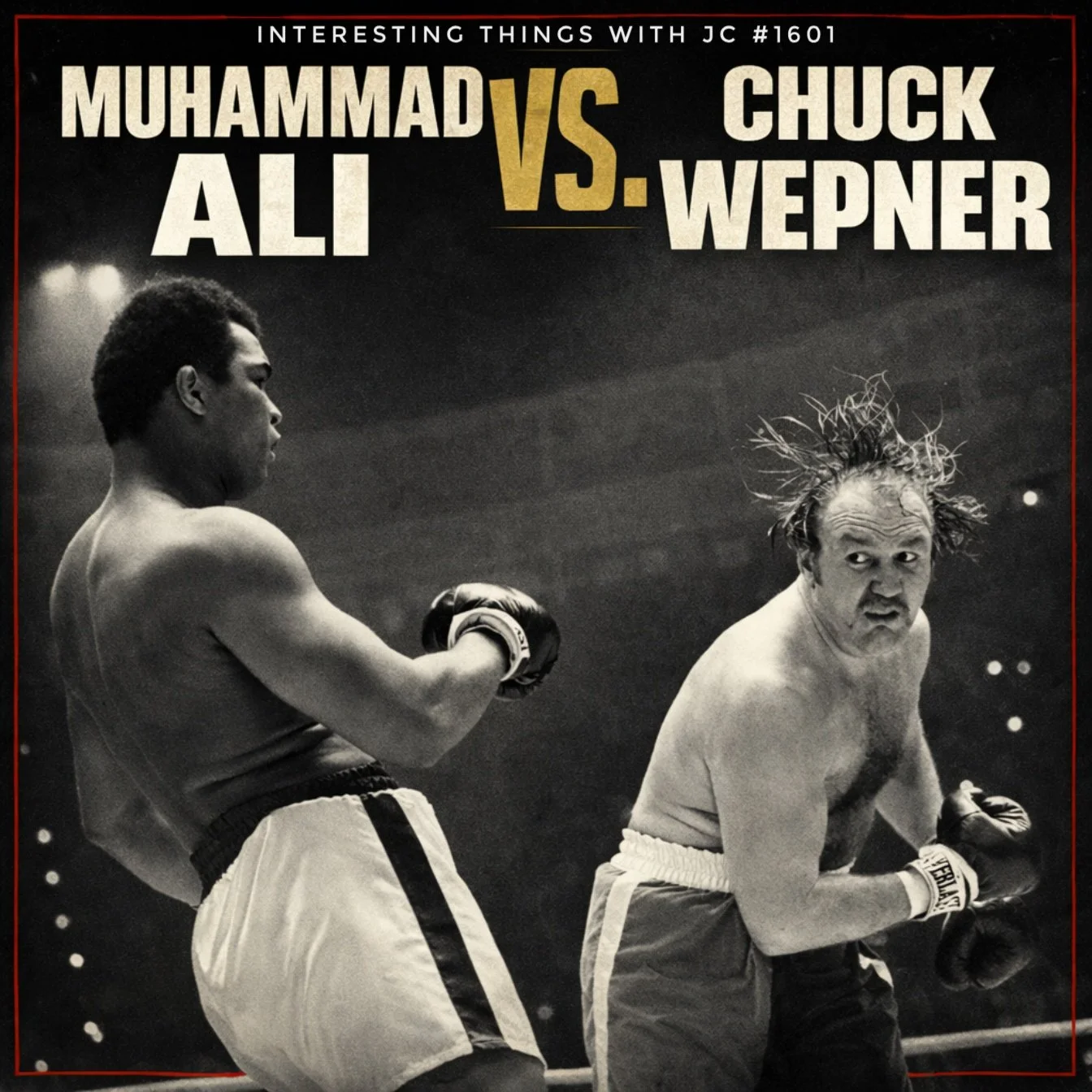
Black and white photograph of a heavyweight boxing match between Muhammad Ali and Chuck Wepner inside a roped arena under bright overhead lights. On the left, Ali, a tall, muscular Black boxer in light-colored trunks, leans back with his glove raised, showing control and balance. On the right, Wepner, a taller, stockier white boxer in darker trunks, turns toward the camera with a strained expression, his hair disheveled as he reacts to a punch. The scene captures a moment of impact, with blurred spectators and arena lighting in the background.
Transcript
Interesting Things with JC #1601: "The Night the Champ Was Pushed"
March 24, 1975. Richfield Coliseum, Richfield Township, Ohio. Paid attendance: 14,847. The building wasn’t full, but the lights were hot over the ring. Canvas tight. Ropes firm.
Muhammad Ali stood in the center. 6 feet 3 inches (1.91 meters). 224 pounds (101.6 kilograms).
Chuck Wepner across from him. 6 feet 5 inches (1.96 meters). 225 pounds (102.1 kilograms). Bayonne (bay-OWN), New Jersey.
Wepner had been cut in nearly every fight he’d had. Over 300 career stitches. Record: 30 wins, 9 losses, 2 draws.
Ali had already gone through Sonny Liston and Joe Frazier. Five months earlier, October 30, 1974, he stopped George Foreman in the 8th round in Kinshasa (kin-SHAH-suh), Zaire (zah-EER), to take back the heavyweight title.
This one was scheduled for 15 rounds. Three minutes each. One minute rest.
The bell.
Ali moved first. Light feet. Left hand snapping straight. He circled, set distance, landed clean jabs. Right hand followed when Wepner reached.
Wepner kept coming forward. Took the jab. Closed distance. Tied Ali up. Leaned his weight in. Forced the referee to separate them. Made the exchanges close and physical.
Rounds built. Ali landing clean. Wepner taking it and staying in front of him.
By the middle rounds, Wepner’s face opened. A cut along the cheek. Blood running down past the mouth. He didn’t step back.
Ali stayed sharp. Jab. Step. Turn. Right hand over the top. He controlled the center and reset the range.
Ninth round.
They came together near the ropes. Wepner stepped in and threw. His foot caught Ali’s. Ali went down.
The referee ruled it a knockdown.
Ali on the canvas.
He got up immediately.
From there, Ali worked in closer. Less movement, more combinations. Hooks inside. Right hands over the top. Short punches in tight.
Wepner took it. Face cut. Eyes swelling. Blood on his chest and trunks. He kept pressing forward.
Rounds ten through twelve. Exchanges in close. Ali landing in bursts. Wepner holding, then stepping back in again.
By the thirteenth and fourteenth, Wepner’s breathing was visible. Mouth open between exchanges. Hands dropping after combinations. Still answering the bell.
Final round.
Fifteenth.
Ali stepped in and let his hands go. A clean right hand. Followed by a fast combination. Wepner staggered back into the ropes.
The referee stepped in at 2 minutes and 41 seconds of the 15th round.
Nineteen seconds left.
Wepner went 14 rounds and 2 minutes. 44 minutes and 41 seconds in the ring.
Ali kept the title.
In the crowd that night was Sylvester Stallone. He watched a man take everything and stay standing. Within days, he wrote a script.
Rocky.
Made for about $1 million, roughly $4 to $6 million in today’s dollars depending on the measure. Released in 1976. Academy Award for Best Picture in 1977.
Chuck Wepner finished his career with 36 wins, 14 losses, and 2 draws.
Fifteen rounds scheduled. Nineteen seconds short.
These are interesting things, with JC.
Student Worksheet
What factors contributed to Wepner lasting nearly the full 15 rounds?
How did Ali adjust his strategy after the knockdown?
Why is the ninth round considered a turning point in the fight?
How did this fight influence the film Rocky?
What lesson does this story teach about success and legacy?
Teacher Guide
Estimated Time: 45–60 minutes
Pre-Teaching Vocabulary Strategy:
Introduce boxing terminology using diagrams or short video clips
Reinforce terms through contextual reading
Anticipated Misconceptions:
Students may think the knockdown was a clean punch rather than a trip-related event
Students may assume lasting longer equals winning
Discussion Prompts:
What defines achievement in competitive settings?
Why do audiences connect with underdog stories?
How can a single moment influence global media?
Differentiation Strategies:
ESL: Provide annotated transcript and vocabulary supports
IEP: Use guided reading questions and chunked text
Gifted: Compare this event to other sports-to-film adaptations
Extension Activities:
Research another real-life story adapted into film
Write a narrative from Wepner’s perspective
Analyze Rocky as a cultural artifact
Cross-Curricular Connections:
Physics: Impact, force, and stamina in athletics
Media Studies: Adaptation of true events into film
Sociology: Cultural meaning of perseverance
Quiz
Q1. What was the official attendance?
A. 20,000
B. 14,847
C. 10,000
D. 18,500
Answer: B
Q2. In which round did the knockdown occur?
A. 5th
B. 9th
C. 12th
D. 15th
Answer: B
Q3. How did the fight end?
A. Decision
B. Knockout
C. Technical knockout
D. Draw
Answer: C
Q4. How much time remained when the fight was stopped?
A. 30 seconds
B. 10 seconds
C. 19 seconds
D. 1 minute
Answer: C
Q5. What film was inspired by this fight?
A. Raging Bull
B. Creed
C. Rocky
D. Million Dollar Baby
Answer: C
Assessment
Open-Ended Questions:
Evaluate how Wepner’s performance redefined expectations of an underdog.
Analyze how this event demonstrates the connection between sports and storytelling.
Rubric:
3 = Accurate, complete, thoughtful
2 = Partial or missing detail
1 = Inaccurate or vague
Standards Alignment
CCSS.ELA-LITERACY.RI.11-12.1 — Cite strong textual evidence from the transcript.
CCSS.ELA-LITERACY.RI.11-12.3 — Analyze how events unfold over time.
C3.D2.His.14.9-12 — Analyze multiple perspectives on historical events.
ISTE 3d — Build knowledge by exploring real-world issues and media.
NCSS Theme: Individual Development and Identity — Understanding perseverance and identity through sport.
UK National Curriculum (KS4 English) — Analyze non-fiction texts and real-world narratives.
IB Language & Literature — Evaluate how narrative structure shapes meaning.
Cambridge IGCSE English — Develop analytical reading of factual texts.
Show Notes
This episode examines the March 24, 1975 heavyweight championship fight between Muhammad Ali and Chuck Wepner at the Richfield Coliseum in Ohio. Despite being a heavy underdog, Wepner lasted until the final seconds of the 15th round and even scored a controversial knockdown against Ali. The fight demonstrated endurance, strategy, and resilience, ultimately inspiring Sylvester Stallone to write Rocky, one of the most influential sports films in history. In educational settings, this story provides a strong example of how perseverance, historical events, and media storytelling intersect, offering students insight into both athletic competition and cultural impact.
References:
Akron Beacon Journal. (2015, March 22). Local history: Muhammad Ali’s 1975 fight at Richfield Coliseum. https://www.beaconjournal.com/story/lifestyle/2015/03/22/local-history-muhammad-ali-s/10606342007/
BoxRec. (n.d.). Chuck Wepner. Retrieved March 23, 2026, from https://boxrec.com/en/box-pro/97
Britannica. (n.d.). Rumble in the Jungle. Retrieved March 23, 2026, from https://www.britannica.com/sports/Rumble-in-the-Jungle
Case Western Reserve University. (n.d.). Ali-Wepner fight. In Encyclopedia of Cleveland History. Retrieved March 23, 2026, from https://case.edu/ech/articles/a/ali-wepner-fight
GQ Magazine. (2018, December 29). Sylvester Stallone on the fight that inspired the Rocky film. https://www.gq-magazine.co.uk/article/sylvester-stallone-interview-rocky
History.com. (n.d.). Muhammad Ali wins the Rumble in the Jungle. Retrieved March 23, 2026, from https://www.history.com/this-day-in-history/october-30/muhammad-ali-wins-the-rumble-in-the-jungle
The Fight City. (n.d.). Ali vs Foreman – The legendary “Rumble in the Jungle”. Retrieved March 23, 2026, from https://www.thefightcity.com/ali-vs-foreman/