1602: "Redstone Arsenal"
Interesting Things with JC #1602: "Redstone Arsenal" – Before rockets carried Americans into space, they were built to fail on purpose in Huntsville, Alabama. At Redstone Arsenal, every rupture, misfire, and crash became part of the blueprint for something that could finally rise.
Curriculum - Episode Anchor
Episode Title: Redstone Arsenal
Episode Number: 1602
Host: JC
Audience: Grades 9–12, college intro, homeschool, lifelong learners
Subject Area: U.S. history, aerospace engineering, space science, military history
Lesson Overview
Students examine how Redstone Arsenal evolved from a World War II chemical-weapons production site into a major center for U.S. rocket development and spaceflight engineering. They will study how repeated testing, failure analysis, and redesign shaped the Redstone rocket program, contributed to Alan Shepard’s 1961 Mercury-Redstone flight, and laid groundwork for the Saturn launch vehicles developed at Marshall Space Flight Center. Redstone Arsenal was established during World War II, later became a center for Army missile research, and is still active today in defense and propulsion-related work.
Learning Objectives
• Define Redstone Arsenal’s original wartime purpose and explain how its mission changed after World War II.
• Compare the Redstone rocket program with earlier V-2 work and explain how testing informed design improvements.
• Analyze how engine tests, structural failures, and guidance problems contributed to later launch reliability.
• Explain how work at Redstone Arsenal helped support both Project Mercury and the development culture that led to the Saturn family.
Key Vocabulary
• Arsenal (AHR-suh-nuhl) — A large military site used for production, storage, research, or testing. Redstone Arsenal began as a wartime production site before becoming a rocket-development center.
• Propulsion (pruh-PUHL-shuhn) — The force system that moves a rocket forward. Engineers at Redstone tested engines to measure thrust, burn time, and failure points.
• Thrust (thruhst) — The pushing force produced by a rocket engine. The Mercury-Redstone launch vehicle used an engine rated at about 78,000 pounds of thrust.
• Guidance system (GY-dns SIS-tuhm) — The set of instruments and controls that keeps a rocket on course. Early systems relied heavily on gyroscopes, accelerometers, and analog control methods.
• Gyroscope (JY-ruh-skohp) — A spinning device used to measure or maintain orientation. It helped early rockets determine position and stability.
• Static test stand (STAT-ik test stand) — A structure that holds a rocket engine in place during ground firing so engineers can study performance without launching the vehicle.
• Payload (PAY-lohd) — The cargo a rocket carries. In missile or spaceflight contexts, this can mean instruments, a capsule, or another mission-specific load.
• Operation Paperclip (op-uh-RAY-shuhn PAY-per-klip) — The U.S. program that brought German scientists and engineers, including Wernher von Braun’s team, to the United States after World War II.
Narrative Core
Open: The episode opens inside Redstone Arsenal in the early 1950s, where rockets were intentionally pushed to failure so engineers could learn what broke.
Info: Listeners are given the site’s earlier history as a World War II chemical-weapons production center and then its postwar transformation after the arrival of Wernher von Braun’s team and the start of U.S. missile development in Huntsville.
Details: The story focuses on violent engine tests, ruptured fuel systems, unreliable guidance, and structural failure. These repeated breakdowns led to the Redstone rocket, later Mercury-Redstone missions, and eventually the engineering culture associated with Marshall’s Saturn-era launch vehicle work. Alan Shepard’s Mercury-Redstone 3 mission reached 116.5 statute miles and lasted 15 minutes 28 seconds. Saturn V later stood 363 feet tall and produced about 7.5 million pounds of thrust at liftoff, commonly rounded to 7.6 million.
Reflection: The broader meaning is that technological progress often depends on controlled failure, careful measurement, and revision. The episode also highlights how places built for war can later become central to scientific and exploratory work.
Closing: These are interesting things, with JC.
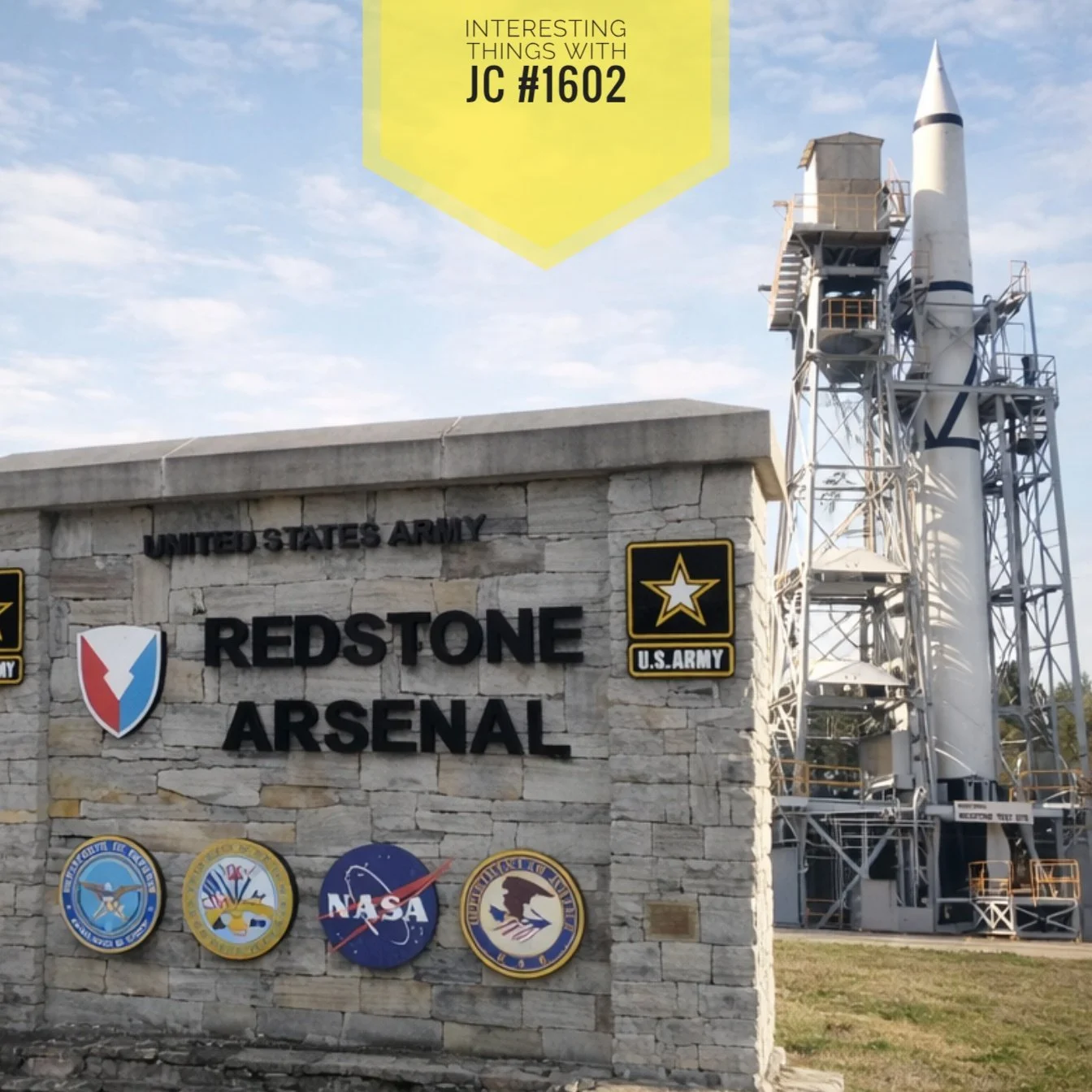
Entrance sign for Redstone Arsenal in Huntsville, Alabama, with U.S. Army and NASA emblems on a stone wall and a white rocket on a launch stand rising in the background under a partly cloudy sky.
Transcript
Interesting Things with JC #1602: "Redstone Arsenal"
In the early 1950s, inside a cluster of reinforced concrete buildings at Redstone Arsenal in Huntsville, Alabama, men were wiring explosives into metal tubes and firing them into the sky, not for war, but to see what would break.
Engines ruptured. Fuel lines burst. Guidance systems failed mid-flight. Rockets spun off course before slamming back to Earth. Every failure was filmed, measured, taken apart, and built again.
That place was Redstone Arsenal.
Originally established in 1941, the site covered about 38,000 acres, 59 square miles (153 square kilometers). Its first mission was chemical weapons production during World War II. Thousands of workers handled compounds like mustard gas and phosgene, producing large-scale munitions under strict containment. By 1945, the war ended, production stopped, and much of the facility went silent.
But the story didn’t end there.
In 1945, under Operation Paperclip, Wernher von Braun and his German rocket team arrived in the United States. They had built the V-2, the first long-range guided ballistic missile, 46 feet tall (14 meters) and able to travel over 200 miles (320 kilometers). By April 1950, that team was relocated to Huntsville, and Redstone Arsenal became their new proving ground.
They didn’t start from nothing. They started from hard-won experience, and pushed it until it failed.
Using liquid oxygen and alcohol-based fuels, engineers built and tested engines producing around 78,000 pounds of thrust (347 kilonewtons). That force had to be controlled precisely. Too much pressure, and the chamber split open. Too little, and the rocket never cleared the pad.
Static test stands absorbed the punishment. Engines were bolted down, ignited, and pushed past safe limits. Steel supports warped under vibration. Concrete cracked. Cameras captured every violent second. Entire assemblies were lost in seconds. Each failure left behind numbers, temperatures, pressures, burn times, data that defined the next design.
Guidance systems were just as unforgiving.
Before digital computing, these rockets relied on analog controls, gyroscopes, accelerometers, and mechanical feedback systems. Trajectories were calculated by hand, then converted into physical adjustments inside the rocket. A small imbalance could send a missile miles off course. When that happened, the only option was to sift through the wreckage and hunt for the flaw.
The Redstone rocket grew out of that process.
It stood about 69 feet tall (21 meters), with a diameter of roughly 5.8 feet (1.8 meters), and could carry a payload near 6,000 pounds (2,720 kilograms). Early test flights exposed weaknesses, engines cutting out early, guidance drifting, structures failing under stress. Those weren’t exceptions. They were expected.
Each launch answered a specific question.
By the late 1950s, those answers produced a reliable system. That same Redstone platform, refined through repeated failure, was adapted for human flight. On May 5, 1961, a Redstone rocket carried Alan Shepard to an altitude of 116 miles (187 kilometers). The flight lasted 15 minutes. Every component on that mission had already failed somewhere, sometime, during testing.
And the scale increased.
At Redstone Arsenal, under what became the Marshall Space Flight Center, the same team that had mastered Redstone pushed into clustered and multi-stage systems. This evolution produced the Saturn I and, ultimately, the Saturn V, the most powerful rocket ever successfully flown. It stood 363 feet tall (110.6 meters) and generated 7.6 million pounds of thrust (33.8 meganewtons).
Before any of those vehicles left the ground, critical components were deliberately driven beyond their limits. Fuel tanks were pressurized until rupture. Engines were run longer than required. Vibrations were pushed to levels that could tear structures apart mid-flight. Weak points weren’t avoided, they were found on purpose.
Nothing was assumed. Everything was tested until it broke.
Today, Redstone Arsenal remains active. It supports missile defense systems, propulsion testing, explosive ordnance training, and advanced research for both military and NASA operations.
You may have seen a guy on TikTok sneaking into Area 51 saying he worked for Redstone Arsenal, talking about time dilation…well…this is the place.
Controlled detonations, high-thrust engine testing, and interception systems are still developed and evaluated on that same ground.
The risk there it never left….what changed was how it was used.
A place once built to produce chemical weapons became a center for propulsion, guidance, and spaceflight. Progress came from pushing systems to failure, measuring the results, and building them again with better understanding.
These are interesting things, with JC.
Student Worksheet
What was Redstone Arsenal originally built to do during World War II?
How did repeated rocket failures help engineers improve later designs?
What role did guidance systems play in early rocket launches?
Why was Alan Shepard’s Mercury-Redstone flight historically important?
Write 3–5 sentences explaining how a place associated with wartime production became important to space exploration.
Teacher Guide
Estimated Time
45–60 minutes
Pre-Teaching Vocabulary Strategy
Begin with a word sort using the terms arsenal, propulsion, thrust, guidance system, gyroscope, static test stand, payload, and Operation Paperclip. Have students group words into “place,” “people,” “machines,” and “process.” Then ask them to predict how the words connect before reading or listening.
Anticipated Misconceptions
• Students may assume successful launches come mostly from flawless design rather than repeated failure analysis.
• Students may believe Redstone Arsenal was built originally for NASA; it was not. It began as a World War II military-industrial site.
• Students may confuse the Redstone missile with the later Mercury-Redstone launch vehicle.
• Students may not realize Operation Paperclip is historically complex and ethically controversial because it involved recruiting specialists from Nazi Germany, including Wernher von Braun.
Discussion Prompts
• Why might engineers deliberately push a design beyond its safe limit?
• What can failure teach that success sometimes cannot?
• How should historians discuss scientific achievement when some contributors had troubling political or wartime pasts?
• What is gained when military technology is redirected toward scientific exploration?
Differentiation Strategies
ESL: Provide a visual vocabulary sheet with labeled rocket diagrams and sentence frames such as “The rocket failed because…” and “Testing helped engineers by…”.
IEP: Break the transcript into short sections with guided notes. Offer audio support, highlighted keywords, and reduced written-response length.
Gifted: Ask students to compare Redstone’s engineering process to iterative design in another field such as software, medicine, or architecture.
Extension Activities
• Research the difference between a ballistic missile and a crewed suborbital launch vehicle.
• Create a timeline from 1941 to 1961 showing Redstone Arsenal’s mission changes.
• Analyze how analog guidance differs from modern digital control systems.
• Write a short argument on whether failure should be considered an essential part of innovation.
Cross-Curricular Connections
• Physics: thrust, mass, force, acceleration, structural stress
• Chemistry: fuels, oxidizers, combustion, wartime chemical production
• History: World War II, Cold War, early U.S. space program
• Engineering: iterative design, systems testing, risk management
• Ethics: historical responsibility, dual-use technology, wartime scientific legacies
Quiz
Q1. What was Redstone Arsenal’s main original purpose during World War II?
A. Building commercial airplanes
B. Training astronauts
C. Producing chemical weapons and munitions
D. Launching communications satellites
Answer: C
Q2. What did engineers often do with rocket engines at Redstone Arsenal?
A. Store them without testing
B. Run them on static test stands to measure performance and failure
C. Launch every engine immediately
D. Replace guidance systems with manual steering
Answer: B
Q3. Which astronaut flew aboard a Redstone rocket on May 5, 1961?
A. John Glenn
B. Gus Grissom
C. Neil Armstrong
D. Alan Shepard
Answer: D
Q4. Which system helped early rockets stay on course before digital computing became standard?
A. Solar panels
B. Analog controls with gyroscopes and accelerometers
C. GPS satellites
D. Laser navigation towers
Answer: B
Q5. What larger rocket family is connected to the engineering culture that grew from Redstone and Marshall work?
A. Gemini Titan only
B. Space Shuttle only
C. Saturn launch vehicles
D. Falcon rockets
Answer: C
Assessment
Open-Ended Question 1
Explain how repeated failure contributed to the success of the Redstone program and later U.S. space missions.
Open-Ended Question 2
Describe the historical transformation of Redstone Arsenal from World War II through the early space age.
3–2–1 Rubric
3 = Accurate, complete, thoughtful explanation using specific details from the episode
2 = Partially accurate response with some relevant detail but missing explanation or precision
1 = Inaccurate, vague, or minimal response with little connection to the episode
Standards Alignment
NGSS HS-ETS1-2
Design a solution to a complex real-world problem by breaking it into manageable parts. Students examine how propulsion, structure, and guidance were treated as separate but linked engineering problems.
NGSS HS-ETS1-3
Evaluate a solution to a complex real-world problem based on prioritized criteria and trade-offs. Students consider reliability, thrust, safety, and structural integrity in rocket testing.
CCSS.ELA-LITERACY.RH.9-10.2
Determine the central ideas of a primary or secondary historical source. Students identify the episode’s central claim about failure-driven innovation.
CCSS.ELA-LITERACY.RH.11-12.7
Integrate and evaluate multiple sources of information presented in diverse formats. Students can pair the transcript with launch data, historical timelines, and official mission records.
CCSS.ELA-LITERACY.WHST.9-10.2
Write informative texts to examine and convey complex ideas clearly. Students explain Redstone Arsenal’s transition from wartime production to aerospace development.
C3 D2.His.1.9-12
Evaluate how historical events and developments were shaped by unique circumstances of time and place. Students study World War II, the Cold War, and the rise of U.S. rocketry.
C3 D2.His.14.9-12
Analyze multiple and complex causes and effects of events in the past. Students assess how military priorities, engineering advances, and political pressures shaped Redstone’s history.
ISTE 1.3 Knowledge Constructor
Students critically curate information from digital resources. They verify historical and technical claims using authoritative sources.
CTE Engineering and Technology Career Cluster
Applies engineering design, testing, troubleshooting, and system improvement practices. This episode directly supports foundational aerospace and systems-engineering concepts.
UK National Curriculum / GCSE Physics Equivalent
Forces, motion, and the use of data in scientific investigation align with the episode’s emphasis on thrust, stress, and measured testing.
Cambridge IGCSE Physics Equivalent
Supports study of motion, forces, and practical investigation through real-world rocket testing examples.
IB MYP Sciences / Design Equivalent
Students investigate systems, testing, and iterative improvement using evidence from a historically grounded engineering case.
Show Notes
This episode explores Redstone Arsenal as a place where modern American rocketry was shaped through trial, failure, and redesign. It explains how a site established during World War II for chemical-weapons production later became a key center for missile development and, eventually, part of the broader engineering story behind the U.S. space program. The episode is classroom-relevant because it connects history, physics, engineering design, and ethics in one narrative: students can see how technological progress depends on measurement, evidence, revision, and historical context. It also matters today because Redstone Arsenal remains active in defense and research, reminding learners that places, technologies, and institutions can change purpose over time while still carrying the weight of their past.
References
Redstone Arsenal establishment, size, and WWII chemical weapons mission (mustard gas, phosgene, etc.):
U.S. Army. (n.d.). Redstone Arsenal timeline. https://www.amcom.army.mil/Organization/Redstone-Arsenal-History/Redstone-Arsenal-Timeline/
Operation Paperclip, von Braun team arrival in U.S. (1945) and relocation to Redstone Arsenal (April 1950):
U.S. Army Redstone Arsenal. (n.d.). 1950-1952. https://history.redstone.army.mil/ihist-1950.html
U.S. Army Redstone Arsenal. (n.d.). Dr. Wernher von Braun. https://history.redstone.army.mil/bio-vonbraun.html
V-2 rocket specifications (height, range):
National Aeronautics and Space Administration. (2001). Wernher von Braun (1912-1977). https://science.nasa.gov/earth/earth-observatory/wernher-von-braun/
Redstone rocket development, early testing with liquid oxygen/alcohol fuels, ~78,000 lbf thrust, static fires, and guidance systems:
Bullard, J. W. (1965). History of the Redstone missile system (Historical Monograph AMC-23M). U.S. Army Missile Command. https://apps.dtic.mil/sti/tr/pdf/ADA434109.pdf
Redstone rocket specifications (height ~69 ft / 21 m, diameter ~5.8 ft / 1.8 m, payload ~6,000 lb):
U.S. Army Redstone Arsenal. (n.d.). History of the Redstone missile system (via DTIC reference above; consistent with primary Army histories).
Alan Shepard / Mercury-Redstone 3 flight (May 5, 1961; altitude 116 miles / 187 km; duration 15 minutes):
National Aeronautics and Space Administration. (n.d.). Mercury-Redstone 3: Freedom 7. https://www.nasa.gov/mission/mercury-redstone-3-freedom-7/
Marshall Space Flight Center origins at Redstone, transition to Saturn I and Saturn V (height 363 ft / 110.6 m; thrust 7.6 million lbf / 33.8 MN):
U.S. Army Redstone Arsenal. (n.d.). 1950-1952 and related ABMA/MSFC history pages. https://history.redstone.army.mil/ihist-1950.html
Current activities (missile defense, propulsion testing, explosive ordnance, high-thrust static fires):
U.S. Army. (2025, December 30). U.S. Army Redstone Test Center: 2025 year in review. https://www.army.mil/article/289841/u_s_army_redstone_test_center_2025_year_in_review