1603: "Remembering Ted Nichols"
Interesting Things with JC #1603: "Remembering Ted Nichols" – He lived with discipline, service, and conviction. From military bands to ministry, Ted Nichols carried a lifelong commitment to doing things the right way, leaving a lasting mark on everyone and everything he touched.
Curriculum - Episode Anchor
Episode Title: Ted Nichols
Episode Number: 1603
Host: JC
Audience: Grades 9–12, college intro, homeschool, lifelong learners
Subject Area: Music history, media studies, animation studies, U.S. cultural history
Ted Nichols, born Theodore Nicholas Sflotsos on October 2, 1928, in Missoula, Montana, worked as a composer, arranger, conductor, educator, and minister. Credible 2026 reporting and specialty animation history sources support his work for Hanna-Barbera from the 1960s into the early 1970s, his Disneyland Dapper Dan connection, and his death on January 9, 2026, in Auburn, Washington, at age 97. Scooby-Doo, Where Are You! premiered in 1969 and became one of the best-known examples of the studio’s tightly timed animation scoring style.
Lesson Overview
Students examine how music can shape motion, pacing, and emotion in animation. Using Ted Nichols as a case study, learners explore how short musical cues, disciplined ensemble training, and television production limits helped define the sound of mid-20th-century American animation. Students will connect biography, historical context, and media technique to understand how sound design influences storytelling.
Define cue-based scoring and explain how short musical cues support animated storytelling.
Compare live ensemble discipline in military bands with studio scoring demands in television animation.
Analyze how sound, tempo, and accent placement influence a viewer’s perception of movement and mood.
Explain how production constraints in 1960s television shaped artistic choices in Hanna-Barbera cartoons.
Key Vocabulary
Cue (kyoo) — A short piece of music written to match a specific action, mood, or scene change in a film or television program.
Tempo (TEM-poh) — The speed of the beat in music; in the episode, tempo helps explain why chase scenes feel urgent and controlled.
Accent (AK-sent) — A musical emphasis on a note or beat, often used to match a visible action such as a fall, jump, or collision.
Orchestration (or-kuh-STRAY-shun) — The process of assigning musical ideas to instruments such as brass, strings, woodwinds, and percussion.
Phrase (frayz) — A musical unit or segment that sounds complete, similar to a sentence in language.
Synchronization (sing-kruh-nuh-ZAY-shun) — The precise matching of sound to image.
Musical director (MYOO-zih-kul dih-REK-ter) — A leader responsible for supervising music preparation, coordination, and performance decisions.
Animation scoring (an-uh-MAY-shun SKOR-ing) — Composing or arranging music specifically to support animated action and timing.
Narrative Core
Open – The story hooks the listener by describing a fall in a hallway and a brass hit that lands at the exact instant of impact, making the moment feel natural.
Info – The episode introduces Ted Nichols’ early life, name change, instrumental training, military service, and disciplined musical background.
Details – The central idea is that Nichols helped shape Hanna-Barbera’s cue-based scoring system, writing short, highly controlled pieces of music that matched motion with precision in shows such as Scooby-Doo, Jonny Quest, Space Ghost, and Wacky Races.
Reflection – The broader meaning is that audiences often experience sound-image coordination as effortless, even though it depends on careful planning, timing, and craft.
Closing – These are interesting things, with JC.
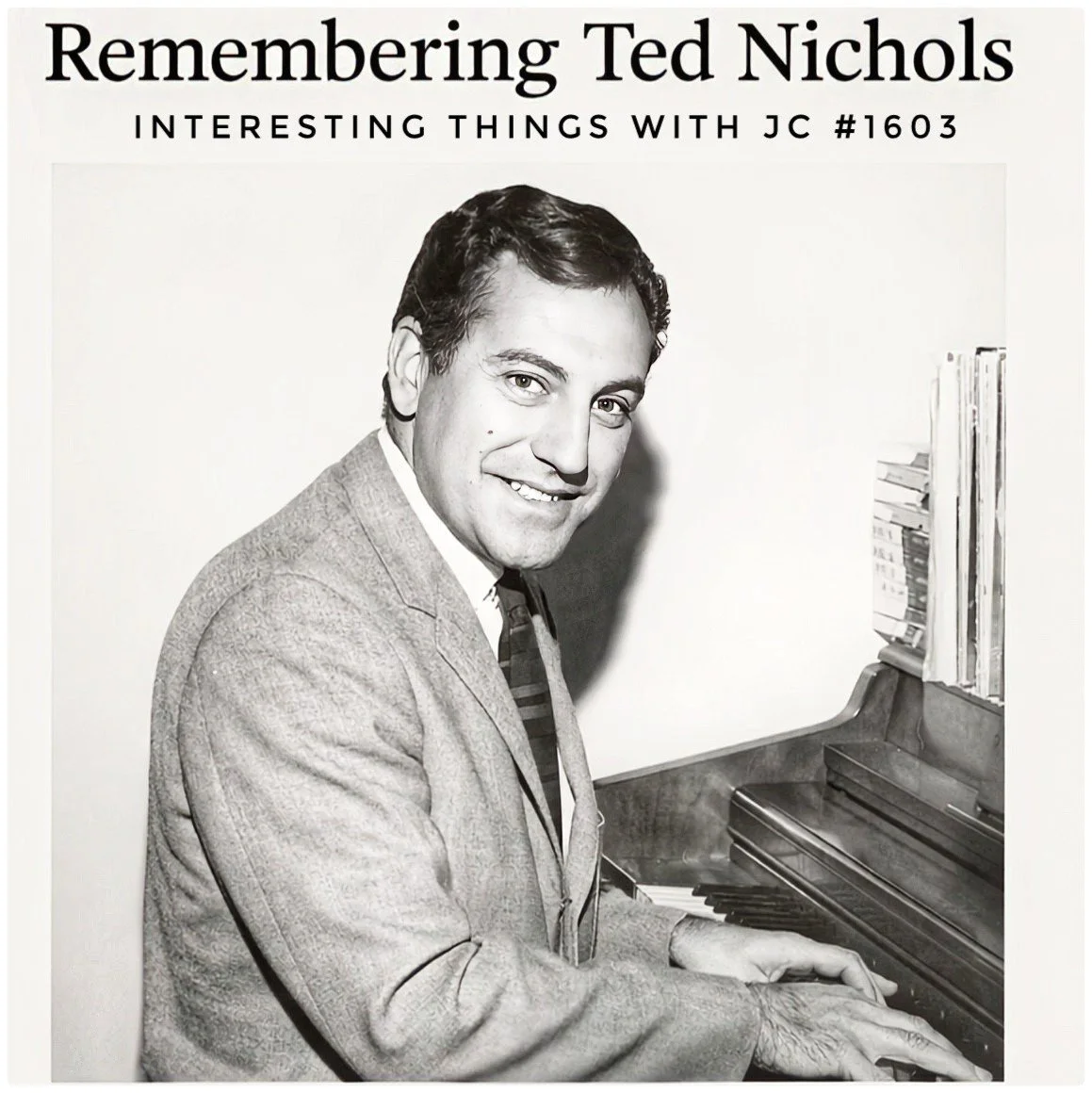
Promotional memorial image for Interesting Things with JC episode #1603 honoring Ted Nichols. The black-and-white design features the title “Remembering Ted Nichols” above a historic portrait of Nichols seated at a piano, wearing a suit and tie and looking toward the camera.
Transcript
Interesting Things with JC #1603: "Remembering Ted Nichols"
A man runs down a hallway. His foot slips. His body tilts forward, and at the exact instant he loses balance, a sharp burst of brass hits.
Not before. Not after.
Right on the fall.
It feels natural.
It isn’t.
Ted Nichols helped build that moment.
He was born Theodore Nicholas Sflotsos (SFLAHT-sos) on October 2, 1928, in Missoula, Montana, to a Greek immigrant father and an American-born mother. He grew up in Spokane, Washington, and began violin at age 10. In 1948, he changed his name to Ted Nichols, a practical move for professional work.
In 1946, he joined the United States Navy as an aviation electrician’s mate while also playing saxophone, violin, and clarinet in tightly disciplined swing bands where timing had to be exact.
During the Korean War era, he continued in the United States Air Force and became Commanding Officer of the Bandsmen Training School at Sampson Air Force Base in New York, recruiting musicians from Juilliard and the Eastman School of Music and training them for precision and consistency.
He was building control into music.
By 1963, he brought that discipline into Hanna-Barbera, a studio producing animated television at a pace that demanded efficiency. Episodes ran about 22 minutes, and full orchestral scoring for every scene was not practical.
So the studio relied on a cue system, and Nichols became a key figure refining and expanding it alongside Hoyt Curtin, later serving as musical director.
Instead of long compositions, he wrote short cues measured in seconds.
At 24 frames per second, three, five, and eight second cues equal 72, 120, and 192 frames, each designed to match movement exactly.
That system became part of the sound of Scooby Doo, Where Are You!, first broadcast in 1969.
In a chase sequence, a steady bass line sets motion, typically between about 120 and 160 beats per minute, while percussion locks the tempo and brass marks visible action with exact accents aligned to animation frames.
Strings signal tension in short bursts, and woodwinds follow character movement with quick runs.
Most cues are built in four bar phrases, with each phrase lasting just under seven seconds, allowing clean repetition and precise editing points so music can stop exactly when the scene changes.
The music follows the motion.
It is built to land on it.
Nichols applied this system across productions including The Flintstones, Space Ghost, Jonny Quest, Wacky Races, and the animated segments of The Banana Splits Adventure Hour, and in 1966 contributed to The Man Called Flintstone, a full-length animated feature.
Before and briefly overlapping his studio work, he also performed at Disneyland as a Dapper Dan.
In 1972, he left Hanna-Barbera and returned to composing operas, religious music, and serving in ministry.
He passed away January 9th, 2026, after a long battle with Alzheimer’s, in Auburn, Washington, at 97.
We remember him today.
These are interesting things, with JC.
Student Worksheet
Who was Ted Nichols, and why is he important to the history of animated television music?
How does the episode explain the relationship between music and visible action in animation?
Why did Hanna-Barbera rely on short cues instead of fully scoring every scene with long orchestral passages?
Describe one way Nichols’ military musical experience may have influenced his later studio work.
Creative prompt: Write a brief scene from an imaginary cartoon chase and explain what instruments, tempo, and accents you would use to score it.
Teacher Guide
Estimated Time
One 45–60 minute class period, or two 30-minute class periods
Pre-Teaching Vocabulary Strategy
Introduce cue, tempo, phrase, accent, and synchronization before playing or reading the episode. Have students clap a steady pulse, then add a hand motion on a teacher-selected “accent beat” to demonstrate how music can line up with action.
Anticipated Misconceptions
Students may assume music in cartoons is improvised after animation is finished; clarify that much of it is planned with timing needs in mind.
Students may think “background music” is unimportant; emphasize that it shapes tension, comedy, pacing, and viewer expectation.
Students may assume all Hanna-Barbera music was written by one person; explain that Hoyt Curtin, Ted Nichols, Jack de Mello, and others contributed within a recognizable studio sound.
Discussion Prompts
Why does precisely timed music feel “natural” even when it is carefully engineered?
How do budget and production limits sometimes lead to creative innovation?
What happens emotionally when sound lands exactly with movement?
How might an audience respond differently if the same scene had no music at all?
Differentiation Strategies: ESL, IEP, gifted
ESL: Provide a vocabulary sheet with phonetic spellings and one-sentence definitions; allow oral responses before written responses.
IEP: Break the listening or reading into sections and pair each section with a simple graphic organizer: person, problem, technique, impact.
Gifted: Ask students to compare Nichols’ cue-based approach with another composer from film or television and evaluate how production context changes musical decisions.
Extension Activities
Have students storyboard a 10-second animated action and mark where musical accents should fall.
Compare one Scooby-Doo chase with another animated sequence from a different decade and analyze differences in pacing and scoring.
Invite students to compose a short rhythmic cue using classroom instruments or digital audio software.
Cross-Curricular Connections
Physics: timing, motion, and pattern
History: postwar U.S. entertainment and television production
Music: orchestration, form, tempo, and phrase structure
Media literacy: how sound changes meaning in visual texts
Technology: digital editing and sound-image synchronization
Quiz
Q1. What was Ted Nichols’ birth name?
A. Theodore Nathan Sflotsos
B. Theodore Nicholas Sflotsos
C. Thomas Nicholas Sflotsos
D. Theodore Nichols Curtis
Answer: B
Q2. Which studio is most closely associated with Ted Nichols’ television scoring career?
A. Pixar
B. Warner Bros. Animation
C. Hanna-Barbera
D. DreamWorks
Answer: C
Q3. According to the episode, why were short musical cues especially useful in television animation?
A. They made all episodes longer
B. They allowed precise timing and efficient editing
C. They eliminated the need for musicians
D. They replaced dialogue
Answer: B
Q4. Which 1969 animated series is highlighted in the episode as an example of Nichols’ sound?
A. The Jetsons
B. Jonny Quest
C. Space Ghost
D. Scooby-Doo, Where Are You!
Answer: D
Q5. Before and briefly overlapping his studio work, Nichols also performed in which Disneyland group?
A. The Firehouse Five Plus Two
B. The Dapper Dans
C. The Main Street Marchers
D. The Golden Horseshoe Revue
Answer: B
Assessment
Open-Ended Question 1
Explain how Ted Nichols’ background in disciplined military music-making may have prepared him for scoring animated television.
Open-Ended Question 2
Analyze how short, precisely timed cues can influence audience understanding of action, comedy, or suspense in animation.
3–2–1 Rubric
3 = Accurate, complete, thoughtful; uses episode evidence and explains relationships clearly
2 = Partially accurate; includes some relevant detail but explanation is limited or uneven
1 = Inaccurate or vague; lacks supporting detail or misunderstands the episode
Standards Alignment
U.S. standards are prioritized below, with academically comparable international equivalents where they fit the episode’s focus on close reading, analysis, music interpretation, and media literacy.
CCSS.ELA-LITERACY.RI.11-12.3 — Students analyze a complex set of ideas and explain how specific details develop those ideas; this fits the episode’s explanation of how timing, cue length, and production constraints shaped Nichols’ work.
CCSS.ELA-LITERACY.RI.11-12.4 — Students determine the meaning and impact of domain-specific language; this aligns with terms such as cue, tempo, phrase, synchronization, and orchestration.
CCSS.ELA-LITERACY.WHST.11-12.2 — Students write informative texts that examine complex ideas clearly and accurately; this matches written analysis of how music functions in animation.
CCSS.ELA-LITERACY.SL.11-12.1 — Students initiate and participate effectively in collaborative discussions; this supports class discussion about music, motion, and television production choices.
C3 D2.His.1.9-12 — Students evaluate how historical developments were shaped by time, place, and broader context; this applies to postwar military training, studio television economics, and mid-century animation culture.
C3 D2.His.14.9-12 — Students analyze multiple and complex causes and effects in the past; this fits analysis of how limited budgets, production speed, and musical expertise influenced Hanna-Barbera’s cue system.
C3 D2.His.16.9-12 — Students integrate evidence from multiple relevant sources into a reasoned argument about the past; this supports research assignments on Nichols and television animation history.
ISTE 1.3.a — Students use effective research strategies to locate resources; this fits source-based inquiry on music history and animation.
ISTE 1.3.b — Students evaluate the accuracy, validity, bias, origin, and relevance of digital content; this is especially useful when students compare interviews, trade reporting, and historical summaries.
ISTE 1.3.c — Students curate information from digital resources to create meaningful conclusions; this aligns with collecting audio clips, notes, and production facts into a media analysis project.
NCAS MU:Pr4 / MU:Pr5 framework — National Core Arts Standards for music emphasize analyzing, interpreting, rehearsing, evaluating, and refining musical work; this episode supports students in studying how musical decisions communicate dramatic intent.
NCAS MU:Cr2.1.E.IIIa / MU:Cr3.1.E.IIIa — Advanced ensemble/composition pathways ask students to develop musical ideas for varied purposes and refine them using criteria; this fits student-created cue writing and revision tasks.
International academic equivalents
England National Curriculum / GCSE-A level music analytical study equivalent — Students analyze how musical elements and context shape meaning; this matches examination of tempo, instrumentation, and structure in animation scoring. Comparable emphasis appears in UK secondary music study focused on listening, analysis, and contextual understanding.
IB Diploma Programme Language and Literature / Music equivalent — Students interpret how form, audience, and context influence meaning across media; this aligns with reading the episode as both biography and media-analysis text. This is a respectful equivalency rather than a direct one-to-one code match.
Cambridge IGCSE / AS-Level style music analysis equivalent — Students listen analytically, describe musical features precisely, and connect structure to expressive purpose; this aligns with identifying how cues support action and mood. This is presented as a content-based equivalency for international educators.
Show Notes
This episode explores how Ted Nichols helped define the sound of Hanna-Barbera animation by using short, tightly timed musical cues that made movement feel immediate and natural. It connects his early life, military musical discipline, and later studio work to a broader classroom discussion about how sound shapes meaning in media. The topic matters today because students encounter synchronized audio-visual storytelling constantly in animation, film, gaming, and digital media, yet rarely stop to examine the craft that makes it work. By focusing on Nichols, the episode gives teachers a strong entry point into music analysis, media literacy, production history, and creative composition.
References
Nichols, T. (2026, January 9). [Death notice via daughter Karen Tolleshaug]. In D. S. Cohen, Ted Nichols, famed Hanna-Barbera composer on ‘The Flintstones’ and ‘Scooby-Doo,’ dies at 97. The Hollywood Reporter. https://www.hollywoodreporter.com/tv/tv-news/ted-nichols-dead-scooby-doo-flintstones-hanna-barbera-1236544041/
Cohen, D. S. (2026, March 23). Ted Nichols, famed Hanna-Barbera composer on ‘The Flintstones’ and ‘Scooby-Doo,’ dies at 97. The Hollywood Reporter. https://www.hollywoodreporter.com/tv/tv-news/ted-nichols-dead-scooby-doo-flintstones-hanna-barbera-1236544041/
Consequence Staff. (2026, March 23). Ted Nichols, composer for The Flintstones, Scooby-Doo, dead at 97. Consequence. https://consequence.net/2026/03/ted-nichols-composer-flintstones-scooby-doo-dead/
Animation World Network. (2026, March 23). Hanna-Barbera composer Ted Nichols dies at 97. https://www.awn.com/news/hanna-barbera-composer-ted-nichols-dies-97
Cartoon Research. (2026, March 16). Celebrating Ted Nichols and the Hanna-Barbera “house sound.” https://cartoonresearch.com/index.php/celebrating-ted-nichols-and-the-hanna-barbera-house-sound/
Cohen, D. S. (2026, March 23). The Hollywood Reporter. https://www.hollywoodreporter.com/tv/tv-news/ted-nichols-dead-scooby-doo-flintstones-hanna-barbera-1236544041/
Cartoon Research. (2026, March 16). Celebrating Ted Nichols and the Hanna-Barbera “house sound.” https://cartoonresearch.com/index.php/celebrating-ted-nichols-and-the-hanna-barbera-house-sound/
Consequence Staff. (2026, March 23). Ted Nichols, composer for The Flintstones, Scooby-Doo, dead at 97. Consequence. https://consequence.net/2026/03/ted-nichols-composer-flintstones-scooby-doo-dead/
Celebrations Press. (2020, April 27). The Dapper Dans of Main Street U.S.A. https://celebrationspress.com/2020/04/27/the-dapper-dans-of-main-steet-u-s-a/
Daveland. (n.d.). Daveland Dapper Dan photos. https://davelandweb.com/dapperdans/
Animation World Network. (2026, March 23). Hanna-Barbera composer Ted Nichols dies at 97. https://www.awn.com/news/hanna-barbera-composer-ted-nichols-dies-97
Cohen, D. S. (2026, March 23). The Hollywood Reporter. https://www.hollywoodreporter.com/tv/tv-news/ted-nichols-dead-scooby-doo-flintstones-hanna-barbera-1236544041/
Animation Magazine. (2026, March 23). Ted Nichols, Hanna-Barbera composer for ‘The Flintstones’ and ‘Scooby-Doo,’ dies at 97. https://www.animationmagazine.net/2026/03/ted-nichols-hanna-barbera-composer-for-the-flintstones-and-scooby-doo-dies-at-97/