
1604: "What Is Time Dilation?"
Interesting Things with JC #1604: "What Is Time Dilation?" – Two perfect clocks start together, then reality pulls them apart. Motion changes time. Gravity changes time. And once you see how, the universe feels far less stable than it did a moment ago.
Curriculum - Episode Anchor
Episode Title: What Is Time Dilation?
Episode Number: 1604
Host: JC
Audience: Grades 9–12, college intro, homeschool, lifelong learners
Subject Area: Physics, Astronomy, History of Science
Lesson Overview
Students examine how time dilation works in both special and general relativity, using atomic clocks, the Hafele–Keating experiment, and GPS as evidence. They distinguish between velocity-based and gravity-based time dilation, connect abstract equations to real technology, and evaluate the difference between experimentally confirmed physics and speculative cosmological ideas. Einstein’s relativity, atomic-clock measurements, GPS satellite timing corrections, and the Planck-time scale are all well documented by authoritative scientific sources.
Learning Objectives
Define time dilation and distinguish between special-relativistic and general-relativistic causes.
Compare how velocity and gravity affect the passage of time for different observers.
Analyze experimental evidence from atomic-clock tests and satellite navigation systems.
Explain why confirmed relativistic physics should be separated from speculative cosmological proposals.
Key Vocabulary
Time dilation (tyme dye-LAY-shuhn) — A difference in elapsed time measured by observers because of relative motion or gravity.
Example: GPS works only because engineers correct for time dilation.Relativity (rel-uh-TIV-ih-tee) — Einstein’s framework describing how space, time, motion, and gravity are related.
Example: Relativity shows that time is not the same for every observer.Lorentz factor (LOR-ents FAK-ter) — The mathematical factor used in special relativity to describe how time, length, and mass-related quantities change with speed.
Example: As speed approaches the speed of light, the Lorentz factor increases sharply.Atomic clock (uh-TOM-ik klok) — An extremely precise clock based on atomic transitions.
Example: Atomic clocks can reveal tiny relativistic differences of only nanoseconds.Gravitational field (grav-ih-TAY-shuh-nuhl feeld) — The influence a mass has on spacetime and on objects within it.
Example: Stronger gravitational fields make time pass more slowly.Event horizon (ih-VENT huh-RY-zuhn) — The boundary around a black hole beyond which light cannot escape.
Example: To a distant observer, processes near an event horizon appear to slow dramatically.Planck time (plahngk tyme) — A very small unit of time, about 5.39 × 10⁻⁴⁴ seconds, often used as a limit where current physics becomes incomplete.
Example: Physicists use Planck time when discussing the limits of present-day theories.
Narrative Core
Open – The story begins with a striking image: two atomic clocks can be synchronized with extraordinary precision, yet one placed on Earth and one in orbit will drift apart.
Info – The episode introduces Einstein’s 1905 special relativity and 1915 general relativity, explaining that both motion and gravity affect time.
Details – The key evidence includes the Lorentz factor, the 1971 Hafele–Keating aircraft experiment, GPS satellite clock corrections, and the stronger effects predicted near black holes. The episode also mentions Planck time and then shifts into a speculative cosmological proposal that is not experimentally confirmed.
Reflection – The broader meaning is that time is not a universal background ticking identically everywhere. It depends on conditions in spacetime, and that insight reshaped modern physics and modern technology.
Closing – These are interesting things, with JC.
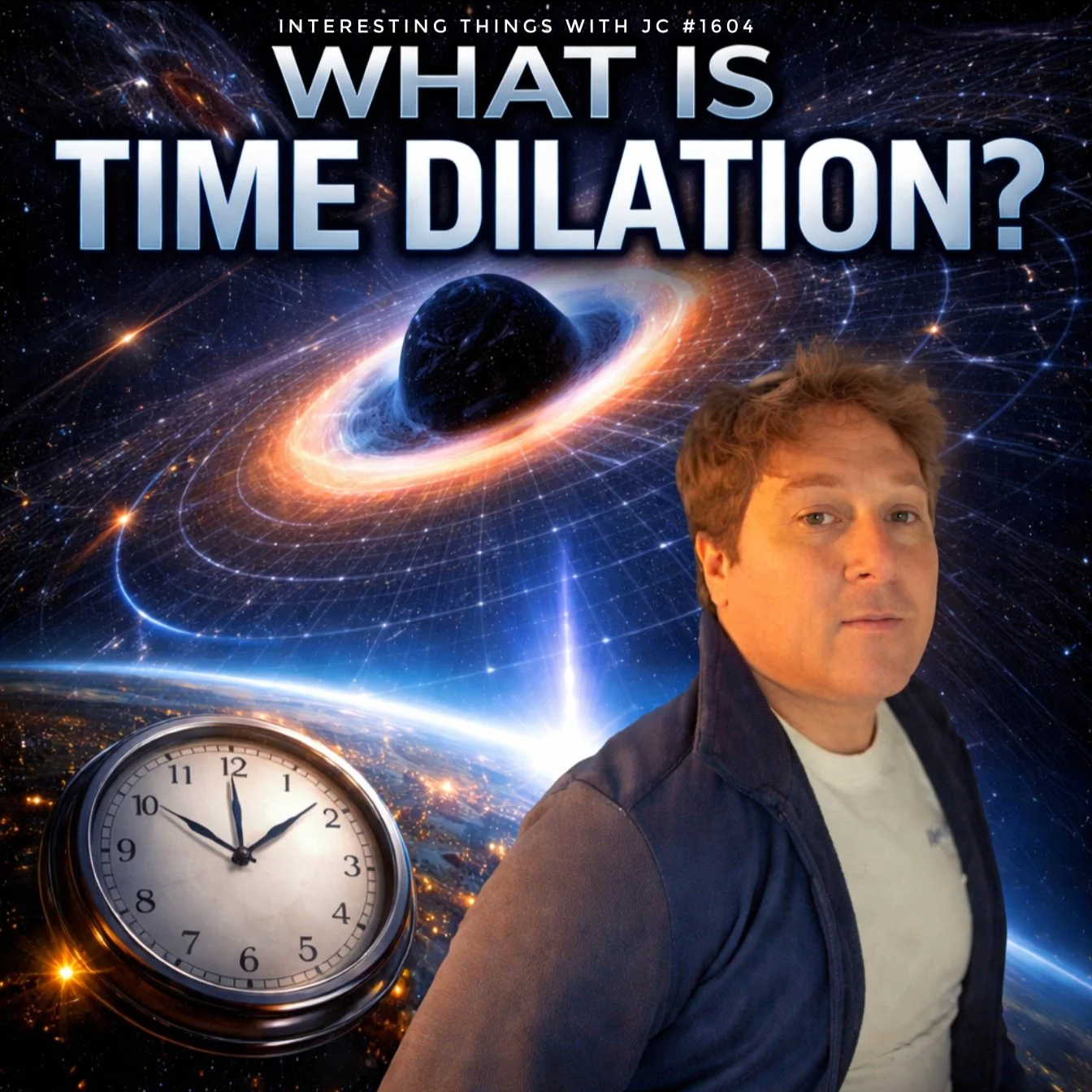
An artistic impression of “Nathan” (famous from TikTok) appears on the cover art for “Interesting Things with JC #1604: What Is Time Dilation?” surrounded by imagery of space, gravity, and time. This image is shared for non-commercial educational and commentary purposes under fair use.
Transcript
Interesting Things with JC #1604: "What Is Time Dilation?"
Two atomic clocks can be synchronized to within less than one second over 100 million years. Place one on Earth and another in orbit, and they will no longer agree.
In 1905, Albert Einstein defined special relativity. It established that time depends on relative velocity. In 1915, general relativity extended this framework by showing that gravitational fields alter the rate at which time passes. These effects are not theoretical approximations. They are quantified, measured, and applied.
Time dilation describes the difference in elapsed time between two observers due to velocity or gravity.
At low speeds, the effect is negligible. A vehicle traveling 60 miles per hour, or 97 kilometers per hour, produces a time difference on the order of nanoseconds over extended periods. As velocity approaches the speed of light, 186,282 miles per second, or 299,792 kilometers per second, the rate of time slows measurably for the moving system relative to a stationary observer.
This relationship is expressed in the Lorentz factor, derived in 1904 by Hendrik Lorentz. It defines how time scales with velocity. At 99 percent of light speed, time for the traveler passes at roughly one seventh the rate of a stationary observer.
Experimental confirmation followed.
In October 1971, physicists Joseph Hafele and Richard Keating placed cesium-beam atomic clocks aboard commercial aircraft. The flights circled Earth, covering approximately 25,000 miles, or 40,233 kilometers. Upon return, the airborne clocks differed from reference clocks at the United States Naval Observatory. Eastward flights lost about 59 nanoseconds. Westward flights gained about 273 nanoseconds. These results matched relativistic predictions within experimental error.
Gravity produces a separate, measurable effect.
According to general relativity, time passes more slowly in stronger gravitational fields. At Earth’s surface, gravitational acceleration is 32.2 feet per second squared, or 9.81 meters per second squared. At the altitude of Global Positioning System satellites, approximately 12,550 miles, or 20,200 kilometers, Earth’s gravitational influence is weaker.
As a result, satellite clocks gain approximately 45 microseconds per day due to reduced gravity, while losing about 7 microseconds per day due to orbital velocity. The net gain is 38 microseconds per day. Without correction, positional errors would accumulate at roughly 6 miles, or 10 kilometers, per day.
Stronger gravitational fields produce larger effects.
Near a non-rotating black hole, described by the Schwarzschild solution in 1916 by Karl Schwarzschild, time dilation increases rapidly as distance approaches the event horizon. At that boundary, the escape velocity equals the speed of light. From the perspective of a distant observer, processes near the horizon appear to slow toward zero.
Modern theoretical physics extends these principles further, while remaining anchored to the same equations.
In standard quantum field theory, time is typically treated as continuous, but some candidate theories of quantum gravity suggest that spacetime may not remain smooth or classical at extremely small scales. The Planck time, approximately 5.39 × 10⁻⁴⁴ seconds (Five point three nine times ten to the negative forty-four seconds), is a natural timescale derived from fundamental constants and is often taken as the scale where current theories are expected to break down without a theory of quantum gravity. Below about this scale, physicists expect that classical descriptions of spacetime may no longer be adequate.
Additional speculative frameworks attempt to reinterpret cosmic structure itself. One such proposal, sometimes described as inverted stellar cosmology, applies relativistic equations under alternative boundary conditions. In these models, large scale regions of spacetime are treated as interior gravitational systems, which can alter how time and distance are interpreted across cosmic scales. These ideas are not experimentally confirmed, but they rely on the same relativistic principles that govern time dilation.
If such configurations exist, the governing rule does not change. The rate at which time passes would still depend on velocity and gravitational potential. What would change is the frame of reference used to measure it.
Time dilation is therefore a measured property of spacetime. It is confirmed by atomic clock experiments, required for satellite navigation, and consistent with astronomical observation. It defines how time behaves under motion and gravity, and it remains one of the most precise predictions in modern physics.
These are interesting things, with JC.
Student Worksheet
What is the difference between time dilation caused by velocity and time dilation caused by gravity?
Why did the Hafele–Keating clocks show different results after eastward and westward flights?
How does GPS provide real-world evidence that relativity is correct?
Explain what the episode means when it says that time is a “measured property of spacetime.”
Why should students distinguish between experimentally confirmed relativity and speculative cosmological models?
Teacher Guide
Estimated Time
45–60 minutes
Pre-Teaching Vocabulary Strategy
Introduce relativity, atomic clock, gravitational field, and event horizon before listening. Have students build a two-column organizer labeled “motion” and “gravity” and place each term where it best fits.
Anticipated Misconceptions
Students may think time dilation is only a science-fiction idea rather than a measured effect.
Students may assume “time slows down” means people feel time stopping locally; in relativity, local time still feels normal to the observer.
Students may confuse special relativity with general relativity.
Students may treat speculative cosmology as equally confirmed with GPS-tested relativity; it is not. The Hafele–Keating results and GPS timing corrections are experimentally supported, while “inverted stellar cosmology” appears to be a speculative proposal rather than a mainstream, validated physical theory.
Discussion Prompts
Why is relativity often hard to notice in ordinary daily life?
What makes atomic clocks so important for testing scientific theories?
Why does modern navigation depend on Einstein’s equations?
How should scientists and students handle ideas that are mathematically interesting but not experimentally confirmed?
Differentiation Strategies: ESL, IEP, gifted
ESL: Pre-teach terms with visuals and sentence frames such as “Time dilation happens because…”.
IEP: Provide a guided note sheet and a cause/effect chart comparing velocity and gravity.
Gifted: Ask students to calculate the Lorentz factor at selected fractions of light speed and critique the speculative section of the episode using evidence standards.
Extension Activities
Research the Hafele–Keating experiment and summarize how its results supported relativity.
Build a short presentation on why GPS would fail without relativistic corrections.
Compare how black holes are described in popular media versus scientific explanations from NASA or NIST-linked sources.
Cross-Curricular Connections
Physics: motion, gravity, spacetime
Mathematics: proportional reasoning, scale, exponential growth in relativistic effects
History of Science: Einstein, Lorentz, Schwarzschild, twentieth-century physics
Technology: satellite navigation, precision timing, telecommunications
Quiz
Q1. What is time dilation?
A. A change in temperature caused by gravity
B. A difference in elapsed time due to motion or gravity
C. A slowing of all clocks everywhere
D. A flaw in atomic clocks
Answer: B
Q2. Which theory explains time differences caused by relative velocity?
A. Thermodynamics
B. Quantum mechanics
C. Special relativity
D. Plate tectonics
Answer: C
Q3. What happened in the Hafele–Keating experiment?
A. Telescopes measured black holes directly
B. Atomic clocks on airplanes differed from reference clocks after flying around Earth
C. GPS satellites stopped functioning
D. Einstein measured Planck time
Answer: B
Q4. Why do GPS satellites need relativistic corrections?
A. Their batteries weaken in orbit
B. Their clocks drift because of both speed and weaker gravity
C. Their radio signals cannot travel in space
D. Their clocks are less accurate than Earth clocks
Answer: B
Q5. Which statement best describes the episode’s speculative cosmology section?
A. It is required to explain GPS
B. It has been tested more thoroughly than relativity
C. It is a confirmed law of physics
D. It is not experimentally confirmed and should be treated cautiously
Answer: D
Assessment
Open-Ended Question 1
Explain how the Hafele–Keating experiment demonstrated time dilation.
Open-Ended Question 2
Describe why GPS satellites gain and lose time for different reasons, and explain why both corrections matter.
3–2–1 Rubric
3 = Accurate, complete, thoughtful
2 = Partial or missing detail
1 = Inaccurate or vague
Standards Alignment
NGSS
HS-PS2-4 — Use mathematical representations to support the claim that interactions with gravitational fields can be described and predicted. This connects to gravitational time dilation and satellite timing.
HS-ETS1-1 — Analyze a major global challenge to specify criteria and constraints for solutions. GPS timing shows how physics principles become engineering requirements.
Science and Engineering Practice: Analyzing and Interpreting Data — Students interpret measured atomic-clock outcomes and GPS correction data.
Crosscutting Concept: Scale, Proportion, and Quantity — Students examine why relativistic effects are tiny at everyday speeds but large at orbital or near-light speeds.
Common Core ELA Literacy
CCSS.ELA-LITERACY.RST.11-12.2 — Determine the central ideas of a scientific text and summarize complex concepts accurately.
CCSS.ELA-LITERACY.RST.11-12.4 — Determine the meaning of technical terms such as Lorentz factor, event horizon, and Planck time.
CCSS.ELA-LITERACY.RST.11-12.7 — Integrate and evaluate multiple sources of information presented in words and quantitative data.
CCSS.ELA-LITERACY.WHST.11-12.2 — Write informative explanations about a scientific process or concept.
Common Core Mathematics
CCSS.MATH.CONTENT.HSN.Q.A.1 — Use units to understand and solve problems involving measurements such as nanoseconds, microseconds, miles, and kilometers.
CCSS.MATH.CONTENT.HSF.BF.A.1 — Interpret functions that model changing quantities, including how time scales with speed.
CCSS.MATH.PRACTICE.MP2 — Reason abstractly and quantitatively with relativity-related numerical relationships.
C3 Framework for Social Studies
D2.His.1.9-12 — Evaluate how historical events and developments were shaped by scientific ideas. Students connect relativity to twentieth-century science history.
D2.His.16.9-12 — Integrate evidence from multiple historical sources to understand change over time in scientific thought.
ISTE Standards for Students
1.3 Knowledge Constructor — Students curate reliable scientific sources to explain relativity and GPS.
1.4 Innovative Designer — Students use scientific knowledge to understand real-world technological systems.
1.5 Computational Thinker — Students interpret numerical timing corrections and modeled physical effects.
CTE / STEM Career Readiness
STEM Career Cluster Standard 2 — Apply academic knowledge and technical skills in engineering and scientific contexts.
STEM Career Cluster Standard 6 — Demonstrate the ability to use technology and scientific reasoning to solve authentic problems.
International Equivalents
UK National Curriculum: Physics (Key Stage 4) — Space, motion, and gravity content aligns with analyzing how gravity affects systems and observations.
AQA GCSE Physics: Space physics / forces and motion connections — Supports interpretation of orbital systems and physical laws.
IB Diploma Programme Physics — Fits relativity, space, and nature-of-science discussions at introductory advanced secondary level.
Cambridge International AS & A Level Physics — Aligns with advanced treatment of motion, gravitation, and modern physics reasoning.
Show Notes
This episode explains time dilation as a real, measurable feature of spacetime rather than a fictional idea. It introduces special relativity and general relativity, shows how precise atomic clocks reveal tiny timing differences, and uses the 1971 Hafele–Keating aircraft experiment plus GPS satellite timing corrections as concrete evidence that motion and gravity both affect time. For classroom use, the topic matters because it connects abstract physics to familiar technologies, gives students a historically grounded example of scientific theory confirmed by experiment, and models the difference between established science and speculative cosmological interpretation. The core claims about atomic clocks, the aircraft experiment, GPS corrections, and Planck time are strongly supported by scientific sources. The “inverted stellar cosmology” portion should be presented as speculative rather than established physics.
References
Hafele, J. C., & Keating, R. E. (1972). Around-the-world atomic clocks: Predicted relativistic time gains. Science, 177(4044), 166–168. https://www.science.org/doi/10.1126/science.177.4044.166
Ashby, N. (2003). Relativity in the Global Positioning System. Living Reviews in Relativity, 6(1). https://pmc.ncbi.nlm.nih.gov/articles/PMC5253894/
National Institute of Standards and Technology. (2025, April 28). New atomic fountain clock joins elite group that keeps world time. https://www.nist.gov/news-events/news/2025/04/new-atomic-fountain-clock-joins-elite-group-keeps-world-time
Einstein, A. (1905). On the electrodynamics of moving bodies. Annalen der Physik, 17(10), 891–921. https://www.space.com/36273-theory-special-relativity.html (overview with historical context)
Einstein, A. (1915). The field equations of gravitation. Sitzungsberichte der Preussischen Akademie der Wissenschaften, 844–847. https://en.wikipedia.org/wiki/Theory_of_relativity (summary of 1905/1915 publications)
Planck time: t_P ≈ 5.39 × 10^{-44} s. (2024). In Wikipedia: Planck units. https://en.wikipedia.org/wiki/Planck_units
Schwarzschild, K. (1916). Über das Gravitationsfeld eines Massenpunktes nach der Einsteinschen Theorie. Sitzungsberichte der Königlich Preussischen Akademie der Wissenschaften, 189–196. https://jila.colorado.edu/~ajsh/bh/schwp.html (explanation of Schwarzschild geometry and time dilation at event horizon)
Lorentz factor at 0.99c yields γ ≈ 7.09 (time passes at ~1/7 rate for traveler). https://www.physicsoftheuniverse.com/topics_relativity_special.html
National Aeronautics and Space Administration. (2025, April 4). Black hole math. https://spacemath.gsfc.nasa.gov/SMBooks/BlackHoleMathV4.pdf
Reference: Structure-Correlated Weak Lensing Residual Test
A pre-registered sector-based analysis framework designed to evaluate whether structure-correlated anisotropy observed in supernova-inferred expansion rates appears in independent weak lensing shear measurements. This test is intended to distinguish between geometric effects and supernova-specific systematics.
Pre-Registered Sector Test for Structure-Correlated Weak Lensing Residuals
Objective
We report a structure-correlated anisotropy in low-redshift (z < 0.1) supernova-inferred expansion rates and propose a blinded, sector-based weak lensing test to determine whether the signal reflects a geometric effect or a supernova-specific systematic.
Background (Empirical Observation)
A regression of inferred H0 against line-of-sight integrated density contrast (X), derived from Cosmicflows-4, yields:
Slope: m ≈ -28 km/s/Mpc
Significance: 6.7 sigma
Intercept: H0_true ≈ 67.4 km/s/Mpc
This produces a directional pattern:
Underdense regions → H0 ≈ 73
Overdense regions → H0 ≈ 63
The signal remains stable under:
- sky randomization (RA/Dec shuffle)
- density field scrambling
- peculiar velocity corrections
Note: This observation is based on supernova distance measurements and requires independent geometric validation.
Pre-Registered Test Regions
Sector A (Void-prior)
RA: 53.0° | Dec: -33.0°
Radius: 12.5°
Expected: gamma_t < 0
Sector B (Overdensity-prior)
RA: 202.0° | Dec: -32.0°
Radius: 12.0°
Expected: gamma_t > 0
Method (Weak Lensing Proxy)
We compute a weighted mean shear per sector:
gamma_t ≈ <g1>_w
with bootstrap resampling to estimate uncertainty and empirical significance.
Sector geometry is pre-selected such that the preferred shear axis aligns with the coordinate frame; g1 acts as a first-order tangential proxy under isotropic orientation averaging.
Statistical Test
Sector Sign Test
Sector A: gamma_t < 0
Sector B: gamma_t > 0
Differential Separation
Delta_gamma_t = gamma_t_B - gamma_t_A
Bootstrap resampling is used to estimate:
- z_delta
- empirical p-value
Decision Criteria
If:
gamma_t_A < 0 AND gamma_t_B > 0 AND z_delta > 3
→ Evidence for structure-correlated lensing asymmetry
Else:
→ Consistent with non-geometric systematic in supernova measurements
Validation Status
The analysis pipeline, estimator, and decision criteria have been verified using simulated shear data. Application to real survey data is required for physical interpretation.
Deliverables
- Pre-registered sector masks
- Bootstrap-based shear estimator
- Two-panel evaluation figure:
- Sector error bars vs zero
- Delta_gamma_t bootstrap distribution
- SQL/data-access templates
Request
We request a residual lensing consistency check using DES Y6 or KiDS shear catalogs to evaluate whether gamma_t exhibits sign-consistent structure correlation across these pre-registered sectors.
