1605: "The Complexity of Midair Refueling"
Interesting Things with JC #1605: "The Complexity of Midair Refueling" – Two aircraft meet in unstable air at high speed, separated by feet and failure. Midair refueling is not just engineering. It is precision, pressure, and trust where even a single foot can break everything.
Curriculum - Episode Anchor
Episode Title: The Complexity of Midair Refueling
Episode Number: 1605
Host: JC
Audience: Grades 9–12, introductory college, homeschool learners, and lifelong learners
Subject Area: Aviation history, physics, engineering, military technology, technical literacy
Lesson Overview
This lesson uses the episode to examine why aerial refueling is one of the most demanding procedures in aviation. Students explore the history of the first successful midair refueling in 1923, compare the boom and probe-and-drogue systems, and analyze how forces, turbulence, positioning, and human training affect success in flight.
The topic also supports quantitative reasoning through fuel capacity, transfer rate, distance, and time calculations. Historically, the first successful U.S. aerial refueling took place over Rockwell Field near San Diego on June 27, 1923, and modern tanker systems can transfer fuel far faster than early hose methods.
Official U.S. Air Force sources list the KC-135 boom at about 1,100 gallons per minute and the F-35A’s internal fuel at 18,498 pounds, so the episode’s larger point about narrow margins, rapid fuel transfer, and operational dependence is sound.
Learning Objectives
Define aerial refueling and identify the major differences between boom refueling and probe-and-drogue refueling.
Compare how transfer rate, aircraft position, and pilot workload differ across the two main refueling systems.
Analyze how wake turbulence, closure speed, and small control inputs affect aircraft stability during refueling operations.
Explain why aerial refueling changes range, endurance, and mission planning for modern air forces.
Key Vocabulary
Aerial refueling — The transfer of fuel from one aircraft to another while both are in flight.
Boom — A rigid refueling tube controlled from the tanker.
Probe-and-drogue — A refueling method in which the receiving aircraft inserts a probe into a flexible basket trailing from the tanker.
Wake vortex — Rotating air behind a lifting aircraft that can upset another aircraft flying nearby.
Closure rate — The speed at which one aircraft approaches another relative to it.
Tanker — The aircraft carrying and transferring fuel to another aircraft.
Receiver — The aircraft taking fuel during an in-flight refueling operation.
Simulator — A training system that lets pilots practice complex operations without actual flight risk.
Narrative Core
Open: The episode opens with two aircraft flying at 30,000 feet only a few feet apart, immediately framing aerial refueling as a problem of precision, trust, and danger.
Info: The listener is given the historical origin point in 1923, when refueling was manual, exposed, and mechanically simple but extremely hazardous.
Details: The episode shifts into the technical challenge: boom versus probe-and-drogue, fuel flow rates, narrow positioning windows, wake turbulence, tiny closure speeds, aircraft fuel demand, and the training required before fuel can safely flow.
Reflection: The broader message is that aerial refueling is not just a machine problem. It is a human performance problem built on repetition, discipline, and trust, and it remains a strategic advantage only a limited number of countries can sustain at scale.
Closing: These are interesting things, with JC.
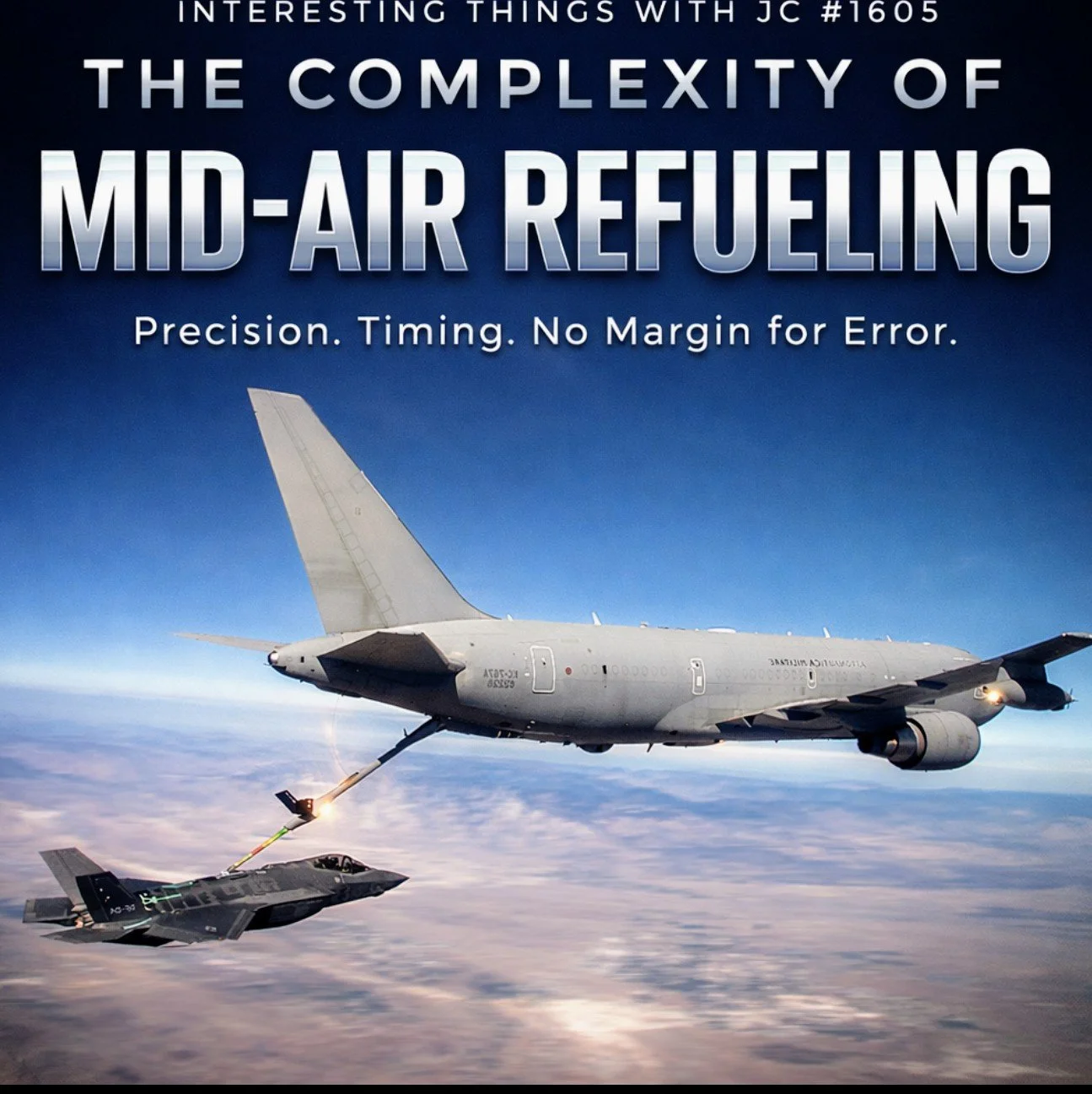
Promotional cover image for “Interesting Things with JC #1605: The Complexity of Mid-Air Refueling.” A large gray military tanker aircraft flies above a smaller dark fighter jet as the refueling boom connects them in midair over a blurred landscape. The background is a deep blue sky. Large white title text reads, “The Complexity of Mid-Air Refueling,” with smaller text above, “Interesting Things with JC #1605,” and below, “Precision. Timing. No Margin for Error.”
Transcript
Interesting Things with JC #1605: "The Complexity of Midair Refueling"
At 30,000 feet (9,144 meters), two aircraft close to within a few feet, sometimes less than 20 feet (6.1 meters). One carries fuel. The other depends on it. Every movement is controlled, steady, exact.
Aerial refueling began on June 27, 1923, when two U.S. Army Air Service De Havilland DH-4B aircraft flew over San Diego, California. A crewman in the receiving aircraft reached out and grabbed a hose lowered from above, transferring about 75 gallons (284 liters) of fuel at roughly 80 miles per hour (129 kilometers per hour). It was manual, exposed, and unforgiving. By the 1950s, jet aircraft pushed beyond 500 miles per hour (805 kilometers per hour), and refueling had to evolve.
The boom system uses a rigid tube controlled by an operator on a tanker such as the KC-135. Fuel can move at up to 1,200 gallons per minute (4,542 liters per minute), allowing large transfers quickly. The receiving aircraft must stay inside a narrow three-dimensional window only a few feet wide. The probe-and-drogue system uses a flexible hose with a basket. The pilot must guide a probe into that target as it shifts in the air. Flow rates are lower, often 400 to 600 gallons per minute (1,514 to 2,271 liters per minute), but multiple aircraft can refuel at once, and the system works well for carrier operations and allied forces.
The difficulty is in the air between them. Tankers produce wake vortices that roll and push trailing aircraft without warning. The receiver approaches at less than 5 knots (5.8 miles per hour or 9.3 kilometers per hour) of closure while both aircraft are already moving at high speed. Small inputs carry consequences. A shift of one foot (0.3 meters) can end the connection.
Modern fighters such as the F-35A carry about 18,250 pounds (8,278 kilograms) of fuel. Under heavy demand, that supply can be exhausted in under two hours. With refueling, range changes completely. During operations in 2001, long-range missions supported by tankers allowed aircraft to remain on station or travel distances that would otherwise be unreachable without multiple landings.
Training reflects the risk. Pilots start in simulators, then move to dry contacts before fuel ever flows. It takes repeated attempts to gain control. Even then, conditions such as weather, fatigue, and visibility add pressure. Tankers themselves are high-value aircraft and require protection in contested airspace, adding another layer of coordination.
Two aircraft, often exceeding 50,000 pounds (22,680 kilograms) for fighters and more than 300,000 pounds (136,078 kilograms) for tankers, hold position in unstable air. They rely on discipline, repetition, and trust built over time.
Fewer than 20 countries operate functional aerial refueling fleets, and only a handful can sustain it consistently. The United States maintains the largest tanker force in the world, with hundreds of aircraft supporting global operations. It is not just the ability to refuel in flight, it is the ability to do it anywhere, under pressure, with repeatable precision that sets the standard.
These are interesting things, with JC.
Student Worksheet
What problem does aerial refueling solve for military aircraft, and why is that important for range and mission time?
Describe one major difference between the boom system and the probe-and-drogue system.
Why do wake vortices make refueling more difficult for the receiving aircraft?
Based on the episode, why do pilots practice dry contacts before actual fuel transfer?
Creative response: Write a short paragraph from the perspective of a pilot moving into refueling position behind a tanker. Include at least three technical details from the episode.
Teacher Guide
Estimated Time
One 45–60 minute class period, or two shorter sessions if students complete the worksheet and quiz separately.
Pre-Teaching Vocabulary Strategy
Begin with a brief vocabulary sort. Ask students to group the terms into “aircraft parts,” “flight conditions,” and “training/operations.” Then have students predict which words describe machinery and which describe risk. This helps students build technical comprehension before listening or reading.
Anticipated Misconceptions
Students may assume aircraft are “flying together” easily because both are already stable in the air. In reality, turbulence and wake effects make the space behind the tanker highly unstable.
Students may think refueling is mainly automated. In practice, it still depends heavily on pilot control, positioning, and crew coordination.
Students may assume all systems work the same way. Boom and probe-and-drogue refueling place different demands on pilots and support different mission needs.
Students may assume many countries can perform this regularly. In reality, tanker capacity is concentrated in a relatively small number of states, with the United States far ahead by fleet size.
Discussion Prompts
Why does a task that looks simple from the ground become extremely difficult in the air?
Which matters more in aerial refueling: machine design or human skill? Defend your answer.
How does refueling change the meaning of “range” in military aviation?
What kinds of training habits build trust between tanker crews and receiver pilots?
Differentiation Strategies
For ESL: Provide a vocabulary bank with visuals for probe, drogue, boom, vortex, and closure rate. Allow oral responses before written responses.
For IEP: Break the lesson into shorter chunks; use a guided notes sheet with partially completed definitions and a labeled diagram.
For gifted learners: Ask students to compare design tradeoffs between faster transfer rates and easier multi-aircraft refueling, or to research autonomous refueling experiments.
Extension Activities
Calculate approximate refueling time if 6,000 gallons must be transferred by boom versus by a 400-gallon-per-minute drogue system.
Research how aerial refueling shaped long-range operations after September 11, 2001.
Create a labeled diagram showing tanker, receiver, boom, probe, drogue, and wake flow.
Cross-Curricular Connections
Physics: Forces, drag, turbulence, velocity, and relative motion
Engineering: Design constraints, system tradeoffs, redundancy, and operational safety
History: Development of aerial warfare logistics from 1923 to the jet age
Mathematics: Unit conversions, rates, time-distance relationships, and estimation
Technical writing: Clear explanation of procedures and systems
Quiz
Q1. What is the main purpose of aerial refueling?
A. To repair aircraft engines in flight
B. To increase range and endurance during missions
C. To improve radar range
D. To reduce aircraft weight
Answer: B
Q2. Which refueling method uses a rigid tube controlled from the tanker?
A. Probe-and-drogue
B. Glide-slope docking
C. Boom system
D. Rotor transfer
Answer: C
Q3. Why is wake turbulence a problem during refueling?
A. It cools the fuel too quickly
B. It can push or roll the receiver aircraft unexpectedly
C. It makes radio communication impossible
D. It causes the tanker to descend rapidly
Answer: B
Q4. Which statement is true of the probe-and-drogue method?
A. It always transfers more fuel per minute than a boom
B. It cannot be used by naval aircraft
C. It allows only one aircraft to refuel at a time
D. It can support multiple receivers and is widely used by naval and allied forces
Answer: D
Q5. Why do pilots begin with dry contacts in training?
A. To save money on fuel filters
B. To avoid flying near tankers
C. To practice positioning before fuel transfer begins
D. To reduce radio traffic
Answer: C
Assessment
Open-Ended Question 1
Explain why aerial refueling requires both technical system design and repeated human training. Use at least three details from the episode.
Open-Ended Question 2
Compare the boom system and the probe-and-drogue system. Which one seems more flexible for coalition operations, and which one seems better for rapid large-volume transfer? Support your answer with evidence.
3–2–1 Rubric
3 = Accurate, complete, thoughtful; uses multiple facts correctly and explains them clearly
2 = Partial or missing detail; shows basic understanding but leaves out important support
1 = Inaccurate or vague; includes major misunderstandings or too little evidence
Standards Alignment
U.S. Science and Engineering
NGSS HS-PS2-1 — Students analyze how force, mass, and acceleration relate; this fits the episode’s focus on relative motion, closure rate, and aircraft control in turbulent air.
NGSS HS-ETS1-3 — Students evaluate solutions to complex real-world problems; this aligns with comparing boom and probe-and-drogue as different engineering responses to the same operational challenge.
NGSS HS-ETS1-4 — Students use models and simulations to improve design solutions; this connects directly to simulator-based refueling practice and systems testing.
U.S. Literacy and Technical Reading
CCSS.ELA-LITERACY.RST.11-12.2 — Students determine central ideas and summarize complex technical information accurately.
CCSS.ELA-LITERACY.RST.11-12.7 — Students integrate information from text, quantitative data, and media.
CCSS.ELA-LITERACY.WHST.11-12.2 — Students write informative and explanatory texts about scientific or technical processes.
CCSS.MATH.CONTENT.HSN.Q.A.1 — Students use units to understand and solve multistep problems.
U.S. Social Studies and Inquiry
C3 D2.His.1.9-12 — Students evaluate how historical developments were shaped by time, place, and broader context.
C3 D2.His.14.9-12 — Students analyze multiple and complex causes and effects of events in the past.
C3 D3.1.9-12 — Students gather and evaluate sources for claims.
Technology and Digital Literacy
ISTE 1.3.b Knowledge Constructor — Students evaluate the accuracy, validity, bias, origin, and relevance of digital content.
ISTE 1.3.c Knowledge Constructor — Students curate information from digital resources using a variety of tools and methods.
ISTE 1.5.b Computational Thinker — Students collect or identify relevant data, use digital tools to analyze it, and represent it in useful ways.
International Academic Equivalents
England KS4 Science (Physics) — The National Curriculum emphasizes forces, evidence-based analysis, and quantitative evaluation, which aligns with studying turbulence, drag, and aircraft control.
AQA GCSE Physics 4.5 Forces — Students analyze resultant forces and motion, a strong match for understanding stability and position changes during refueling.
Cambridge IGCSE Physics 0625 — Students study speed, force, drag, work, and power, all directly relevant to refueling mechanics and operational constraints.
Show Notes
This episode introduces aerial refueling as a combination of aviation history, physics, engineering, and human precision. It begins with the first successful U.S. midair refueling over Rockwell Field near San Diego on June 27, 1923, then moves into the modern challenge of holding two aircraft in close formation while fuel transfers through either a boom or a probe-and-drogue system. For classroom use, the topic matters because it turns abstract concepts such as force, drag, turbulence, systems design, unit conversion, and procedural discipline into a vivid real-world case study. Official sources support the episode’s core ideas: the KC-135 boom transfers fuel at about 1,100 gallons per minute, the KC-46’s drogue systems transfer around 400 gallons per minute, wake vortices are a real hazard to following aircraft, and the United States still maintains by far the world’s largest tanker fleet. One number in the script is close but slightly understated: the U.S. Air Force currently lists the F-35A’s internal fuel capacity at 18,498 pounds rather than 18,250. Overall, the episode is highly usable in the classroom because it links historical innovation with modern operational science and technical reading.
References
This Day in Aviation. (2025, June 27). 27 June 1923. https://www.thisdayinaviation.com/27-june-1923/
Transportation History. (2024, June 27). 1923: A pair of planes and a rubber hose bring about a major mid-air milestone. https://transportationhistory.org/2024/06/27/1923-a-pair-of-planes-and-a-rubber-hose-bring-about-a-major-mid-air-milestone/
U.S. Air Force. (n.d.). 1923 -- The beginnings of inflight refueling. https://www.afhistory.af.mil/FAQs/Fact-Sheets/Article/458986/1923-the-beginnings-of-inflight-refueling/
U.S. Air Force. (n.d.). F-35A Lightning II. https://www.af.mil/About-Us/Fact-Sheets/Display/Article/478441/f-35a-lightning-ii/
U.S. Air Force. (n.d.). KC-135 Stratotanker. https://www.af.mil/About-Us/Fact-Sheets/Display/Article/1529736/kc-135-stratotanker/
Global Firepower. (2026). Tanker fleet strength by country. https://www.globalfirepower.com/aircraft-total-tanker-fleet.php
Aerospace Global News. (2025, October 19). Which countries have the biggest aerial tanker fleets? https://aerospaceglobalnews.com/news/biggest-aerial-tanker-fleets/
Wikipedia. (2026). Aerial refueling. https://en.wikipedia.org/wiki/Aerial_refueling
Vachon, M. J., et al. (2004). Calculated drag of an aerial refueling assembly. NASA. https://ntrs.nasa.gov/api/citations/20040013408/downloads/20040013408.pdf