1606: "Louise Fitzpatrick: The Only Student of Albert Pinkham Ryder"
Interesting Things with JC #1606: "Louise Fitzpatrick: The Only Student of Albert Pinkham Ryder" – Albert Pinkham Ryder never taught anyone else. But for Louise Fitzpatrick, he made one quiet exception, passing along not a method, but a way of seeing that lived in silence, patience, and a single worn easel.
Curriculum - Episode Anchor
Episode Title: Louise Fitzpatrick: The Only Student of Albert Pinkham Ryder
Episode Number: 1606
Host: JC
Audience: Grades 9–12, college intro, homeschool, lifelong learners
Subject Area: Art history, American history, visual culture, media literacy
Lesson Overview
Students use this episode to examine how artistic influence can move through observation, mentorship, materials, and personal relationships rather than formal schooling. The episode centers on Albert Pinkham Ryder, Louise Fitzpatrick, and the unusual transfer of artistic knowledge through one artist’s singular exception. Key historical details in the episode align with museum and archival records on Ryder, Fitzpatrick, the portrait, and the easel’s later provenance.
Define how informal artistic mentorship differs from formal classroom teaching and apprenticeship.
Compare what artists learn through direct instruction versus observation, access, and long-term proximity.
Analyze how Ryder’s slow, heavily reworked painting process shaped both his art and his legacy.
Explain why Louise Fitzpatrick matters in American art history even though her own work did not achieve broad fame.
Key Vocabulary
Mentor (MEN-tor) — A mentor is an experienced person who guides another; in this episode, Ryder becomes an unusual artistic mentor to Louise Fitzpatrick through access and observation rather than formal lessons.
Recluse (reh-KLOOSS) — A recluse is someone who lives in a withdrawn or private way; Ryder is described as avoiding much of the public art world.
Impasto (im-PAS-toh) — Impasto refers to paint laid on thickly so texture becomes visible on the surface.
Varnish (VAR-nish) — Varnish is a protective or glossy coating used in painting; Ryder’s layered surfaces are associated with unusual and unstable combinations of materials.
Provenance (PROV-uh-nuhns) — Provenance is the documented history of ownership of an object, such as Ryder’s easel passing through Fitzpatrick and the Evergood family.
Modernism (MOD-er-niz-um) — Modernism is a broad artistic movement that favored new forms and new ways of seeing; Ryder is often discussed as an important influence on early American modernism.
Observation (ob-zur-VAY-shun) — Observation is careful watching; Louise learned by watching Ryder work over long stretches of time.
Revision (rih-VIZH-un) — Revision means altering or reworking something; Ryder often returned to paintings repeatedly over many years.
Narrative Core (Based on the PSF – use renamed labels)
Open
The story begins with a contrast: many artists teach in classrooms, many never teach at all, but once in a lifetime an artist may break that pattern for only one person.
Info
Listeners are introduced to Albert Pinkham Ryder as a slow, intensely personal American painter born in New Bedford, Massachusetts, in 1847. His paintings were layered and often reworked for years, and he generally avoided the normal machinery of the art world.
Details
The key turn comes when Ryder allows Louise Fitzpatrick, an amateur painter and neighbor, into his studio. She watches him work, sometimes assists under his direction, paints his portrait, and eventually receives his easel. In Ryder’s final months, Louise and Charles Fitzpatrick care for him in their Long Island home. These details match surviving museum and archival references to Fitzpatrick as Ryder’s pupil or sole student and to the later path of the easel.
Reflection
The episode argues that influence is not always measured by fame, school size, or public acclaim. Sometimes knowledge is preserved through a single trusted relationship. That idea becomes tangible in the easel passed from Ryder to Fitzpatrick and later onward through artistic circles.
Closing
These are interesting things, with JC.
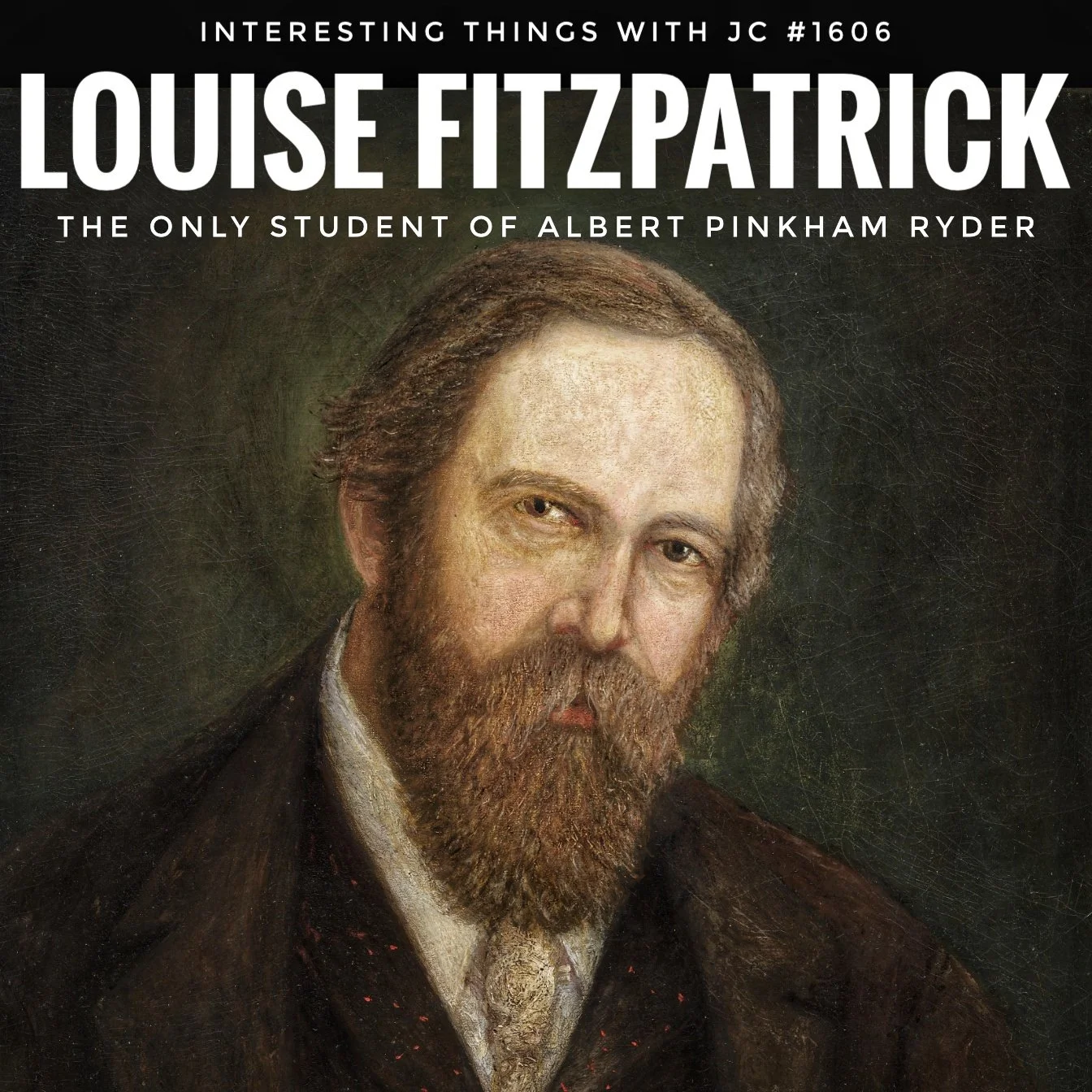
Promotional cover art for “Interesting Things with JC #1606” featuring a painted portrait of Albert Pinkham Ryder by Louise Fitzpatrick. Large white text reads “LOUISE FITZPATRICK” and “THE ONLY STUDENT OF ALBERT PINKHAM RYDER” above a dark-toned portrait of a bearded man facing slightly left.
Transcript
Interesting Things with JC #1606: "Louise Fitzpatrick: The Only Student of Albert Pinkham Ryder"
There are artists who teach in classrooms… and then there are artists who never teach at all.
And then, once in a lifetime, there’s someone who breaks that pattern for just one person.
In the late 1800s, Albert Pinkham Ryder had already become something uncommon in American art. Born in 1847 in New Bedford, Massachusetts, he worked at his own deliberate pace. A single painting could take years, sometimes decades. He built surfaces slowly, layering oil paint with varnish, resin, and sometimes wax or bitumen. The results were thick and moody, but often unstable. Many canvases cracked or shifted as they aged because he kept reworking them long after others would have stopped.
He didn’t chase recognition. He avoided galleries and crowds, living in New York City, largely outside the machinery of the art world. He never opened a school. Never trained apprentices.
Which makes what happened with his West 15th Street neighbors stand out.
Living nearby was Louise Fitzpatrick, an amateur painter born around 1833 and living into the 1930s, and her husband Charles, a former sailor. Over time, the couple became close to the reclusive artist through proximity and familiarity. Ryder, known for never teaching except for this one exception, allowed Louise into his studio in a way he allowed no one else.
What she received wasn’t formal instruction. There were no lessons, no critiques, no step-by-step method.
There was access and observation.
She watched him work in long silences: paint applied slowly, then scraped away, then left untouched for weeks or months before he returned. She saw how he trusted instinct and patience over any formula. At times, Ryder asked her to place specific colors onto his canvases, directing her hand while he controlled the outcome. A canvas might remain unresolved for months before being altered again.
She learned that time itself was part of the medium, that uncertainty wasn’t failure, it was the process.
Louise painted his portrait in oil, a direct likeness that now hangs in the collection of the National Portrait Gallery. Before his death in 1917, Ryder gave her his own easel, a worn, working object marked by years of use.
In his final months, as his health failed, Louise and Charles brought Ryder into their home on Long Island, about 50 miles from Manhattan. They cared for him daily, limited visitors, and maintained the conditions he preferred. Louise remained with him through the end.
She wasn’t just the only person who witnessed his technique. She became the one who carried it forward.
Ryder’s paintings would influence early American modernism, but most artists only saw the finished surfaces. Louise saw the decisions behind them: the repeated revisions, the acceptance that a painting might never fully settle, the years of layered work.
Her own paintings remained modest and never gained wide recognition. But her place in Ryder’s life reflects a different measure of influence.
One artist. One exception. One easel passed hand to hand.
That easel later moved from Louise to her friend Flora Evergood, for her son Philip, a painter influenced by Ryder’s work. It eventually made its way to the New Bedford Whaling Museum, not far from where Ryder was born.
In a world that counts success by numbers, students taught, works sold, audiences reached, this stands in the form of a single easel passed from one set of hands to another.
A transfer of knowledge that would otherwise have remained hidden.
A reminder that some of the most important things in art, and in life, are never meant for the crowd.
These are interesting things, with JC
Student Worksheet
Why is Louise Fitzpatrick described as an exception in Albert Pinkham Ryder’s life?
What does the episode suggest Louise learned by watching Ryder rather than through formal lessons?
How did Ryder’s painting process differ from a faster, more conventional studio practice?
Why does the easel matter as a historical object in this story?
Write 5–7 sentences explaining how this episode redefines the meaning of artistic influence.
Teacher Guide
Estimated Time
45–60 minutes
Pre-Teaching Vocabulary Strategy
Begin with a quick vocabulary sort. Ask students to place the words mentor, provenance, impasto, revision, and modernism into one of three categories: people and relationships, art materials and methods, or historical interpretation. Then have students explain why one word could fit more than one category.
Anticipated Misconceptions
Students may assume all important artists ran studios or taught classes.
Students may assume influence only counts when the student becomes famous.
Students may think a painting is completed in one short burst rather than over months or years.
Students may confuse “only student” with a formal school enrollment rather than a unique personal mentorship. Museum and archival language more often describes Fitzpatrick as Ryder’s pupil or sole student.
Discussion Prompts
Is observation a form of teaching? Why or why not?
What does the episode suggest about privacy, trust, and learning?
How does an ordinary object like an easel become historically important?
Should artistic legacy be measured by public fame, or by influence on later people and practices?
Differentiation Strategies: ESL, IEP, gifted
ESL: Provide a vocabulary chart with plain-language definitions and one image for each term.
IEP: Chunk the transcript into short sections and pair each with one guiding question.
Gifted: Ask students to compare this case with another artist-student relationship from art history and evaluate which kind of mentorship seems more transformative.
Extension Activities
Research another artist known for unusual working methods and compare that artist’s process with Ryder’s.
Create a timeline tracing the easel’s movement from Ryder to Fitzpatrick to the Evergood family to the museum.
Write a museum label for Louise Fitzpatrick that argues for her importance in American art history.
Cross-Curricular Connections
History: Urban artistic life in late nineteenth- and early twentieth-century America.
Chemistry: How layered paint materials can age, crack, and become unstable.
English Language Arts: Narrative voice, structure, and the use of contrast in nonfiction storytelling.
Media Literacy: How a short narrative builds authority through detail, pacing, and object-based storytelling.
Quiz
Q1. What made Louise Fitzpatrick unusual in Ryder’s life?
A. She bought most of his paintings
B. She was his only known student
C. She ran his gallery
D. She published his poems
Answer: B
Q2. How did Louise mainly learn from Ryder?
A. By attending weekly lectures
B. By reading his written manuals
C. By observing him work in the studio
D. By copying prints from museums
Answer: C
Q3. Which object symbolizes the transfer of artistic knowledge in the episode?
A. A sketchbook
B. A frame
C. A palette knife
D. An easel
Answer: D
Q4. What is one major characteristic of Ryder’s painting process in the episode?
A. He finished paintings in one day
B. He used strict formulas and routines
C. He revised paintings over long periods
D. He avoided textured surfaces
Answer: C
Q5. Where does Louise Fitzpatrick’s portrait of Ryder now reside?
A. The Museum of Modern Art
B. The National Portrait Gallery
C. The Whitney Museum
D. The Brooklyn Museum
Answer: B
Assessment
Open-Ended Question 1
Explain how this episode challenges the idea that teaching only happens in formal classrooms.
Open-Ended Question 2
Analyze why Louise Fitzpatrick remains historically significant even though she did not become widely famous.
3–2–1 Rubric
3 = Accurate, complete, thoughtful response with clear evidence from the episode
2 = Partially accurate response with some relevant detail but limited explanation
1 = Inaccurate, vague, or unsupported response
Standards Alignment
U.S. Standards
CCSS.ELA-LITERACY.RH.11-12.1
Students cite specific textual evidence when explaining Ryder’s artistic process and Fitzpatrick’s role in preserving his legacy.
CCSS.ELA-LITERACY.RH.11-12.2
Students determine the central ideas of a historical narrative and accurately summarize how informal mentorship shaped artistic transmission in this episode.
CCSS.ELA-LITERACY.RH.11-12.7
Students integrate spoken narrative, archival evidence, and museum documentation to answer questions about the episode’s claims.
C3 D2.His.1.9-12
Students evaluate how Ryder and Fitzpatrick’s relationship was shaped by time, place, artistic culture, and personal circumstance.
C3 D2.His.3.9-12
Students assess how the significance of Louise Fitzpatrick’s actions changes over time as later archives and museums preserve evidence of her connection to Ryder.
NCAS VA:Re7.1.IIa
Students analyze how artistic choices, materials, and process contribute to meaning in Ryder’s work and in the story told about it.
ISTE Student Standard 3: Knowledge Constructor
Students gather, evaluate, and organize information from multiple credible sources to build an evidence-based account of the episode topic.
International Equivalents
England National Curriculum: Art and Design
This lesson aligns with the expectation that art education should help learners think critically and develop a rigorous understanding of art and design through study of artists, methods, and meanings.
AQA GCSE Art and Design (8201) Subject Content
Students examine how artists develop ideas, respond to themes, and work across materials and processes, all of which connect to Ryder’s layered and revisional practice.
Cambridge IGCSE Art & Design (0400)
The episode supports learners in observation, analytical ability, critical understanding, and personal response to artworks and artistic process.
IB Diploma Programme Visual Arts
The lesson supports analytical thinking, technical understanding, and reflective engagement with how artists create meaning through process and interpretation.
Show Notes
This episode explores a rare and revealing relationship in American art history: the bond between Albert Pinkham Ryder and Louise Fitzpatrick. Rather than presenting art as something passed down through formal schools or public workshops, the story highlights a quieter model of learning based on trust, observation, patience, and shared time. That makes the episode highly useful in the classroom, where students can connect biography, material process, historical evidence, and questions of legacy. It also opens a strong discussion about how artistic knowledge survives, sometimes not through institutions, but through one person who was present closely enough to witness it. Several core details in the episode are supported by museum and archival records, including Fitzpatrick’s portrait of Ryder at the National Portrait Gallery, records describing her as Ryder’s pupil or sole student, and the documented passage of Ryder’s easel through Fitzpatrick and the Evergood family to the New Bedford Whaling Museum. Ryder’s importance to later American art, including early modernist painters, is likewise well attested by museum scholarship.
References
Archives of American Art, Smithsonian Institution. (n.d.). Albert Pinkham Ryder collection, 1869–1927. https://www.aaa.si.edu/collections/albert-pinkham-ryder-collection-8391
The Metropolitan Museum of Art. (n.d.). Marsden Hartley’s Maine. https://www.metmuseum.org/met-publications/marsden-hartleys-maine
The Metropolitan Museum of Art. (n.d.). American paintings in The Metropolitan Museum of Art, Vol. 3: A catalogue of works by artists born before 1865. https://www.metmuseum.org/met-publications/american-paintings-in-the-metropolitan-museum-of-art-vol-3-a-catalogue-of-works-by-artists-born-be
The Metropolitan Museum of Art. (n.d.). Albert Pinkham Ryder, by Marsden Hartley. https://www.metmuseum.org/art/collection/search/486010
Smithsonian Institution. (n.d.). Albert Pinkham Ryder. https://www.si.edu/object/albert-pinkham-ryder%3Anpg_NPG.83.1