1607: "Why Do You Itch?"
Interesting Things with JC #1607: "Why Do You Itch?" – It starts with nothing, then one precise spot demands everything. A signal rises, relief follows, and then it returns, because your body never assumes you are safe, even when there is nothing there at all. Today’s episode is inspired by Dr. Igo.
Curriculum - Episode Anchor
Episode Title: Why Do You Itch?
Episode Number: 1607
Host: JC
Audience: Grades 9–12, college intro, homeschool, lifelong learners
Subject Area: Biology, Human Physiology, Neuroscience, Health Literacy
Lesson Overview
Students explore how the human body detects itch, why scratching brings temporary relief, and how the nervous system and brain work together to interpret and respond to skin sensations. The episode supports biology instruction on sensory receptors, neural signaling, and feedback responses, while also strengthening scientific listening, explanation, and health-information literacy. The lesson aligns well with high school life science because itch involves interacting body systems, neural signaling, and stimulus-response mechanisms.
3–4 measurable learning objectives using action verbs:
Define itch as a protective sensory response triggered by physical or chemical stimulation of the skin and nervous system.
Compare itch and pain pathways by explaining why scratching can temporarily reduce the sensation of itching.
Analyze how histamine, sensory nerve fibers, the spinal cord, and the brain contribute to the experience of itch.
Explain why some itching can begin or intensify without a visible trigger, including the roles of stress, attention, and observed scratching.
Key Vocabulary
Itch (ich) — An irritating skin sensation that creates the urge to scratch; in this episode, itch is described as the body’s warning that something may be on the skin that should not be there.
Histamine (HISS-tuh-meen) — A chemical released by the body during immune responses, such as after a mosquito bite, that can activate itch-related nerve endings.
C-fibers (see FY-bers) — Small sensory nerve fibers that can carry itch signals from the skin toward the spinal cord and brain.
Spinal cord (SPY-nul kord) — The central nerve pathway that relays and processes signals between the body and the brain; itch signaling passes through it.
Serotonin (ser-uh-TOH-nin) — A signaling chemical that can influence itch pathways and help explain why itching may return after scratching.
GRPR neurons (G-R-P-R NYOO-rons) — Spinal nerve cells associated especially with itch transmission rather than general touch or pressure.
Sensory receptor (SEN-suh-ree ree-SEP-ter) — A specialized structure that detects changes such as touch, temperature, or chemicals and begins a nerve signal.
Stimulus (STIM-yuh-lus) — A change inside or outside the body that triggers a response, such as an insect bite, dry skin, or a brushing thread.
Narrative Core (Based on the PSF – use renamed labels)
Open – The episode begins with a familiar moment: a person sitting still when one exact spot suddenly starts to itch.
Info – It introduces the skin as a large sensory surface packed with detectors that notice pressure, movement, and chemical changes.
Details – The explanation traces itch from skin triggers to C-fibers, the spinal cord, the brain, histamine release, scratching, serotonin, and GRPR neurons.
Reflection – The episode expands the idea by explaining that itch can also be intensified by attention, stress, or even seeing someone else scratch, showing that the sensation is both physical and neurological.
Closing – These are interesting things, with JC.
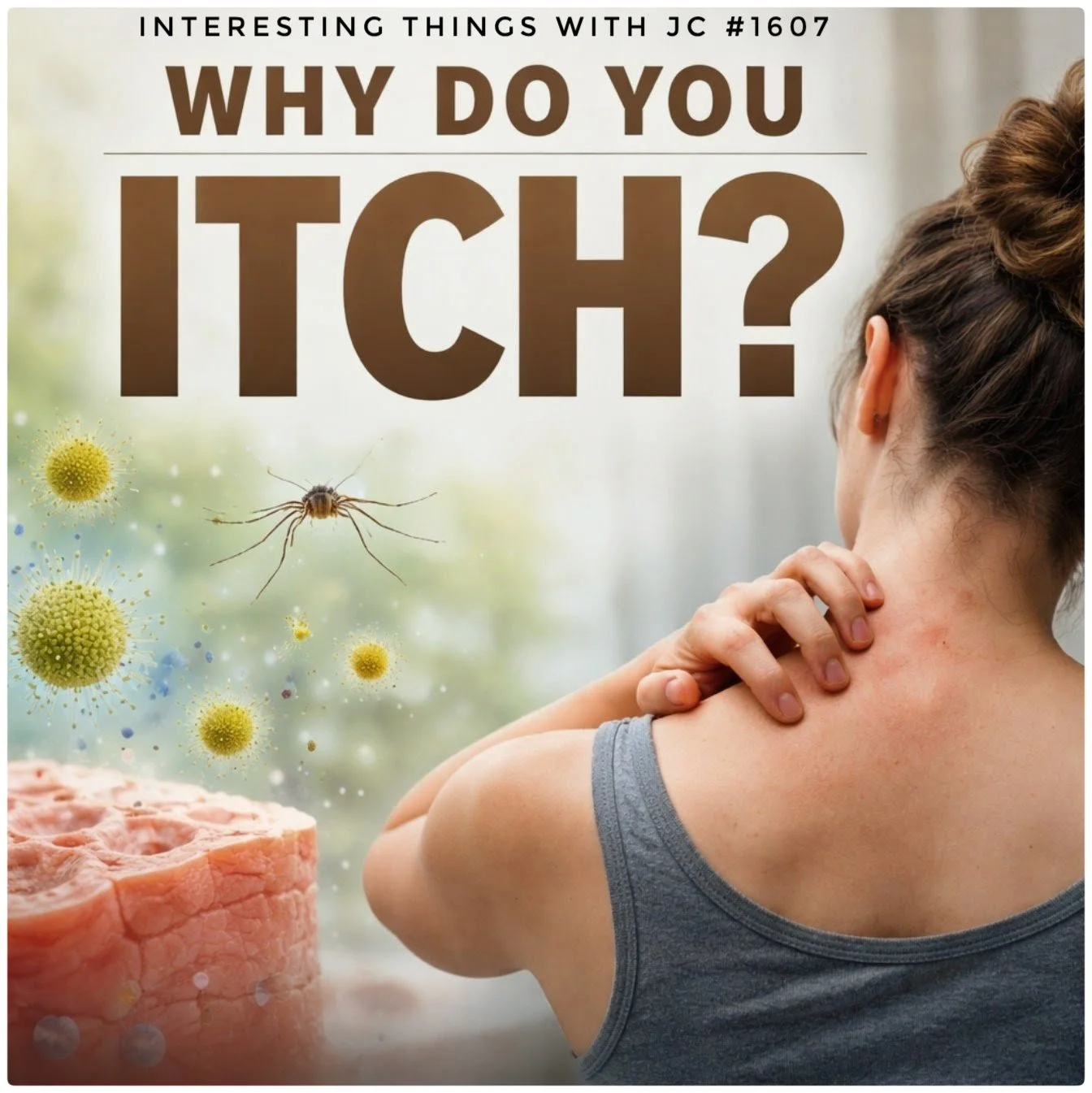
Poster for “Interesting Things with JC #1607: Why Do You Itch?” showing a person scratching the back of their neck, with a mosquito, floating allergen-like particles, and a close-up skin graphic.
Transcript
Interesting Things with JC #1607: "Why Do You Itch?"
You itch because your body thinks something is on your skin that shouldn’t be there.
You know the moment. You’re sitting still, doing nothing at all, when one exact spot suddenly demands your attention. Nothing obvious caused it. Yet your hand moves anyway.
Your skin covers about 20 square feet, roughly 2 square meters, filled with tiny sensors that detect even the slightest movement, pressure, or chemical change. When something disturbs that surface, it activates specialized C-fibers that carry the itch signal to your brain.
That signal travels up your spinal cord and maps to one precise spot. That’s why it always feels like it’s right in one spot.
Most of the time, a small trigger sets it off. A mosquito bite introduces saliva. Your body releases histamine. Nearby nerve endings activate. But it doesn’t take much. Dry skin can do it. A loose thread brushing your arm can do it. Even a single hair shifting slightly can trigger the response.
When you scratch, it brings relief. What you’re really doing is creating a mild pain signal. Pain travels faster than itch, so your brain shifts its attention and the itch fades for a moment.
Then the system resets.
Your brain releases serotonin, which can reactivate the itch pathway in the spinal cord through a specific set of nerve cells. These cells, known as GRPR neurons, are built almost entirely to carry itch signals, not pain or pressure. Once activated, they keep the message moving forward. That’s why the sensation can return or even spread with nothing new happening on your skin.
And sometimes, nothing triggered it at all.
The same pathway can begin in the brain itself. Stress can heighten sensitivity. Intense focus can amplify small sensations. Even watching someone else scratch can activate the same brain regions, so you feel the itch just by seeing it.
This system has protected humans for a very long time. That persistent signal once warned of an insect biting, a parasite attaching, or something that could lead to infection.
So you sit there, doing nothing, and one spot lights up anyway, not because something is there, but because your body decided it was worth checking.
Most of the time, there is nothing there.
But your body never assumes that.
These are interesting things, with JC.
Student Worksheet
In your own words, explain why the body produces the sensation of itch.
What role does histamine play after a mosquito bite?
Why can scratching reduce itch temporarily even though it does not remove the cause?
How do GRPR neurons help explain why an itch can return or spread?
Write a short paragraph describing a time when attention, stress, or seeing someone else scratch seemed to make you notice an itch more.
Teacher Guide
Estimated Time
30–45 minutes
Pre-Teaching Vocabulary Strategy
Begin with a quick sort using the terms itch, histamine, sensory receptor, spinal cord, and serotonin. Ask students to place each term into one of three categories: body structure, body chemical, or body response. Then revisit the sort after the episode and revise as needed.
Anticipated Misconceptions
Students may think itching always means there is something visible on the skin. In fact, itch can be triggered by subtle chemical or mechanical changes, and sometimes by central nervous system processing alone.
Students may think scratching solves the problem. Scratching usually interrupts itch briefly by adding competing pain-related input, but it does not necessarily remove the original trigger.
Students may assume itch and pain are the same sensation. They are related but distinct sensory pathways with overlapping interactions.
Discussion Prompts
Why would the body evolve a system that bothers us even when nothing dangerous is present?
How does this episode show that the brain does not simply “receive” sensations, but also shapes them?
When is an itch useful, and when might it become misleading?
What does this topic reveal about the relationship between perception and survival?
Differentiation Strategies: ESL, IEP, gifted
ESL: Provide a labeled diagram of skin, sensory neuron, spinal cord, and brain; pair vocabulary with visuals and sentence stems such as “Itch begins when…”
IEP: Chunk the transcript into short sections, read aloud, and provide guided notes with partially completed cause-and-effect chains.
Gifted: Ask students to compare itch as an adaptive response with other protective reflexes, or evaluate how chronic itch might affect quality of life and medical treatment. (PMC)
Extension Activities
Create a flowchart showing the path from skin stimulus to brain response to scratching.
Research the difference between acute itch and chronic itch using reliable medical or scientific sources.
Design a classroom infographic explaining why “seeing someone scratch” can make another person feel itchy.
Cross-Curricular Connections:
Biology: nervous system signaling and sensory receptors
Psychology: attention, perception, and suggestion
Health: reliable interpretation of body symptoms and health information
ELA: explanatory writing using scientific evidence
Media Literacy: evaluating the quality of science communication and medical claims
Quiz
Q1. What is the main reason the body creates an itch sensation?
A. To improve blood circulation
B. To warn that something may be irritating the skin
C. To relax muscles
D. To cool the skin
Answer: B
Q2. Which chemical mentioned in the episode is commonly released during reactions such as a mosquito bite?
A. Insulin
B. Dopamine
C. Histamine
D. Melanin
Answer: C
Q3. Why does scratching often reduce itch temporarily?
A. It removes all nerve endings
B. It creates a mild pain signal that competes with itch
C. It stops the brain from working
D. It lowers body temperature
Answer: B
Q4. What are GRPR neurons mainly associated with?
A. Vision
B. Balance
C. Itch signaling
D. Muscle growth
Answer: C
Q5. According to the episode, which situation can sometimes trigger or intensify itch even without a skin irritant?
A. Drinking water
B. Sleeping deeply
C. Watching someone else scratch
D. Wearing shoes
Answer: C
Assessment
2 open-ended questions
Explain the full pathway of an itch sensation from trigger to brain response, using at least three scientific terms from the lesson.
Describe why itch can be considered both protective and imperfect. Use evidence from the episode.
Include a 3–2–1 rubric:
3 = Accurate, complete, thoughtful
2 = Partial or missing detail
1 = Inaccurate or vague
Standards Alignment
NGSS
HS-LS1-2 — Students can model how interacting systems in multicellular organisms perform specific functions. This episode fits because skin receptors, peripheral nerves, the spinal cord, and the brain work together in a coordinated response to neural stimuli.
HS-LS1-3 — Students can examine feedback mechanisms that help maintain function in organisms. The scratch-relief-reset cycle offers a clear entry point for discussing how body signaling systems can regulate sensation, even if imperfectly.
Common Core State Standards for Literacy in Science and Technical Subjects
CCSS.ELA-Literacy.RST.9-10.1 — Students cite specific textual evidence to support analysis of science texts. They can cite details from the transcript to explain itch mechanisms.
CCSS.ELA-Literacy.RST.9-10.2 — Students determine central ideas of a science text and summarize accurately. This aligns with identifying the main claim that itch is a protective signal rather than random annoyance.
CCSS.ELA-Literacy.RST.11-12.4 — Students determine the meaning of symbols, terms, and domain-specific vocabulary. This lesson asks learners to use terms such as histamine, serotonin, and GRPR neurons accurately.
ISTE Standards for Students
1.3 Knowledge Constructor — Students can gather and evaluate scientific information about the body, compare sources, and build an evidence-based explanation of itch.
1.6 Creative Communicator — Students can express scientific understanding through infographics, diagrams, or explanatory media based on the episode.
National Health Education Standards
3.12.3 — Students evaluate the validity, reliability, and accessibility of health information, products, and other resources. This applies when students distinguish accurate itch science from myths or misinformation.
3.12.4 — Students use valid and reliable sources of health information, products, and other resources. This lesson encourages students to support claims with trustworthy scientific or medical sources.
International Academic Equivalents
AQA GCSE Biology: Homeostasis and Response — This topic includes the structure and function of the nervous system and how it brings about fast responses, making it a strong content match for a lesson on sensory detection and response.
IB Biology (Guide 2025), C3.1.5–C3.1.7 — These expectations address the spinal cord as an integrating center and sensory neurons carrying signals to the central nervous system, which directly supports the lesson’s explanation of itch signaling.
Show Notes
This episode explains itch as a protective sensory warning system rather than a random annoyance. It connects everyday experiences such as mosquito bites, dry skin, and even the feeling of itching after watching someone else scratch to real biological mechanisms involving skin receptors, specialized sensory nerve fibers, spinal signaling, histamine, and brain processing. In the classroom, this topic matters because it helps students understand how the nervous system interprets stimuli, why perception is not always a perfect reflection of reality, and how scientific explanations can deepen understanding of ordinary human experiences. The science in the episode is broadly consistent with current research showing that itch involves specialized neural circuits, including GRPR-linked spinal pathways, and that scratching can suppress itch temporarily through competing sensory input.
References
Dong, X., & Dong, X. (2018). Peripheral and central mechanisms of itch. Annual Review of Neuroscience, 41, 379–399. https://pmc.ncbi.nlm.nih.gov/articles/PMC6022762/
Prajapati, J. N., et al. (2024). Neural pathways that compel us to scratch an itch. Cell, 187(20), 5511–5528. https://pmc.ncbi.nlm.nih.gov/articles/PMC7617712/
Holle, H., Warne, K., Seth, A. K., Critchley, H. D., & Ward, J. (2012). Neural basis of contagious itch and why some people are more prone to it. Proceedings of the National Academy of Sciences, 109(48), 19816–19821. https://www.pnas.org/doi/10.1073/pnas.1216160109
National Center for Biotechnology Information. (2025). In brief: How does skin work? https://www.ncbi.nlm.nih.gov/books/NBK279255/
Papoiu, A. D. P., Nattkemper, L. A., Sanders, K. M., Kraft, R. A., Chan, Y. H., Coghill, R. C., & Yosipovitch, G. (2011). Contagious itch in humans: A study of visual “transmission” of itch in atopic dermatitis and healthy subjects. British Journal of Dermatology, 165(2), 273–281. https://pmc.ncbi.nlm.nih.gov/articles/PMC3110738/
Schmelz, M., Schmidt, R., Bickel, A., Handwerker, H. O., & Torebjörk, H. E. (1997). Specific C-receptors for itch in human skin. The Journal of Neuroscience, 17(20), 8003–8008. https://www.jneurosci.org/content/17/20/8003
Sun, Y.-G., & Chen, Z.-F. (2007). A gastrin-releasing peptide receptor mediates the itch sensation in the spinal cord. Nature, 448(7154), 700–703. https://www.nature.com/articles/nature06029
Yosipovitch, G. (2016, May 1). Why we itch. Scientific American. https://www.scientificamerican.com/article/why-we-itch/
Zhao, Z.-Q., Liu, X.-Y., Jeffry, J., Karunarathne, W. K., Li, J. L., Munanairi, A., Zhou, X.-Y., Li, H., Sun, Y.-G., Wan, L., Wu, Z.-Y., Kim, S., Huo, F.-Q., Mo, P., Barry, D. M., Zhang, S., Kim, C. H., & Chen, Z.-F. (2014). Descending control of itch transmission by the serotonergic system via 5-HT1A facilitating GRP-GRPR signaling. Neuron, 84(4), 821–834. https://www.cell.com/neuron/fulltext/S0896-6273(14)00901-5