1608: "Inside a Patriot Battery"
Interesting Things with JC #1608: "Inside a Patriot Battery" – When seconds decide everything, there is no room for instinct. Inside a Patriot battery, precision is not a preference.
Curriculum - Episode Anchor
Episode Title: Inside a Patriot Battery
Episode Number: 1608
Host: JC
Audience: Grades 9–12, college intro, homeschool, lifelong learners
Subject Area: Military technology, engineering systems, career and technical education, informational literacy
Framework structured in accordance with the uploaded reusable curriculum prompt.
Lesson Overview
Students examine how a Patriot battery operates as a coordinated defense system rather than a single machine. The episode emphasizes procedure, timing, technical specialization, readiness, and the human decision-making required to operate a complex air and missile defense network. Historically, Patriot batteries have included a phased-array radar, engagement control station, power generation equipment, and multiple launchers; Army historical references also note that three soldiers in the engagement control station can operate the battery in combat, while reload and emplacement training are repeatedly evaluated under formal readiness standards.
3–4 measurable learning objectives using action verbs:
Define the major components of a Patriot battery and explain how those parts function together as an integrated system.
Compare the roles of operators, maintenance crews, and reload teams in sustaining readiness under time pressure.
Analyze how procedure, sequencing, and human confirmation affect outcomes in high-stakes technical environments.
Explain how training, certification, and maintenance contribute to the real-world effectiveness of complex defense technology.
Key Vocabulary
Patriot battery (PAY-tree-uht BAT-uh-ree) — A Patriot battery is a complete firing unit made up of radar, control, power, and launcher elements working together.
Engagement Control Station (en-GAYJ-muhnt kuhn-TROHL STAY-shuhn) — The ECS is the control hub where operators monitor tracks and make engagement decisions.
Emplacement (em-PLACE-muhnt) — Emplacement is the process of positioning and setting up equipment correctly for operation.
Phased-array radar (fayzd uh-RAY RAY-dar) — A phased-array radar scans and tracks targets electronically rather than by mechanically turning a dish.
Trajectory (truh-JEK-tuh-ree) — Trajectory refers to the path an object follows through space.
Gunnery certification (GUHN-uh-ree sur-tuh-fuh-KAY-shuhn) — A formal evaluation in which crews are tested on weapon-system procedures and readiness tasks.
Diagnostics (dy-ug-NOS-tiks) — Diagnostics are tests used to detect faults or performance problems in equipment.
Data link (DAY-tuh link) — A data link is a communication connection that allows systems to share operational information.
Narrative Core
Open
The episode opens by rejecting the idea of instinct and replacing it with procedure, training, and precision. That framing immediately tells listeners that the story is about disciplined systems thinking under pressure.
Info
Listeners are introduced to the Patriot missile system as a network of interconnected parts: radar, launchers, power, antennas, and the Engagement Control Station. The script also explains the basic responsibilities of ECS personnel and the speed of the threats they may face.
Details
The key turn is that the technology only works when every earlier step has already been done correctly. Emplacement, leveling, cable connections, certifications, preventive maintenance, and reload procedures all determine whether the battery can function when a real threat appears.
Reflection
The broader meaning is that high-stakes systems depend on trained people who can perform exact procedures under pressure. The episode shows that readiness is built long before combat, through repetition, testing, and technical discipline.
Closing
These are interesting things, with JC.
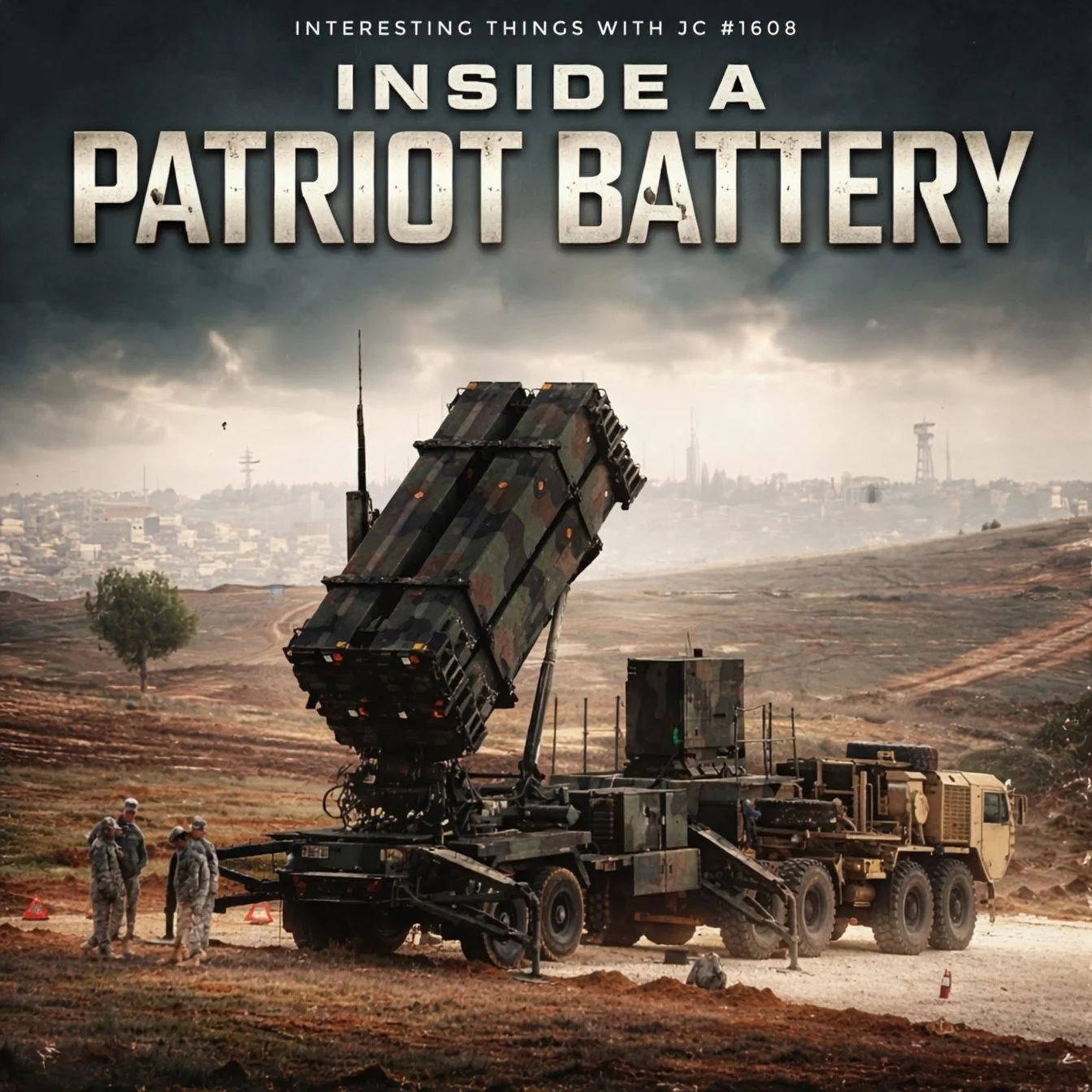
This image is a podcast cover for the episode “Interesting Things with JC #1608: Inside a Patriot Battery.” The background shows a wide outdoor landscape with a military vehicle and a raised Patriot missile launcher positioned on rough ground. Several uniformed service members stand near the launcher on the left side of the image. The sky is overcast and dramatic, creating a serious, high-stakes atmosphere. In the distance, a city skyline is visible. Large bold text at the top reads, “INTERESTING THINGS WITH JC #1608” and “INSIDE A PATRIOT BATTERY.”
Transcript
Interesting Things with JC #1608: "Inside a Patriot Battery"
A Patriot battery doesn’t run on instinct. It runs on procedure, training, and precision. Every action is defined. Every step has a sequence. Because once that system is up, there’s no time to figure anything out.
The Patriot missile system, the MIM-104, has been in service since 1981. A single battery is not one piece of equipment. It’s a network. Radar, launchers, power generation units, antenna systems, and the control station, all spread out and connected. Each launcher can carry four missiles, each about 17 feet long, 5.2 meters, and weighing close to 2,000 pounds, 907 kilograms.
At the center is the Engagement Control Station, the ECS. Inside, usually three soldiers operate the system. The Tactical Control Officer makes engagement decisions. The Tactical Control Assistant verifies and supports those decisions. The communications operator maintains the data link to higher command and adjacent units.
They are managing a live air picture built from radar returns, identification systems, and external data feeds. Tracks appear, change speed, change altitude, and shift direction in real time. Some are friendly. Some are unknown. Some are threats.
A ballistic missile can travel over 3,800 miles per hour, 6,100 kilometers per hour. That means from detection to impact, the window to act can be measured in seconds to a few minutes depending on range.
That timeline is why everything behind the scenes has to be exact.
Before a Patriot system can operate, the battery has to be emplaced correctly. The radar, weighing over 90,000 pounds, 40,800 kilograms, must be leveled within strict tolerances. Launchers must be positioned with clear fields of fire and proper spacing. Power units must deliver stable output continuously. The system relies on cables running hundreds of feet, over 100 meters, linking every component.
Each connection carries data or power. A single fault can break communication between systems or degrade performance.
Crews don’t just train this. They are tested on it, repeatedly.
They run formal gunnery certifications where entire crews are graded on simulated combat scenarios. Targets appear, timelines compress, and decisions are tracked step by step. If identification is wrong, it fails. If engagement procedures are out of sequence, it fails. If timing is off, it fails.
There is no partial credit.
These evaluations are not one-time events. Crews cycle through them, and standards don’t drop. Operators are expected to understand not just their role, but how the entire system functions, down to components and data flow.
Not everyone stays in this field. The training pipeline is demanding, and proficiency takes time. Even after formal schooling, it can take close to a year before a crew member is fully trusted in position.
This is a small, specialized group inside the Army. Highly technical. Continuously evaluated. And expected to perform under conditions where hesitation is not an option.
Preventive maintenance checks are constant. Radar systems are calibrated. Launchers inspected. Power systems monitored. Diagnostics run to catch faults before they matter.
Reload crews add another layer of precision. Missiles weighing nearly a ton must be lifted, aligned, and secured using specialized equipment. The process follows strict steps, and mistakes can damage equipment or delay readiness. Crews train to complete reloads in under an hour, because an empty launcher reduces coverage.
Inside the ECS, operators track every object within their sector. Speed, altitude, trajectory, identification. Each factor feeds into a decision that has to be made quickly and correctly.
The system can intercept aircraft, cruise missiles, and ballistic threats, but it depends on human confirmation at key moments. The technology supports the process. It does not replace it.
The Patriot system has been used in combat since 1991 during the Gulf War against Iraqi Scud missiles. Since then, upgrades have improved radar performance, engagement capability, and system integration. In recent conflicts, systems have been used to intercept advanced threats, including high-speed missiles.
But the system is only as capable as the people running it.
This is technical work under pressure. Long hours maintaining complex equipment. Repeating procedures until they are exact. Operating in an environment where mistakes are not acceptable and timing matters.
Because when a real track appears, there is no time to prepare.
Only time to act.
And that moment depends entirely on the standard that was held long before it arrived.
These are interesting things, with JC.
Student Worksheet
Why does the episode describe a Patriot battery as a network rather than a single weapon?
What is the role of the Engagement Control Station in the battery?
How does the episode connect readiness to maintenance, emplacement, and reload procedures?
Why does the script emphasize that “there is no partial credit” during certification?
Write a short paragraph explaining how human decision-making and machine capability work together in the Patriot system.
Teacher Guide
Estimated Time
45–60 minutes
Pre-Teaching Vocabulary Strategy
Begin with a technical-word sort. Have students group terms into categories such as people, equipment, procedures, and data. Then ask students to predict how each word might connect to a larger defense system before reading or hearing the transcript.
Anticipated Misconceptions
– Students may think a Patriot battery is a single launcher. In fact, Army references describe it as a battery-level system with radar, control, power, and multiple launch stations.
– Students may assume advanced technology removes the need for human judgment. The episode correctly stresses that people remain central to confirmation, sequencing, and response. Army and professional ADA training materials also emphasize crew qualification and gunnery proficiency rather than fully automatic decision-making.
– Students may assume “four missiles per launcher” applies to every Patriot configuration. That description fits classic launcher loading, but newer PAC-3 family loadouts can differ, so teachers may note that missile count depends on missile type and launcher configuration.
– Students may treat “in service since 1981” as a single clean milestone. Public histories place Patriot development, production, battalion activation, and early operational service across the early 1980s, with combat use beginning in 1991.
Discussion Prompts
Why are procedures especially important in a system where the response window may be only seconds or minutes?
What does this episode suggest about the relationship between technical expertise and trust?
In what ways is maintenance just as important as operation?
How does the episode use narrative pacing to create a sense of urgency?
What other careers require exact procedural performance under pressure?
Differentiation Strategies: ESL, IEP, gifted
– ESL: Provide a labeled diagram of a system with vocabulary matching and sentence frames such as “The ECS is important because…”
– IEP: Break the transcript into sections and use a cause-and-effect organizer linking training, readiness, and action.
– Gifted: Ask students to compare Patriot operations with another complex engineered system such as air traffic control, hospital trauma response, or spacecraft mission control.
Extension Activities
Create a flowchart showing the sequence from detection to engagement decision.
Research the history of Patriot employment during the 1991 Gulf War and summarize how the system’s role evolved over time.
Write a technical explainer for a general audience describing why system integration matters more than any one component.
Build a classroom simulation in which students role-play operator, maintainer, and evaluator positions.
Cross-Curricular Connections
– Physics: speed, trajectory, radar tracking, and motion under time constraints
– Engineering: systems integration, constraints, reliability, and maintenance
– Computer science: data flow, signal processing, and human-machine interfaces
– History: Gulf War and post-1991 evolution of missile defense
– Career and technical education: certification culture, procedural discipline, and specialized technical roles
Quiz
Q1. What is the main idea of the episode?
A. Patriot batteries operate mostly by intuition
B. Patriot batteries depend on exact procedures, training, and coordinated systems
C. Patriot batteries are simple to maintain
D. Patriot batteries can work without human operators
Answer: B
Q2. What is the ECS?
A. A type of missile
B. A radar dish
C. The Engagement Control Station where operators manage the system
D. A transport vehicle
Answer: C
Q3. Why are crews repeatedly evaluated?
A. To reduce the need for maintenance
B. To shorten missile size
C. To confirm they can perform in compressed, high-pressure scenarios
D. To replace command decisions
Answer: C
Q4. According to the episode, why does reload speed matter?
A. It improves camouflage
B. An empty launcher reduces coverage
C. It lowers radar power needs
D. It eliminates operator workload
Answer: B
Q5. Which statement best matches the episode’s message about technology?
A. Technology removes the need for people
B. Technology matters only during peacetime
C. Technology supports the process, but people still make key decisions
D. Technology is more important than training
Answer: C
Assessment
Open-Ended Question 1
Explain how the Patriot battery demonstrates systems thinking. Use at least three specific details from the episode.
Open-Ended Question 2
Why does the episode argue that standards held long before a real threat appears determine success in the moment of action?
3–2–1 Rubric
3 = Accurate, complete, thoughtful; uses multiple details from the episode and clearly explains relationships among training, equipment, and decision-making.
2 = Partial or missing detail; shows general understanding but explanation is incomplete or only loosely supported.
1 = Inaccurate or vague; provides little evidence from the episode or misunderstands the core concept.
Standards Alignment
NGSS
HS-ETS1-2 — Students examine how a complex real-world defense system can be broken into manageable subsystems such as radar, control, launch, power, and communications.
HS-ETS1-3 — Students evaluate how safety, reliability, timing, and procedural accuracy affect the performance of a complex engineered system.
Common Core State Standards (ELA/Literacy)
CCSS.ELA-Literacy.RI.11-12.2 — Students determine central ideas in a technical informational text and summarize how those ideas develop through the episode.
CCSS.ELA-Literacy.RST.11-12.4 — Students interpret domain-specific terms such as “emplacement,” “trajectory,” and “diagnostics” in a technical context.
CCSS.ELA-Literacy.SL.11-12.1 — Students participate in evidence-based discussion about human judgment, technology, and readiness.
CCSS.ELA-Literacy.W.11-12.2 — Students write explanatory responses that clearly convey complex technical ideas from the episode.
C3 Framework for Social Studies
D2.His.1.9-12 — Students place Patriot use in historical context by connecting the 1991 Gulf War to later system upgrades and employment.
D2.Geo.4.9-12 — Students analyze how physical positioning, fields of fire, and operating environment influence military system effectiveness.
ISTE Standards for Students
1.3.d Knowledge Constructor — Students build knowledge by exploring a real-world technical problem involving defense systems, procedure, and timing.
1.4 Innovative Designer — Students can model system components and constraints to understand how design decisions affect real-world performance.
CTE / Career Readiness
Career Cluster: STEM / Engineering and Technology — The episode supports technical reading, systems operation, maintenance logic, and readiness evaluation in a high-skill workforce setting. This aligns well with engineering and defense-technology pathway habits of practice, including precision, documentation, troubleshooting, and safe procedure.
Career Cluster: Government and Public Administration — Students see how specialized public-service roles require certification, teamwork, and accountability under pressure.
International Academic Equivalents
Cambridge IGCSE / AS Level English Language — Comparable alignment exists in analyzing technical nonfiction, structure, purpose, and precise vocabulary in an informational text.
IB Diploma Programme Language and Literature — Comparable alignment exists in analyzing how language, structure, and audience shape meaning in a factual spoken text.
UK National Curriculum English (Key Stage 4) — Comparable alignment exists in critical reading of nonfiction, evaluating language choice, and explaining how information is organized for effect.
Show Notes
This episode introduces listeners to the Patriot battery as a tightly integrated air and missile defense system in which readiness depends on exact procedures, repeated training, and disciplined human performance. Rather than presenting the weapon as a single dramatic machine, the script shows how radar, launchers, power, communications, emplacement, maintenance, and reload operations all combine to make the system effective. That classroom angle matters because it turns a military topic into a broader lesson about systems engineering, teamwork, and decision-making under pressure. Public Army history sources describe a Patriot battery as a firing unit made up of radar, control, power generation, and up to eight launchers, and note that three soldiers in the engagement control station can operate it in combat; Army training sources also emphasize emplacement, reload proficiency, and crew-focused gunnery qualification as essential to readiness. The episode therefore works well in courses on engineering, history, technical literacy, and career preparation because it illustrates that complex technology is only as reliable as the standards, procedures, and people behind it.
References
• U.S. Army. (n.d.). PATRIOT. Redstone Arsenal Historical Information. https://history.redstone.army.mil/miss-patriot.html
• U.S. Army. (2016, April 1). Safety, security requires readiness first. https://www.army.mil/article/165246/safety_security_requires_readiness_first
• U.S. Army Air Defense Artillery. (2024). IBCS Gunnery: Modernizing Training to Leverage IBCS. https://www.lineofdeparture.army.mil/Journals/Air-Defense-Artillery/ADA-Archive/2024-E-Edition/IBCS-Gunnery/
• U.S. Army. (2013). Patriot missile students run exercise with UAE soldiers. https://www.army.mil/article/96851/patriot_missile_students_run_exercise_with_uae_soldiers
• Center for Strategic and International Studies. (n.d.). Patriot. Missile Threat. https://missilethreat.csis.org/system/patriot