1582: "Remembering Lou Holtz"
Interesting Things with JC #1582: "Remembering Lou Holtz" – A boy from a crowded basement apartment in a steel town refused to accept the limits others placed on him. Decades later his words echoed through one of college football’s most famous tunnels, reminding generations that champions are not built tomorrow. They are built today.
Curriculum - Episode Anchor
Interesting Things with JC #1582: “Remembering Lou Holtz”
This episode honors the life of Lou Holtz and helps students to examine how poverty, discipline, communication, leadership, and institutional tradition can shape a public legacy in American sports history. It also gives students a way to study how individual biography connects to broader themes such as postwar working-class life, college athletics, character education, and memory. Lou Holtz was born in Follansbee, West Virginia, on January 6, 1937, later played at Kent State, coached at multiple colleges, led Notre Dame to the 1988 national championship, was inducted into the College Football Hall of Fame in 2008, and died on March 4, 2026, at age 89.
Episode Information
Title: “Remembering Lou Holtz”
Series: Interesting Things with JC
Episode Number: 1582
Primary Disciplines: U.S. History, Sports History, Leadership Studies, English Language Arts
Suggested Grade Band: Grades 8–12, with easy adaptation for adult learners
Instructional Use: Bell ringer, advisory lesson, leadership reflection, sports history mini-unit, short-form close reading lesson
Lesson Overview
This lesson invites students to explore Lou Holtz not simply as a famous football coach, but as a case study in perseverance and institutional influence. The episode begins with his childhood in working-class West Virginia and Ohio, where crowded living conditions and limited resources shaped his outlook. It then follows his years at Kent State, his early coaching path, and his rise through programs such as William & Mary, NC State, Arkansas, Notre Dame, and South Carolina. The story culminates in his enduring connection to Notre Dame’s “Play Like a Champion Today” tradition, his national title in the 1988 season, and his continued influence as a broadcaster, speaker, and public figure. Notre Dame credits Holtz with installing the famous sign in 1986, and the National Football Foundation identifies him as the only coach to take six different college programs to bowl games.
The episode is especially useful for helping students distinguish between celebrity and legacy. Holtz won games, but the narrative presented here is really about habits, standards, symbolism, and endurance. Students can study how public memory is constructed and how a phrase, a ritual, or a personal philosophy can outlast a career.
Learning Objectives
Students will be able to explain how Lou Holtz’s early life influenced his later leadership style.
Students will be able to summarize major stages of Holtz’s coaching career and place them in chronological order.
Students will be able to analyze how traditions such as “Play Like a Champion Today” function as symbols within school culture.
Students will be able to identify central themes in the episode, including persistence, discipline, accountability, and public legacy.
Students will be able to write or speak about the difference between success, influence, and character using evidence from the episode.
Key Vocabulary
Perseverance means continued effort despite obstacles, setbacks, or limited opportunity.
Walk-on refers to an athlete who joins a team without an athletic scholarship.
ROTC stands for Reserve Officers’ Training Corps, a college program that prepares students for military service and leadership.
Accountability means being responsible for one’s actions and meeting expected standards.
Tradition is a practice or custom passed down and repeated over time within a group or institution.
Legacy is the lasting impact a person leaves behind after a career or lifetime.
Wishbone offense is a run-heavy football formation associated with option-based play and disciplined execution.
Narrative Core
At the center of this episode is a familiar but important American story: a child from a modest background grows into a figure of national influence. Lou Holtz’s story begins in Follansbee, West Virginia, and continues in East Liverpool, Ohio, where his family lived in tight financial circumstances. Later accounts from Kent State and the National Football Foundation emphasize that he paid his way through school in part through Army ROTC and eventually received a commission in the U.S. Army Reserve after graduating in 1959.
His coaching career shows a pattern of rebuilding and elevating programs. He became head coach at William & Mary in 1969, coached NC State from 1972 to 1975, Arkansas from 1977 to 1983, Notre Dame from 1986 to 1996, and South Carolina from 1999 to 2004. The National Football Foundation notes his rare achievement of taking six college programs to bowl games, while Notre Dame’s historical materials highlight the way he tied performance to ritual, expectation, and identity.
The episode’s most recognizable symbol is the sign over the Notre Dame tunnel that reads, “Play Like a Champion Today.” Notre Dame states that Holtz installed the sign in 1986 at the end of the locker room steps leading to the field. The phrase became much more than decoration. It became a ritual act, a piece of institutional memory, and a shorthand for preparation meeting opportunity.
The episode also lands in the present by noting his death on March 4, 2026. Recent obituary and memorial reporting confirms that Holtz died in Orlando, Florida, at age 89, surrounded by family. His passing invites reflection not just on wins and losses, but on how public figures are remembered through stories, phrases, buildings, and habits they leave behind.
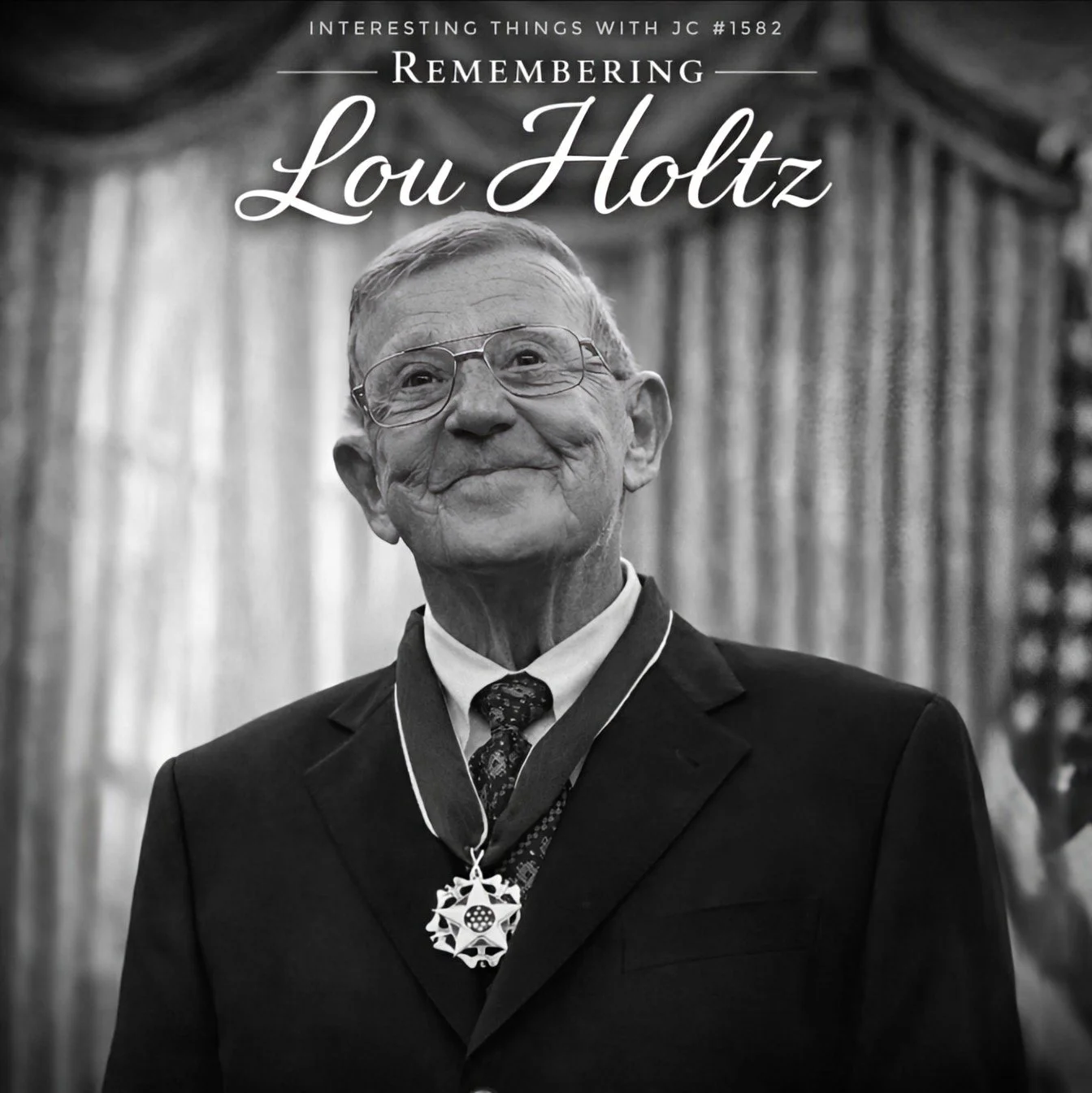
Lou Holtz is shown in a black-and-white portrait wearing the Presidential Medal of Freedom for the cover image of “Interesting Things with JC #1582: Remembering Lou Holtz.”
Transcript
Interesting Things with JC #1582: "Remembering Lou Holtz"
Lou Holtz started life in a place where success was never guaranteed.
He was born January 6, 1937 in Follansbee, West Virginia, a steel town of about 3,000 people along the Ohio River. Mills ran day and night. Men worked long shifts. Families stretched every paycheck.
His father, Andrew Holtz, drove buses and worked at the steel mill. His mother, Anne Marie, kept the household together with discipline and faith. When the family later moved to East Liverpool, Ohio, they lived in a cramped basement apartment without indoor plumbing. Several relatives lived there together. Lou even shared a bed just to make space.
Those early conditions shaped him.
As a boy Lou talked constantly. Teachers and classmates called him “Louie the Lip.” Instead of shrinking from the nickname, he embraced it. Confidence was something he carried everywhere.
At East Liverpool High School he loved football, but he did not look like a typical player. Lou stood about 5 feet 10 inches tall, roughly 1.78 meters, and weighed around 150 pounds, about 68 kilograms. Coaches often kept him on the bench.
Holtz refused to accept that as the end of the story.
In 1956 he walked on to the football team at Kent State University in Kent, Ohio. There was no scholarship waiting for him. Within two seasons he earned one through persistence and became a starting linebacker. While playing football he studied history and joined ROTC, learning discipline and leadership that later defined his coaching.
During those years at Kent State he met a young woman named Beth Barcus.
They met on campus in the late 1950s while both were students. Beth understood what coaching life demanded. The hours were long, the pay was uncertain, and jobs changed quickly. She stood beside Lou through every move as they raised their four children and built their life together.
Lou often said later that marrying Beth was the smartest decision he ever made.
Holtz graduated in 1959 and briefly served in the United States Army Reserve before beginning the climb through the coaching ranks.
The early jobs paid almost nothing.
In 1960 he worked as a graduate assistant at the University of Iowa under head coach Forest Evashevski, pronounced eh-vah-SHEV-skee. The pay was small and the hours were long.
He later coached at William and Mary from 1961 through 1963 and at the University of Connecticut from 1964 to 1965.
In 1968 he joined Woody Hayes at Ohio State. That Buckeye team finished the season as national champions.
Holtz was only 32 years old when he became head coach at William and Mary in 1969. Within one year the program won the Southern Conference championship in 1970.
It became a pattern that followed him for decades.
At North Carolina State from 1972 to 1975 he led the Wolfpack to four bowl games and a top ten national ranking in 1974.
In 1977 he took over the University of Arkansas. His Razorbacks ran the wishbone offense, a triple option attack that punished defenses with constant running plays. In the 1978 Orange Bowl Arkansas stunned Oklahoma 31 to 6.
Six bowl appearances followed during his Arkansas years.
But Lou Holtz became a national figure when he arrived at the University of Notre Dame in South Bend, Indiana in 1986.
The program had slipped from its historic dominance. Holtz introduced strict accountability built around what he called the “Do Right” philosophy.
Do right academically.
Do right on the field.
Do right in life.
That same season he revived a small tradition inside Notre Dame Stadium.
Above the players’ tunnel he hung a sign that read:
“Play Like a Champion Today.”
The phrase had appeared decades earlier during the era of Notre Dame coach Frank Leahy in the 1940s. Holtz brought it back and placed it about 10 feet above the tunnel floor, roughly 3.05 meters high. Every player running onto the field reached up and slapped the sign on the way out.
The message was simple.
Champions are not built tomorrow.
They are built today.
Players who ran through that tunnel carried the message with them. Decades later Notre Dame athletes still reach up and tap that sign before stepping onto the field, a tradition that traces directly back to Holtz’s leadership.
Two seasons later the results were undeniable.
On January 2, 1989 the Irish defeated West Virginia 34 to 21 in the Fiesta Bowl to win the national championship. The team finished 12 and 0. It remains Notre Dame’s most recent national title.
Holtz finished his Notre Dame career with 100 victories, multiple top five national finishes, and players who became legends of the sport. Tim Brown won the Heisman Trophy in 1987. Raghib “Rocket” Ismail became one of the fastest and most electric players college football had seen.
Holtz also became known for his preparation.
Before every game he carried a small note card with four questions he believed every person should ask themselves.
Do people trust you?
Are you committed to excellence?
Do you care about the people around you?
And are you doing the right thing?
Those questions shaped his teams and later shaped thousands of audiences who heard him speak.
After leaving Notre Dame in 1996, Holtz returned to coaching at the University of South Carolina in 1999. The Gamecocks had finished 0 and 11 the year before he arrived. Within two seasons they were winning the Outback Bowl. They repeated that victory the following year.
Holtz retired from coaching in 2004 with 249 career victories.
In 2008 he was inducted into the College Football Hall of Fame.
After coaching he spent a decade as a college football analyst on ESPN from 2005 to 2015. Viewers often noticed his distinctive speech. Holtz had a noticeable lisp, something he had battled since childhood.
When he was younger he practiced speaking with marbles in his mouth to strengthen his diction. That determination helped turn him into one of the most respected motivational speakers in America. His books included Winning Every Day and Wins, Losses, and Lessons.
His wife Beth, who had stood beside him through the long climb of his coaching career, passed away June 30, 2020.
The University of Notre Dame honored both of them by dedicating the Beth and Lou Holtz Family Grand Reading Room at the Hesburgh Library in 2021.
On March 4, 2026 Lou Holtz left us. He passed away at the age of 89 at his home in Orlando, Florida joining his beloved wife Beth in eternal rest. His children and family were with him during those final days as hospice provided support in those final weeks.
A boy who once slept in a crowded basement apartment without plumbing grew up to coach national champions and influence generations of players.
And every Saturday in South Bend, players still reach up and tap that sign above the tunnel.
Play Like a Champion Today.
These are interesting things, with JC.
Student Worksheet
Write one paragraph explaining how Lou Holtz’s childhood conditions may have influenced the way he later approached discipline and leadership.
Write one paragraph identifying the most important turning point in his career. Support your answer with at least two details from the transcript.
Explain why a sign or ritual can become powerful inside a school or team culture. Use “Play Like a Champion Today” as your example.
Choose one of Holtz’s four self-check questions and explain why it matters beyond sports.
In two or three sentences, explain the difference between fame and legacy as shown in this episode.
Teacher Guide
This episode works well as a short biography lesson, but it becomes stronger when taught as a lesson about institutional culture. Students may initially focus on football, championships, or famous schools. The deeper instructional opportunity is to help them see how language, habits, and repeated actions help build identity within teams, schools, and communities.
A strong opening move is to ask students what traditions their own school has that carry symbolic meaning.
After that, the teacher can introduce Holtz as someone whose influence extended beyond game strategy.
His story gives teachers an accessible way to discuss postwar American mobility, the role of sports in higher education, and the way public memory attaches to symbols such as slogans, rituals, and buildings named in honor of people.
For discussion, it is useful to emphasize sequence.
Holtz did not begin at Notre Dame.
He moved through smaller roles and difficult jobs before reaching national prominence.
That pattern helps students understand the difference between overnight fame and long development. It also helps counter shallow celebrity narratives.
Teachers may also wish to note that some lines in the script are motivational in tone and should be treated as narrative framing rather than as independently documented quotations unless directly sourced elsewhere. The best classroom use is to treat the transcript as a polished educational narrative grounded in verifiable career milestones.
Discussion Questions
Why does the episode spend so much time on Holtz’s childhood before discussing championships?
What does the phrase “Play Like a Champion Today” communicate that a longer speech might not?
Why do institutions preserve rituals even when the people who started them are gone?
How can a coach, teacher, or leader shape culture without controlling every action?
Why might the public remember one symbol, one phrase, or one building more clearly than a long list of statistics?
Quiz
In what state was Lou Holtz born?
A. Ohio
B. Indiana
C. West Virginia
D. PennsylvaniaAt what university did Lou Holtz play football as a walk-on?
A. Notre Dame
B. Kent State
C. Arkansas
D. Ohio StateWhat military-related college program did Holtz participate in while in school?
A. Peace Corps
B. Naval Academy prep
C. ROTC
D. Civil Air PatrolWhich university did Holtz lead to a national championship following the 1988 season?
A. South Carolina
B. Arkansas
C. Notre Dame
D. NC StateWhat famous sign is closely associated with Holtz’s legacy at Notre Dame?
A. Never Quit
B. Do Right Always
C. Fight On Today
D. Play Like a Champion TodayIn what year was Lou Holtz inducted into the College Football Hall of Fame?
A. 1999
B. 2004
C. 2008
D. 2015Which university honored Beth and Lou Holtz by dedicating a grand reading room in 2021?
A. Kent State
B. Notre Dame
C. South Carolina
D. ArkansasWhat is one major theme of this episode?
A. Technological innovation
B. Ocean trade
C. Perseverance and leadership
D. Urban planning
Answer Key
C
B
C
C
D
C
B
C
Assessment
A successful student response should demonstrate clear understanding of the chronology of Holtz’s life, including his early hardship, college years, coaching rise, and later legacy. It should also show the ability to move beyond biography and interpret broader meaning. Strong answers will connect concrete facts to abstract ideas such as perseverance, accountability, symbolism, and institutional memory.
For a written extension, students can compose a short analytical response to this prompt: “How does a repeated daily habit become part of a larger legacy?” They should use Lou Holtz and the Notre Dame sign as their central example.
Standards Alignment
U.S. Alignment
CCSS.ELA-LITERACY.RI.8.2 / RI.9-10.2
Students determine a central idea of an informational text and analyze its development over the course of the text.
CCSS.ELA-LITERACY.RI.8.3 / RI.9-10.3
Students analyze how individuals, events, and ideas are introduced, connected, and developed.
CCSS.ELA-LITERACY.W.8.2 / W.9-10.2
Students write informative and explanatory texts to examine a topic and convey ideas clearly.
CCSS.ELA-LITERACY.SL.8.1 / SL.9-10.1
Students engage effectively in collaborative discussions, building on others’ ideas and expressing their own clearly.
C3 Framework for Social Studies D2.His.1 / D2.His.14
Students evaluate historical sources and explain how perspectives and contexts shape interpretations of the past.
ISTE 1.3 Knowledge Constructor
Students critically curate information from digital resources and build knowledge through active exploration.
Bloom’s Taxonomy
Remembering career facts, understanding themes, applying ideas to school culture, analyzing legacy, and evaluating leadership choices.
UDL Considerations
Present the transcript aloud and in print for multiple means of representation.
Allow oral discussion, short writing, or visual symbolism mapping for multiple means of action and expression.
Invite personal connection to school traditions or mentors for multiple means of engagement.
International Equivalencies
UK National Curriculum English
Students read critically, summarize ideas, and evaluate how language and structure shape meaning.
AQA / Edexcel / OCR English Language Skills
Students identify explicit information, infer meaning, and analyze writer’s methods and viewpoints.
Cambridge IGCSE First Language English
Students read for ideas and details, evaluate texts, and communicate informed personal responses.
IB Middle Years Programme / Diploma Programme Language and Literature
Students analyze how texts communicate values, identity, and cultural meaning through language and structure.
Show Notes
“Remembering Lou Holtz” is an episode about far more than football. It traces the life of a man who began in a steel-town environment where comfort and certainty were never promised, then follows his rise through college athletics into national recognition. That arc matters educationally because it offers students a grounded example of how biography intersects with broader social history. Holtz’s story touches postwar industrial America, higher education, military preparation through ROTC, regional college football culture, and the construction of personal legacy in public memory. His induction into the College Football Hall of Fame in 2008 and his death on March 4, 2026, make this episode especially suitable for reflection on how institutions remember influential figures.
The episode is especially effective when treated as a study in symbolic leadership. Notre Dame’s own historical materials state that Holtz installed the “Play Like a Champion Today” sign in 1986. Over time, that sign became inseparable from the school’s football identity. In classroom terms, it is a strong example of how a simple repeated act can transmit values, reinforce belonging, and preserve continuity across generations of students and athletes. That makes the episode useful not only in sports history, but also in discussions of rhetoric, school culture, and ritual.
The closing portion of the episode also offers a way to discuss the relationship between private life and public honor. Notre Dame’s Hesburgh Library dedicated the Beth and Lou Holtz Family Grand Reading Room in 2021, underscoring that the Holtz legacy extended beyond athletics into education, memory, and philanthropy. That detail helps teachers move the lesson away from simple hero narrative and toward a more balanced understanding of public remembrance.
References
National Football Foundation. (2008). Inductee | Louis Leo Holtz 2008. College Football Hall of Fame. https://www.cfbhall.com/inductees/lou-holtz-2008/
National Football Foundation. (2026, March 4). NFF College Football Hall of Fame Coach Lou Holtz Passes Away. https://footballfoundation.org/news/2026/3/4/nff-college-football-hall-of-fame-coach-lou-holtz-passes-away.aspx
University of Notre Dame. (n.d.). Play Like a Champion Today. 125 Football. https://125.nd.edu/moments/play-like-a-champion-today/
University of Notre Dame Hesburgh Libraries. (2021). Beth and Lou Holtz Family Grand Reading Room blessed, dedicated during weekend ceremony. https://www.library.nd.edu/news/beth-and-lou-holtz-family-grand-reading-room-dedication/
Legacy.com. (2026, March 4). Coach Lou Holtz Obituary (2026) - Orlando, FL - Dawson Funeral Home, Inc. https://www.legacy.com/us/obituaries/name/lou-holtz-obituary?id=60944949
ESPN. (2026, March 4). Lou Holtz, coaching legend who led Notre Dame to title, dies. https://www.espn.com/college-football/story/_/id/48103098/legendary-football-coach-commentator-lou-holtz-dies-89
Horatio Alger Association. (2023, January 18). Louis L. Holtz, Legendary College Football Coach, to Receive 2023 Horatio Alger Award. https://horatioalger.org/news-events/news/louis-l-holtz-legendary-college-football-coach-to-receive-2023-horatio-alger-award/
U.S. Army. (2021, January 5). Football coach Lou Holtz recounts lessons learned in Army. https://www.army.mil/article/242185/football_coach_lou_holtz_recounts_lessons_learned_in_army
The White House Archives. (2020, December 2). President Donald J. Trump to award the Medal of Freedom to Lou Holtz. https://trumpwhitehouse.archives.gov/briefings-statements/president-donald-j-trump-award-medal-freedom-lou-holtz/
The White House Archives. (2020, December 3). Remarks by President Trump at the presentation of the Presidential Medal of Freedom to Lou Holtz. https://trumpwhitehouse.archives.gov/briefings-statements/remarks-president-trump-presentation-presidential-medal-freedom-lou-holtz/
The White House Archives. (n.d.). Medal of Freedom. https://trumpwhitehouse.archives.gov/medaloffreedom/