1636: "AM Radio as the Last Mass-Mind Medium"
Interesting Things with JC #1636: "AM Radio as the Last Mass-Mind Medium" – A 50,000-watt AM station is transmitting one voice across multiple states at night while millions of people in different places hear the same signal at the same time, even as every other modern system splits audiences into separate individualized streams.
Curriculum - Episode Anchor
Episode Title: AM Radio as the Last Mass-Mind Medium
Episode Number: 1636
Host: JC
Audience: Grades 9–12, Introductory College, Homeschool, Lifelong Learners
Subject Area: Physics, Media Studies, Communication Systems
Lesson Overview
Objectives:
Explain how AM radio waves propagate using ground wave and skywave behavior
Analyze why AM radio maintains large-scale reach compared to modern media systems
Evaluate the role of AM radio in emergency communication infrastructure
Compare centralized broadcast systems with personalized digital media
Essential Question: How can a single signal still reach millions in a world of personalized media?
Success Criteria:
Students accurately describe AM signal behavior and range
Students distinguish AM vs. FM vs. digital media systems
Students provide evidence-based explanations of AM’s role in emergencies
Student Relevance: Students use streaming and personalized media daily; this lesson reveals how communication once functioned—and still functions—without algorithms
Real-World Connection: Emergency Alert Systems rely on AM infrastructure to reach large populations during outages
Workforce Reality: Careers in broadcasting, emergency management, and telecommunications require understanding resilient communication systems
Key Vocabulary
Amplitude Modulation (AM) (am-pli-tood mod-yuh-lay-shun): A method of encoding information in radio waves by varying signal strength
Frequency (free-kwen-see): Number of wave cycles per second
Wavelength (wave-length): Distance between wave peaks
Ionosphere (eye-on-oh-sfeer): Upper atmospheric layer that reflects radio waves
Ground Wave (ground wave): Radio signal traveling along Earth’s surface
Skywave (sky-wave): Radio signal reflected off the ionosphere
Clear-Channel Station (kleer chan-uhl): High-power AM station with wide coverage
Broadcast (broad-kast): Transmission of a signal to a wide audience
Signal Propagation (sig-nuhl prop-uh-gay-shun): Movement of radio waves through space
Emergency Alert System (ee-mer-jen-see uh-lurt sis-tem): National warning system for public safety
Narrative Core
Open: A lone driver crosses a dark Nevada highway, guided only by a fading AM signal that connects him to unseen listeners.
Info: In the 1920s, radio unified households, delivering a single shared voice across entire nations.
Details: AM signals travel long wavelengths, reflecting off the ionosphere at night, enabling one transmitter to reach thousands of miles. Unlike FM or digital systems, AM prioritizes reach over sound quality.
Reflection: Modern media fragments audiences into personalized streams, while AM remains a shared, simultaneous experience.
Closing: These are interesting things, with JC.
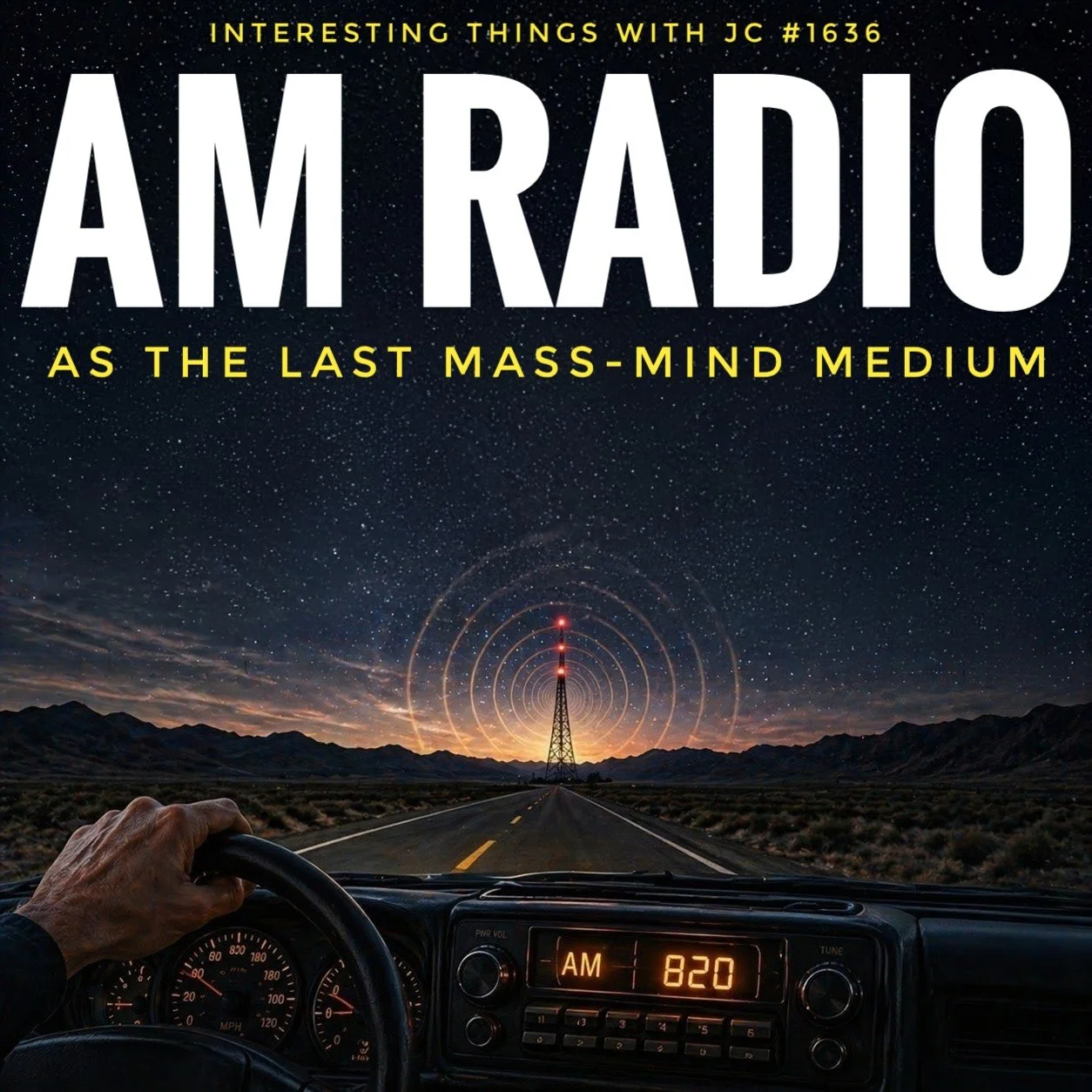
A realistic cinematic image showing AM radio as a shared communication medium, with a car dashboard, open desert road, radio tower, and bold centered title text.
Transcript
Interesting Things with JC #1636:
"AM Radio as the Last Mass-Mind Medium"
A man is driving alone across Nevada at 2:17 in the morning, somewhere between nothing and nowhere, and the only thing cutting through the dark is a thin, crackling voice coming out of his dashboard, fading in and out as the road stretches forward.
He does not know who is talking. He does not know where it is coming from. But he knows someone else is hearing it too.
That is how it used to work.
In the 1920s, radio was not background noise. It was the center of the room. Families built their evenings around it, sitting close to a single wooden set as one signal carried voices into millions of homes at the same time. When Franklin D. Roosevelt spoke during the Great Depression, he was not speaking into a fragmented audience. He was speaking into a country that, for a moment, was listening together.
That reach came from the way AM actually moves.
The signal rides long wavelengths that travel along the ground during the day and then reflect off the ionosphere at night. A single 50,000-watt clear-channel station can cover multiple states after dark, sometimes pushing its signal well past 1,000 miles, about 1,600 kilometers. One transmitter can fill entire regions. No subscription. No login. If you are in range, you are in.
When FM arrived with cleaner sound, music moved. But voice stayed. Talk, news, sports, anything where the message mattered more than fidelity. AM became the place where information lived, not because it sounded better, but because it reached farther and reached more people at once.
Then everything else started to split.
Television broke into channels, then into cable, then into streaming. The internet took it further, turning every feed into something tailored and filtered for each individual. Two people can sit in the same room now and experience completely different versions of the world, pulled apart by algorithms that decide what each person is likely to stay with.
AM never followed that path.
It still sends one signal outward. Truckers running overnight routes, farmers up before daylight, night-shift workers, people who cannot sleep, all hearing the same voice at the same time, whether they agree with it or not.
You see it most clearly when everything else disappears.
When storms knock out power, when cell networks fail, when data stops moving, AM stations often stay on the air. Many run on backup generators designed to operate for days. The Emergency Alert System still relies on a network of Primary Entry Point stations, most of them on AM, capable of reaching roughly 90 percent of the United States population with a single coordinated message.
In those moments, the system resets to something older and simpler. One voice reaching anyone who can still turn a dial.
That never went away.
While everything else moved toward personalization, AM stayed rooted in simultaneity. It does not adapt to you. It does not learn your preferences. It does not try to keep you comfortable. It simply broadcasts, and whoever is there hears it.
That creates something rare now.
Not perfection. Not agreement. But a shared moment that does not belong to any one person.
That man on the highway does not know who else is out there listening, but he is not alone in that signal.
He never was.
These are interesting things, with JC.
Student Worksheet
Comprehension Questions:
What allows AM radio signals to travel long distances at night?
Why did AM radio remain important for voice communication?
What role does AM play during emergencies?
Analysis Questions:
Compare AM radio to modern streaming platforms in terms of audience experience
Why might centralized communication still be necessary today?
Evaluate the trade-offs between sound quality and signal reach
Reflection Prompt: Describe a situation where shared information is more important than personalized content
Difficulty Scaling:
Basic: Identify key terms
Intermediate: Explain signal behavior
Advanced: Evaluate media systems
Student Output: Short written responses (1–2 paragraphs per section)
Academic Integrity Guidance: Use original explanations; support claims with lesson content
Teacher Guide
Quick Start: Play audio, then discuss shared listening experience
Pacing (Audio-First):
5 min: Bell ringer
6 min: Audio
15 min: Discussion
15 min: Worksheet
Bell Ringer: “What media do you use daily, and is it shared or personalized?”
Audio Guidance: Focus on imagery and signal explanation
Audio Fallback: Provide transcript reading
Time on Task: ~40 minutes total
Materials: Audio, worksheet, board
Vocabulary Strategy: Pre-teach ionosphere and wavelength with quick diagrams
Misconceptions:
AM is outdated → clarify ongoing emergency use
Stronger signal = better sound → distinguish clarity vs. reach
Discussion Prompts:
Why does shared media matter?
What happens when communication fails?
Formative Checkpoints: Exit responses, discussion participation
Differentiation:
Visual learners: diagrams
Advanced: research EAS system
Assessment Differentiation: Allow oral or written responses
Time Flexibility: Expand discussion or shorten worksheet as needed
Substitute Readiness: Use transcript if audio unavailable
Engagement Strategy: Real-world emergency scenarios
Extensions: Compare with satellite radio
Cross-Curricular Connections: Physics + civics
SEL Connection: Shared experience vs. isolation
Skill Value Emphasis: Systems thinking and media literacy
Answer Key:
Ground and skywave propagation enable long-distance travel
AM prioritizes reach over sound quality for voice content
AM supports emergency alert broadcasting systems
Quiz
What enables AM signals to travel farther at night?
A. Higher volume
B. Ionospheric reflection
C. Digital compression
D. Satellite relayWhy did voice content remain on AM?
A. Better sound
B. Shorter waves
C. Greater reach
D. Lower costWhat system relies on AM stations?
A. GPS
B. Emergency Alert System
C. Wi-Fi
D. BluetoothWhat defines AM broadcasting?
A. Personalized feeds
B. One-to-many transmission
C. Encrypted signals
D. Visual outputWhat is a key trade-off of AM?
A. Speed vs. cost
B. Quality vs. reach
C. Privacy vs. access
D. Size vs. power
Assessment
Open-Ended Questions:
Explain how AM radio demonstrates resilience in communication systems
Analyze how shared media experiences differ from personalized media
Rubric (3–2–1):
3: Accurate, detailed, evidence-based
2: Partial understanding
1: Minimal or incorrect
Exit Ticket: Why might AM radio still matter in the future?
Standards Alignment
NGSS:
HS-ESS2-5: Analyze how ionospheric conditions affect AM signal propagation using models and diagrams
HS-PS4-1: Model wave behavior to explain differences between AM and FM transmission
CCSS:
RST.11-12.2: Determine and summarize central ideas of technical explanations about radio systems
RST.11-12.7: Integrate visual and quantitative data (signal maps, wattage) with text explanations
WHST.11-12.1: Write evidence-based arguments evaluating AM radio as a mass communication system
C3 Framework:
D2.Geo.7.9-12: Analyze how geography influences signal coverage and communication reach
D2.Civ.14.9-12: Evaluate the role of communication systems in public safety infrastructure
D4.1.9-12: Construct arguments using evidence about shared vs. fragmented media systems
ISTE:
1.3 Knowledge Constructor: Evaluate differences between broadcast and algorithm-driven information systems
1.1 Empowered Learner: Reflect on personal media consumption and learning strategies
1.7 Global Collaborator: Understand how shared communication systems connect populations
CTE:
Telecommunications: Analyze broadcast system design and redundancy
Engineering: Evaluate trade-offs between signal range and fidelity
Public Safety: Understand emergency communication networks and infrastructure
Career Readiness:
Systems thinking in communication networks
Critical evaluation of information reliability
Technical literacy in signal behavior and infrastructure
Homeschool/Lifelong:
Independent research on local AM stations and coverage
Application of physics concepts to real-world communication systems
Show Notes
This lesson examines AM radio as a rare example of a shared communication system that still operates alongside personalized digital media. Students explore both the science of signal propagation and the societal implications of centralized broadcasting, especially during emergencies when reliable communication is critical.
References
Federal Communications Commission. (2023). AM broadcasting. https://www.fcc.gov/media/radio/am-broadcasting
National Weather Service. (2022). Emergency Alert System overview. https://www.weather.gov/nwr/eas
Encyclopaedia Britannica. (2023). Amplitude modulation. https://www.britannica.com/technology/amplitude-modulation