1637: “Norbert aka Tony Pork”
Interesting Things with JC #1637: “Norbert” – They call him Tony Pork. He’s a 175 pound pig that pushed himself down a suburban Illinois street on a skateboard using his back legs while steering with his front trotters, then crossed a 10 meter Guinness World Record track in 11.32 seconds after learning to balance on the board… but nobody’s seen him land a kickflip yet.
Curriculum - Episode Anchor
Episode Title: Norbert aka Tony Pork
Episode Number: 1637
Host: JC
Audience: Grades 9–12, Introductory College, Homeschool, Lifelong Learners
Subject Area: Animal Intelligence, Behavioral Science, Learning Theory
Lesson Overview
Learning Objectives:
Analyze how reward-based learning influences animal behavior
Explain how pigs demonstrate intelligence through problem-solving and adaptation
Evaluate the relationship between motivation, repetition, and skill development
Connect scientific observations about animal cognition to real-world examples
Essential Question:
How does animal intelligence challenge assumptions about learning and behavior?
Success Criteria:
Students can describe operant conditioning and reward-based learning
Students can identify examples of problem-solving in animals
Students can explain how repetition and motivation shape behavior
Students can support conclusions using evidence from the episode
Student Relevance Statement:
Students regularly experience learning through repetition, rewards, feedback, and practice in sports, games, music, and academics. This lesson connects those experiences to how animals learn new behaviors.
Real-World Connection:
Animal trainers, veterinarians, behavioral scientists, robotics engineers, and psychologists all study learning systems and adaptive behavior.
Workforce Reality:
Careers involving animal care and behavioral science require patience, observation, ethical responsibility, and evidence-based training methods.
Key Vocabulary
Operant Conditioning(OP-er-unt kun-DISH-un-ing) — Learning through rewards or consequences
Cognition(kog-NISH-un) — Mental processes related to thinking and learning
Adaptation(ad-ap-TAY-shun) — Adjusting behavior to fit new situations
Motivation(moh-tuh-VAY-shun) — The reason an organism performs an action
Repetition(rep-uh-TISH-un) — Performing something repeatedly to strengthen learning
Behavioral Science(bih-HAYV-yer-ul SY-ens) — Study of behavior in humans and animals
Stimulus(STIM-yuh-lus) — Something that causes a response
Problem-Solving(PROB-lum SOLV-ing) — Finding solutions to challenges or obstacles
Narrative Core
Open:
A skateboarding pig rolling through suburban Illinois sounds fictional at first. Yet Norbert, also known online as Tony Pork, became famous for doing exactly that.
Info:
Norbert learned to skateboard after his owner, Vincent Baran, placed unsalted peanuts on an old skateboard. The pig quickly learned how balance and movement connected to rewards.
Details:
Researchers have long understood that pigs are highly intelligent animals capable of memory, adaptation, and fast learning. On October 9, 2024, Norbert completed a Guinness World Record attempt by pushing a skateboard across a 10-meter track in 11.32 seconds.
Reflection:
The story challenges assumptions about intelligence. Humans often underestimate animals based on appearance or stereotypes. Norbert’s behavior demonstrates how learning, motivation, and repetition can produce surprising outcomes.
Closing:
These are interesting things, with JC.
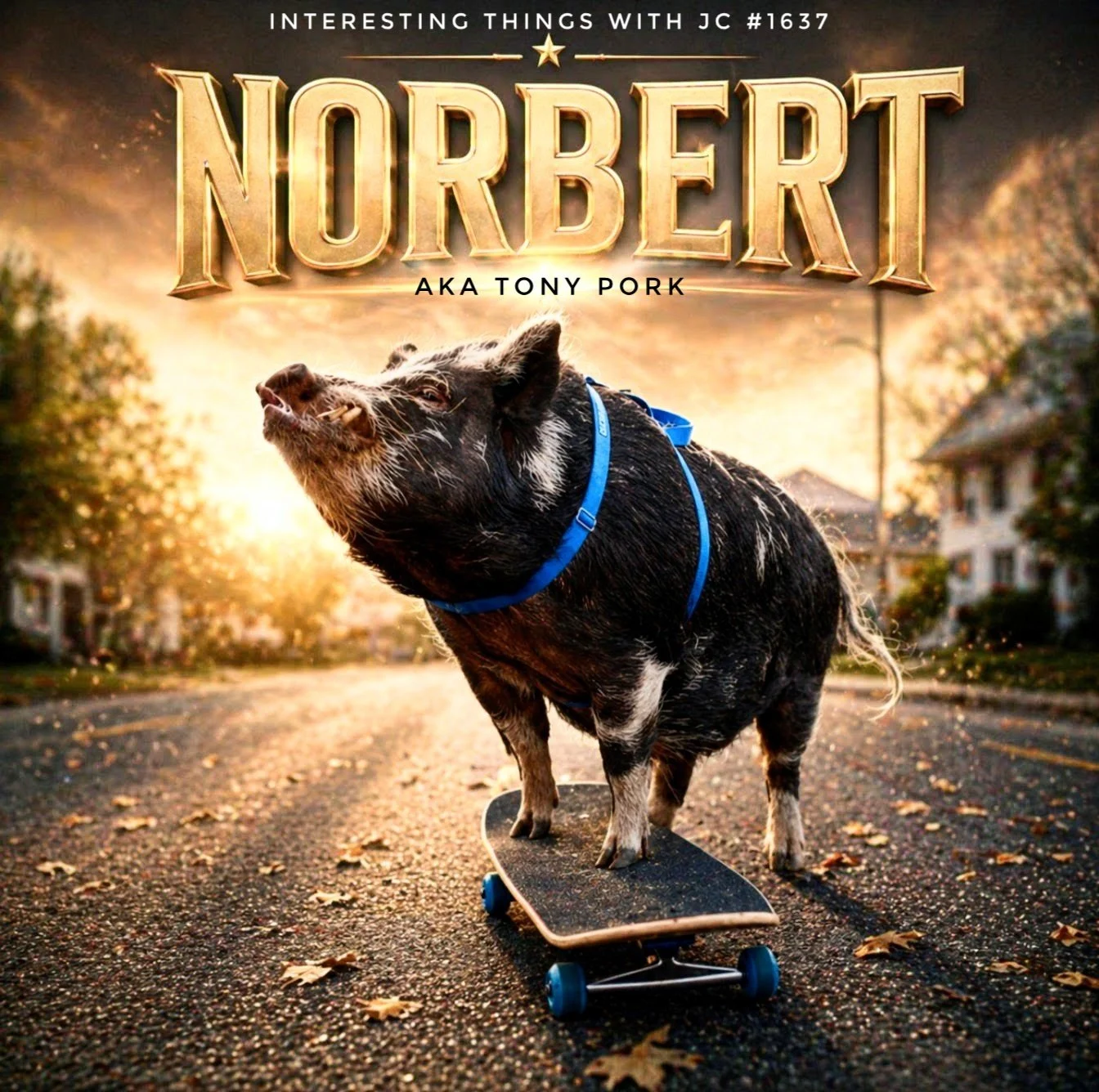
Episode artwork showing Norbert, a black-and-white pig wearing a blue harness, standing on a skateboard in a suburban street at sunset. Large gold text reads “NORBERT,” with smaller text below reading “AKA TONY PORK.” The image would only be cooler if he was on a Poorhouse Skateboard.
Transcript
Interesting Things with JC #1637
“Norbert aka Tony Pork”
A 175-pound pig came rolling down a suburban street in Buffalo Grove, Illinois. His front trotters were planted on the skateboard while his back legs pushed like a kid bombing a hill after school.
The wild part was not that he stayed on the board. It was that he looked like he knew exactly what he was doing.
His name is Norbert. Online, people call him Tony Pork.
It started when Vincent Baran tossed a few unsalted peanuts onto an old skateboard. Norbert climbed on right away. Fifteen minutes later, he was balancing. A few short sessions after that, he was pushing himself down the street.
That actually fits what researchers know about pigs. They are surprisingly sharp at reward-based learning. They solve mazes quickly, remember tasks for a long time, and adapt fast. Norbert simply put those skills on four wheels.
On October 9th, 2024, Vincent set up a Guinness World Record attempt. He built a 33-foot track, exactly 10 meters, with reflective markers for the official cameras. At the far end sat the perfect motivation: peanut butter covered bananas, apples, and string cheese.
Norbert hopped on and pushed hard with his back legs. He crossed the full distance in 11.32 seconds.
That made him the fastest pig ever to push a skateboard 10 meters in Guinness World Records history.
The funny thing is how quickly it stops feeling weird. Once you understand how intelligent pigs really are, a skateboarding pig starts to make perfect sense. Norbert was not being forced. He was solving a problem that combined movement, reward, and repetition.
These days he is house trained, lounges on the couch watching movies, and has millions of followers online. Somewhere in suburban Illinois, there is a 175-pound pig who is better at skateboarding than most of us ever were after our middle school phase.
It is a pretty good reminder that real intelligence does not always show up where we expect it to.
These are interesting things, with JC.
Student Worksheet
Comprehension Questions:
Who is Norbert, and what unusual skill made him famous?
How did Vincent Baran first encourage Norbert to use the skateboard?
What foods were used as motivation during the Guinness World Record attempt?
How long did it take Norbert to travel 10 meters?
Analysis Questions:
Why do researchers consider pigs intelligent animals?
How does Norbert demonstrate operant conditioning?
Why might repetition be important in both animal and human learning?
How does the story challenge stereotypes about intelligence?
Reflection Prompt:
Describe a time when practice and motivation helped you learn a new skill. Compare your experience to Norbert learning to skateboard.
Difficulty Scaling:
Foundational: Identify key facts from the transcript
Intermediate: Explain learning behaviors and motivation
Advanced: Analyze how assumptions influence perceptions of intelligence
Student Output:
Students will complete written responses using evidence from the transcript and classroom discussion.
Academic Integrity Guidance:
Students should use their own words, support ideas with evidence, and avoid copying responses from classmates or online sources.
Teacher Guide
Quick Start:
Play the podcast episode first. Ask students to write down one surprising fact they hear during the audio.
Pacing Guide (Audio-First):
Bell ringer — 5 minutes
Vocabulary preview — 5 minutes
Audio listening — 5 minutes
Discussion — 10 minutes
Worksheet activity — 15 minutes
Assessment and exit ticket — 10 minutes
Bell Ringer:
Ask students: “What animals are commonly considered intelligent? Why?”
Audio Guidance:
Encourage students to listen for examples of learning, repetition, and motivation.
Audio Fallback:
If audio is unavailable, use the transcript as a read-aloud activity.
Time on Task:
Approximately 45–50 minutes.
Materials:
Podcast audio or transcript
Student worksheet
Writing utensils
Projector or speakers
Vocabulary Strategy:
Have students connect vocabulary words to examples from pets, sports, or personal learning experiences.
Misconceptions:
Intelligence only applies to humans
Animals learn only through instinct
Training automatically means force or punishment
Discussion Prompts:
Why are humans surprised by intelligent animal behavior?
How do rewards influence learning?
What similarities exist between human and animal learning systems?
Formative Checkpoints:
Vocabulary matching
Think-pair-share discussions
Evidence-based written responses
Differentiation:
Provide sentence starters for developing writers
Allow verbal responses for discussion-based learners
Offer transcript annotation for advanced learners
Assessment Differentiation:
Students may complete written, verbal, or visual responses depending on learning needs.
Time Flexibility:
Lesson may be shortened to 30 minutes or extended into a research project.
Substitute Readiness:
All materials are self-contained and usable without prior lesson knowledge.
Engagement Strategy:
Use humor and surprise from the skateboarding pig story to introduce deeper concepts about cognition and learning.
Extensions:
Research other intelligent animal behaviors
Compare animal training methods
Explore neuroscience and learning theory
Cross-Curricular Connections:
Science: animal cognition and behavior
Psychology: learning theory
Media Studies: viral internet culture
Physical Education: balance and motor coordination
SEL Connection:
Students examine patience, persistence, and growth through practice.
Skill Value Emphasis:
Observation, analysis, communication, and evidence-based reasoning are valuable across scientific and technical careers.
Answer Key:
Comprehension answers should reference Norbert’s skateboarding, rewards, and record-setting performance
Analysis responses should explain reward-based learning and adaptation
Reflection responses should connect practice and motivation to personal experiences
Quiz
What motivated Norbert during training?
A. Loud music
B. Rewards like peanuts and food
C. Flashing lights
D. Water spraysWhat world record did Norbert achieve?
A. Fastest swimming pig
B. Largest trained pig
C. Fastest pig to push a skateboard 10 meters
D. Longest skateboard jump by a pigWhat learning system is highlighted in the episode?
A. Punishment-based learning
B. Random chance learning
C. Reward-based learning
D. Passive observation learningWhich statement best reflects the episode’s message?
A. Animals cannot adapt quickly
B. Intelligence can appear in unexpected places
C. Skateboarding is easy for all animals
D. Intelligence depends only on sizeWhy did the skateboard activity become easier for Norbert over time?
A. He ignored distractions
B. He practiced repeatedly with motivation
C. The skateboard became lighter
D. The road became shorter
Assessment
Open-Ended Questions:
Explain how Norbert’s behavior demonstrates intelligence and learning. Use evidence from the episode.
Describe how rewards and repetition influence both animal and human learning.
Rubric:
3: Clear explanation with strong evidence and thoughtful analysis
2: Accurate explanation with some supporting evidence
1: Limited explanation with minimal evidence
Exit Ticket:
What is one new thing you learned about animal intelligence from today’s lesson?
Standards Alignment
NGSS HS-LS1-3: Plan and conduct investigations to provide evidence that feedback mechanisms maintain biological systems, including behavioral responses to environmental stimuli and rewards
NGSS HS-LS2-8: Evaluate evidence for how organism behavior supports survival, adaptation, and environmental interaction
NGSS Science and Engineering Practice: Construct explanations based on valid scientific evidence related to cognition, learning, and adaptation
CCSS.ELA-LITERACY.RI.9-10.1: Cite strong and thorough textual evidence to support analysis of informational text
CCSS.ELA-LITERACY.RI.9-10.2: Determine central ideas of a text and analyze development of concepts across the narrative
CCSS.ELA-LITERACY.RI.11-12.7: Integrate and evaluate multiple sources of information presented in different formats and media
CCSS.ELA-LITERACY.SL.9-10.1: Initiate and participate effectively in collaborative discussions using evidence and reasoning
CCSS.ELA-LITERACY.W.9-10.2: Write informative texts examining scientific concepts and supporting evidence clearly
C3 Framework D2.Sci.1.9-12: Apply scientific reasoning, evidence, and questioning strategies when evaluating claims about animal behavior
C3 Framework D3.1.9-12: Gather and evaluate information from multiple sources while assessing credibility and accuracy
C3 Framework D4.1.9-12: Construct arguments using evidence from informational and scientific texts
ISTE 1.3 Knowledge Constructor: Critically curate information from digital resources to build knowledge and make informed conclusions
ISTE 1.5 Computational Thinker: Analyze patterns, processes, and systems involved in learning and behavior
ISTE 1.7 Global Collaborator: Use collaborative discussion to compare interpretations and evidence-based conclusions
CTE Science, Technology, Engineering, and Mathematics Career Cluster: Apply observation, data interpretation, and analytical reasoning to behavioral science contexts
Career Readiness Practice 2: Apply academic and technical skills in real-world problem-solving situations
Career Readiness Practice 4: Communicate clearly and effectively using scientific reasoning and evidence
UK National Curriculum Key Stage 4 Science: Develop understanding of animal behavior, adaptation, and scientific inquiry through evidence-based investigation
IB MYP Sciences Criterion B: Design and explain scientific investigations using observation and analysis
Homeschool/Lifelong Learning Alignment: Encourage interdisciplinary inquiry, scientific curiosity, media literacy, and reflective thinking through real-world examples
Show Notes
A pig riding a skateboard sounds like internet comedy until science enters the picture. In this episode, students explore the remarkable intelligence of pigs through the story of Norbert, also known as Tony Pork, a 175-pound pig that earned a Guinness World Record for skateboarding 10 meters in 11.32 seconds. The lesson examines how reward-based learning, repetition, memory, and problem-solving shape behavior in both animals and humans. Students connect behavioral science concepts to real-world learning systems while evaluating assumptions about intelligence, adaptation, and motivation. By combining humor, scientific observation, and modern media culture, this lesson creates an engaging entry point into cognition, psychology, animal behavior, and evidence-based reasoning.
References
Baran, V. (as cited in Guinness World Records). (2025, October 23). When pigs fly… Norbert skateboards! Meet the adorable pig with sick skating skills. Guinness World Records. https://www.guinnessworldrecords.com/news/2025/10/when-pigs-fly-norbert-skateboards-meet-the-adorable-pig-with-sick-skating-skills
Gieling, E. T., Nordquist, R. E., & van der Staay, F. J. (2011). Assessing learning and memory in pigs. Animal Cognition, 14(2), 151–173. https://pubmed.ncbi.nlm.nih.gov/21203792/
Guinness World Records. (2024). Fastest 10 m pushing a skateboard by a pig. https://www.guinnessworldrecords.com/world-records/761413-fastest-10-m-pushing-a-skateboard-by-a-pig
Marino, L., & Colvin, C. M. (2016). Thinking pigs: Cognition, emotion, and personality. International Journal of Comparative Psychology, 29. https://www.wellbeingintlstudiesrepository.org/cgi/viewcontent.cgi?article=1000&context=mammal
UPI. (2025, October 23). Skateboarding pig earns Guinness World Record. https://www.upi.com/Odd_News/2025/10/23/Guinness-World-Records-skateboarding-pig-Norbert/4421761235564/
New Roots Institute. (2022, September 13). Pig intelligence. https://www.newrootsinstitute.org/articles/pig-intelligence
Treehugger. (n.d.). How smart are pigs? https://www.treehugger.com/how-smart-are-pigs-5119260