1613: "Victor Glover Jr.”
Interesting Things with JC #1613: "Victor Glover Jr." – He trained to trust systems where failure is instant, and then chose to sit on top of a rocket anyway. From combat flights to orbit to a path around the Moon, he carried something with him that didn’t come from engineering. It changed how he saw everything below.
Curriculum - Episode Anchor
Please print page or copy to your desired workbook
Episode Title: Victor Glover Jr.
Episode Number: 1613
Host: JC
Audience: Grades 9–12, Introductory College, Homeschool, Lifelong Learners
Subject Area: Aerospace Engineering / Human Spaceflight / Character & Decision-Making
Lesson Overview
Learning Objectives:
Analyze the training and decision-making required for human spaceflight missions
Explain the role of test pilots and astronauts in high-risk environments
Evaluate how personal belief systems and professional training can coexist under pressure
Describe the significance of Artemis II in the context of human space exploration
Essential Question:
How do preparation, discipline, and personal belief systems shape performance in extreme environments?
Success Criteria:
Students can describe Victor Glover Jr.’s career path accurately
Students can explain the risks and responsibilities of space missions
Students can connect technical training with human factors like mindset and belief
Student Relevance Statement:
Students will explore how skills, discipline, and personal values influence success in high-stakes careers they may pursue.
Real-World Connection:
Modern aerospace missions depend on individuals who can operate complex systems while managing risk, uncertainty, and isolation.
Workforce Reality:
Careers in aviation, engineering, and space exploration require years of training, precision, accountability, and mental resilience.
Key Vocabulary
Astronaut (AS-truh-nawt): A person trained to travel and work in space
Test Pilot (test PAI-luht): A pilot who flies experimental aircraft to evaluate performance
Orbit (OR-bit): The curved path of an object around a planet or star
Artemis II (AR-tuh-miss TOO): NASA mission planned to send humans around the Moon
Extravehicular Activity (EK-struh-vuh-HIK-yuh-ler): Work done outside a spacecraft
Vacuum (VAK-yoom): Space with no air or atmosphere
Systems (SIS-tuhmz): Interconnected components working together
Trajectory (truh-JEK-tuh-ree): The path an object follows through space
Narrative Core
Open:
There is a man looking out a window where Earth is no longer beneath him, but behind him.
Info:
Victor Glover Jr. is traveling farther from Earth, continuing a journey that began long before spaceflight.
Details:
From Pomona, California, he built a path through disciplined environments, naval aviation, aircraft carriers, and test piloting. Selected by NASA in 2013, he flew to the International Space Station in 2020, performing complex operations and spacewalks. Now assigned to Artemis II, he will travel beyond low Earth orbit, including a period of complete communication blackout behind the Moon.
Reflection:
Despite technical systems and rigorous training, he emphasizes what he carries internally—his beliefs, discipline, and mindset.
Closing:
These are interesting things, with JC.
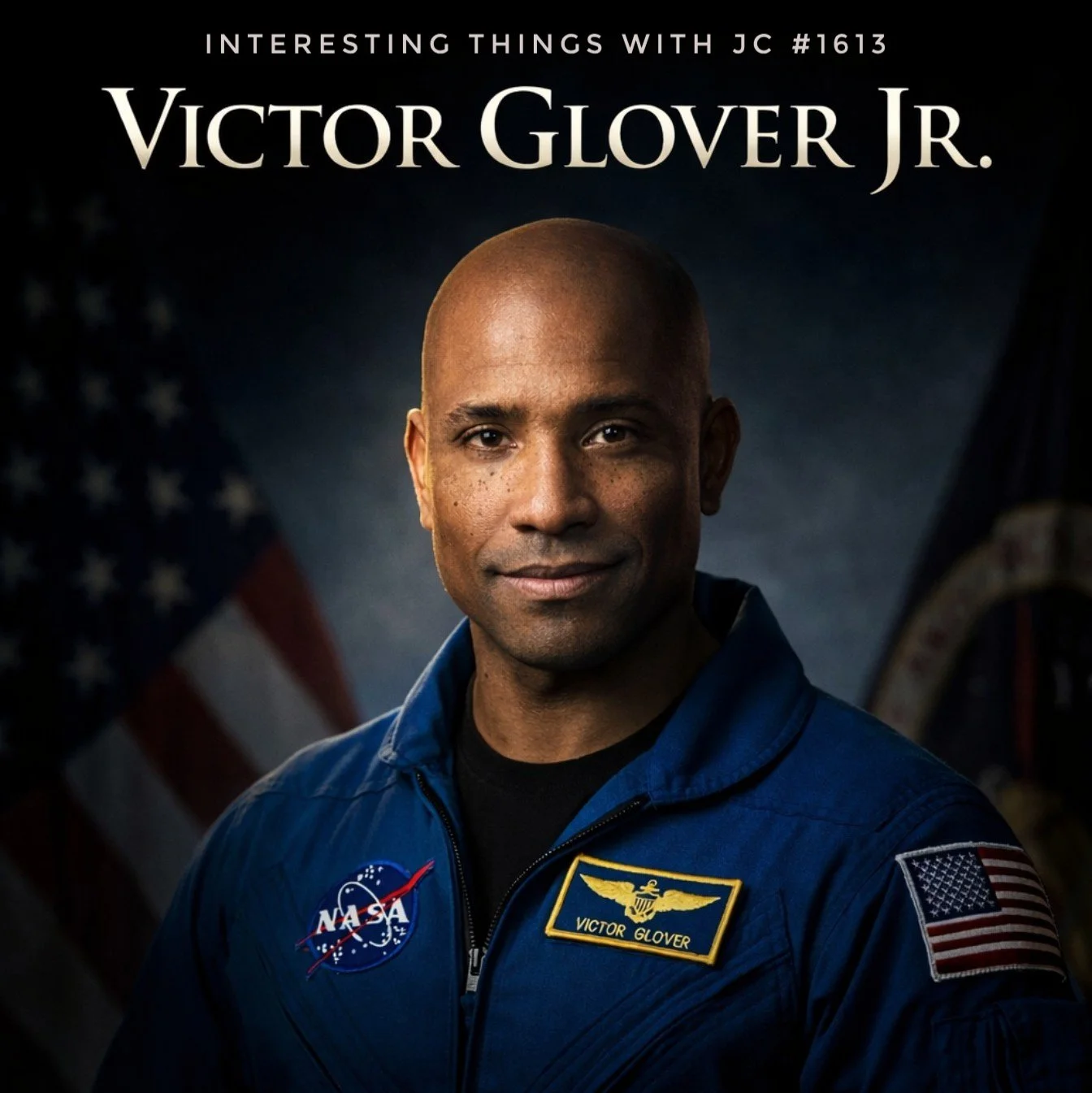
NASA astronaut Victor Glover Jr. in official portrait attire, representing U.S. human spaceflight and Artemis-era missions.
Transcript
Interesting Things with JC #1613: "Victor Glover Jr."
There is a man right now looking out a window, and the Earth is no longer the place he stands on but something behind him as distance continues to grow with every passing moment.
Victor Glover Jr. is on his way to the Moon, and by the time he reached this moment, that distance didn’t begin with a rocket but years earlier in Pomona, California, where there was no visible path to space, so if that path was going to exist, it had to be built.
He built it inside environments that don’t allow hesitation, flying high-performance aircraft off carrier decks where the margin for error is measured in feet, then moving into test pilot work where the aircraft themselves are still being defined while you’re inside them, where systems are trusted because they have to be and decisions carry consequence the moment they’re made.
By the time NASA selected him in 2013, he was already operating inside risk, so when he launched in 2020 to the International Space Station and spent months in orbit working, maintaining systems, and stepping outside into open vacuum where every movement is deliberate because it has to be, it wasn’t a departure from that pattern but the same pattern carried higher.
Now that same trajectory is carrying him farther, beyond Earth orbit on Artemis II, moving along a path that will take him around the Moon and back, including a stretch where the spacecraft passes behind it and contact with Earth disappears completely, a distance no human has crossed in more than fifty years since Apollo 17.
At that distance, the machinery is still there, the systems, the procedures, the training, all of it still matters, but when he talks about space, that’s not what he stays on because he talks about what he carried with him.
During his time in orbit, he spoke about his Christian faith, about praying before flight and taking communion in space, not because of where he was but because of what it meant, and in those moments, references to Jesus Christ are not symbolic to him but something he brought into an environment where almost everything else changes.
And when he looks back at Earth, watching it shrink into something small, connected, and rare, that perspective doesn’t replace the systems he trusts but exists alongside them, because he has said that spaceflight didn’t weaken his belief in God, it reinforced it.
So what he carries is not one thing but both at the same time, training and belief moving together as he travels farther from Earth than he ever has before, with distance increasing and communication gone for a stretch while everything familiar falls away except what he brought with him.
Because sometimes the story isn’t just about how far someone goes, it’s about what remains unchanged while everything else changes.
These are interesting things, with JC.
Student Worksheet
Comprehension Questions:
Who is Victor Glover Jr.?
What role did he serve before becoming an astronaut?
What is Artemis II?
What happens when the spacecraft goes behind the Moon?
What environments helped shape his decision-making skills?
Analysis Questions:
Why is test pilot experience valuable for astronauts?
How does operating in high-risk environments influence decision-making?
What does it mean to “carry something with you” into space beyond equipment?
Reflection Prompt:
Describe a personal value or belief you rely on during difficult situations. How might it help in an extreme environment?
Difficulty Scaling:
Basic: Identify key facts
Intermediate: Explain cause and effect
Advanced: Evaluate human factors in spaceflight
Student Output:
Written paragraph (5–8 sentences)
Optional discussion or presentation
Academic Integrity Guidance:
Use original responses
Support ideas with evidence from the transcript
Avoid copying peer answers
Teacher Guide
Quick Start:
Play audio, then guide discussion on risk, training, and mindset.
Pacing Guide (Audio-First):
0–3 min: Bell ringer
3–8 min: Play audio
8–20 min: Discussion
20–35 min: Worksheet
35–45 min: Review
Bell Ringer:
What skills are required to work in high-risk environments?
Audio Guidance:
Students listen for references to training, risk, and belief systems.
Audio Fallback:
Use transcript for reading and annotation.
Time on Task:
45 minutes total
Materials:
Audio or transcript
Worksheet
Writing tools
Vocabulary Strategy:
Pre-teach key terms before audio
Misconceptions:
Spaceflight is purely technological
Astronauts rely only on machines
Discussion Prompts:
What makes spaceflight risky?
How do training and mindset interact?
Why is communication loss significant?
Formative Checkpoints:
Student responses during discussion
Worksheet accuracy
Differentiation:
Provide guided notes
Allow verbal responses
Assessment Differentiation:
Shortened responses for support
Extended analysis for advanced learners
Time Flexibility:
Lesson can expand to two periods
Substitute Readiness:
Transcript-based delivery requires no audio
Engagement Strategy:
Connect to real astronaut missions
Extensions:
Research Artemis missions
Cross-Curricular Connections:
Physics: motion and trajectory
Psychology: decision-making under stress
SEL Connection:
Focus on resilience and personal identity
Skill Value Emphasis:
Critical thinking, discipline, and accountability
Answer Key:
Comprehension: factual responses from transcript
Analysis: test pilot experience builds decision-making under uncertainty
Reflection: subjective but must be logical and relevant
Quiz
What mission is Victor Glover Jr. assigned to?
A. Apollo 11
B. Artemis II
C. Gemini IV
D. SkylabWhat role did he serve before NASA?
A. Engineer
B. Teacher
C. Test pilot
D. ScientistWhat happens behind the Moon?
A. Increased gravity
B. Communication loss
C. Faster speed
D. Oxygen increaseWhere did his journey begin?
A. Houston
B. Pomona
C. Florida
D. SeattleWhat does he emphasize carrying into space?
A. Equipment only
B. Money
C. Personal belief and training
D. Data
Assessment
Open-Ended Questions:
Explain how Victor Glover Jr.’s career prepared him for spaceflight.
Analyze how personal beliefs can influence performance in extreme conditions.
Rubric (3–2–1):
3: Clear, accurate, detailed explanation with examples
2: Partial explanation with some accuracy
1: Limited or unclear response
Exit Ticket:
What is one skill and one mindset needed for success in space missions?
Standards Alignment
NGSS HS-ETS1-3: Evaluate solutions to complex real-world problems based on prioritized criteria and trade-offs → Students analyze how astronaut training (test piloting, EVA procedures, mission protocols) prepares individuals to operate safely in high-risk environments like Artemis II.
NGSS HS-PS2-1: Analyze data to support the claim that Newton’s laws describe motion → Students connect trajectory, orbit, and spacecraft movement concepts discussed in the lesson to real mission behavior.
CCSS.ELA-LITERACY.RST.11-12.2: Determine central ideas of a text and summarize complex processes → Students identify and explain the central idea of how training and belief systems function together in extreme environments.
CCSS.ELA-LITERACY.WHST.11-12.1: Write arguments supported by evidence → Students construct written responses evaluating how personal mindset influences performance in spaceflight conditions.
ISTE 1.5b (Computational Thinker): Develop and test solutions to complex problems → Students examine how astronauts rely on systems thinking, procedural logic, and real-time decision-making under uncertainty.
C3 Framework D2.His.2.9-12: Analyze change and continuity over time → Students compare modern Artemis missions with Apollo-era missions, identifying what has changed (technology) and what remains constant (human factors).
Career Readiness: Apply discipline, risk assessment, and decision-making in high-stakes environments → Students evaluate real aerospace career expectations, including accountability and precision.
Lifelong Learning / Homeschool Alignment: Integrate technical knowledge with personal values → Students reflect on how internal belief systems and external skills interact in real-world performance.
Show Notes
This episode explores the intersection of technical training and personal identity through the journey of Victor Glover Jr., highlighting how astronauts rely not only on systems and procedures but also on internal discipline and belief. It provides students with a grounded understanding of space exploration while emphasizing human factors that remain constant even in extreme environments.
References
NASA. (2023). Victor J. Glover biography. https://www.nasa.gov/astronauts/biographies/victor-j-glover
NASA. (2024). Artemis II mission overview. https://www.nasa.gov/artemis-ii
U.S. Naval Air Systems Command. (2022). Naval test pilot school overview.https://www.navair.navy.mil/nawcad/nawcad-lakehurst/test-pilot-school