Interesting Things with JC #1614: "Lunar Sphere of Influence" – This is the invisible point where the Moon’s gravity overtakes Earth’s on Artemis II. The spacecraft is already inside this boundary, where it stops losing speed and begins accelerating again without firing engines. The path has not changed, but the force controlling it already has.
Curriculum - Episode Anchor
Episode Title: Lunar Sphere of Influence
Episode Number: 1614
Host: JC
Audience: Grades 9–12, Introductory College, Homeschool, Lifelong Learners
Subject Area: Physics / Space Science
Lesson Overview
Learning Objectives:
Explain how gravitational influence shifts between celestial bodies
Describe the inverse-square relationship in gravity
Analyze spacecraft motion during Earth-to-Moon transfer
Interpret how velocity changes without propulsion in gravitational systems
Essential Question:
How does gravity determine which celestial body controls a spacecraft’s motion?
Success Criteria:
Students accurately define sphere of influence
Students explain why velocity decreases then increases during lunar transfer
Students apply inverse-square reasoning to real distances
Student Relevance Statement:
Understanding gravity explains satellite motion, GPS accuracy, and space travel design
Real-World Connection:
Used in mission planning for NASA lunar missions and satellite trajectories
Workforce Reality:
Aerospace engineers must calculate gravitational transitions precisely to avoid mission failure
Key Vocabulary
Sphere of Influence (SOI) /ˈsfɪr əv ˈɪnfluəns/: Region where one body's gravity dominates motion
Gravity /ˈɡrævɪti/: Force attracting objects with mass
Inverse-Square Law /ɪnˈvɜrs skwɛr lɔ/: Force decreases with square of distance
Velocity /vəˈlɑsɪti/: Speed with direction
Acceleration /əkˌsɛləˈreɪʃən/: Change in velocity over time
Escape Velocity /ɪˈskeɪp vəˈlɑsɪti/: Speed needed to leave a gravitational field
Trajectory /trəˈdʒɛktəri/: Path of an object through space
Gravitational Well /ˌɡrævɪˈteɪʃənəl wɛl/: Region where gravity pulls objects inward
Narrative Core
Open:
There is a point in space where control quietly changes hands. No signal, no marker, but physics has already decided.
Info:
As spacecraft leave Earth, gravity continuously slows them. Distance reduces Earth’s pull while another force grows stronger.
Details:
At roughly 66,000 kilometers from the Moon, gravitational dominance shifts. The Moon, though smaller, becomes the primary influence due to proximity. Velocity begins increasing again, not from engines, but from falling inward. This transition is governed by the inverse-square law, where distance determines force strength more than mass alone at range.
Reflection:
Motion in space is not about constant thrust, but about understanding invisible forces shaping direction and speed.
Closing:
These are interesting things, with JC.
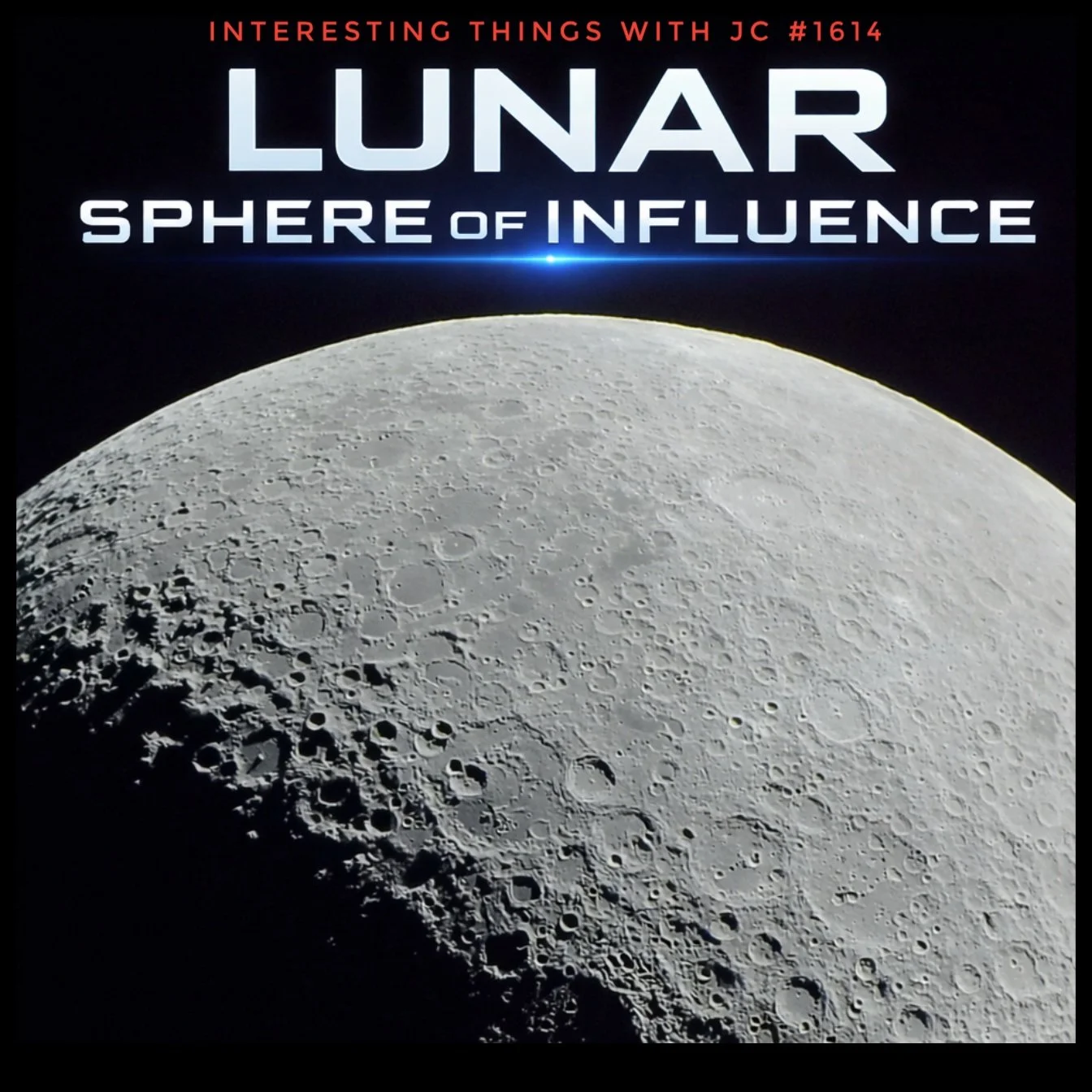
Close-up of the Moon’s cratered surface with strong light and shadow against black space. Large glowing title “LUNAR SPHERE OF INFLUENCE” appears across the upper third in a cinematic style.
Transcript
Interesting Things with JC #1614: Lunar Sphere of Influence
At less than 60,000 miles, about 96,500 kilometers, from the Moon, Artemis II is already past the point where Earth is the stronger pull.
Nothing marks it. No signal. But the physics has already flipped.
This is the Lunar Sphere of Influence, the region where the Moon’s gravity overtakes Earth’s on a spacecraft.
That boundary sits about 41,000 miles, or 66,000 kilometers, from the Moon.
And Artemis II is well inside it.
Up to that point, it has been slowing down. It left Earth at roughly 25,000 miles per hour, about 40,000 kilometers per hour, fast enough to escape, but as it climbs away, Earth’s gravity pulls against it the entire time, steadily reducing the speed.
But that doesn’t last.
Gravity doesn’t shut off. It shifts control.
As Artemis II crosses into the Moon’s sphere of influence, Earth’s pull has weakened enough that the Moon’s pull becomes stronger. Once that happens, the direction of the dominant force changes.
It begins to accelerate again.
Not from engines, but because it is now falling toward the Moon.
Gravity follows an inverse-square relationship. Distance drives everything. Earth is far more massive, but much farther away at this point, so its pull drops off quickly. The Moon is smaller, but now close enough that its influence builds rapidly.
At that crossover distance, the Moon becomes the primary gravitational system.
From there on, the path is governed by the Moon.
Same trajectory. Same velocity.
Different center.
This is how lunar missions are built. Earth provides the initial energy and sends you outward. You slow as you climb away, then accelerate again as you fall into the Moon’s gravity well.
If you need to enter orbit, you fire engines and reduce that speed.
If not, you keep it, swing around the Moon, and head back.
By the time Artemis II was reported under 60,000 miles, about 96,500 kilometers, from the Moon, that transition was already complete.
There’s no visible boundary.
But once you pass it, you are no longer leaving Earth.
You are already under the Moon’s control.
These are interesting things, with JC.
Student Worksheet
Comprehension Questions:
What is the lunar sphere of influence?
At what approximate distance does the Moon’s gravity dominate?
Why does a spacecraft slow down after leaving Earth?
Analysis Questions:
Explain how the inverse-square law affects gravitational strength between Earth and Moon
Why does acceleration increase again near the Moon without engines?
Compare mass vs. distance in determining gravitational dominance
Reflection Prompt:
Describe how understanding invisible forces like gravity changes how we think about motion in space
Difficulty Scaling:
Basic: Define terms and identify distances
Intermediate: Explain force changes using vocabulary
Advanced: Apply concept to a Mars mission scenario
Student Output:
Written responses (1–2 paragraphs for analysis)
Diagram showing force shift between Earth and Moon
Academic Integrity Guidance:
Use original explanations
Support answers with concepts from lesson
Avoid copying phrasing from transcript
Teacher Guide
Quick Start: Play audio → pause at key transitions → discuss gravitational shift
Pacing Guide:
0–5 min: Bell ringer
5–10 min: Audio playback
10–20 min: Guided discussion
20–35 min: Worksheet
35–45 min: Review
Bell Ringer: What happens to gravity as distance increases?
Audio Guidance: Pause after “physics has already flipped” and “it begins to accelerate again”
Audio Fallback: Teacher reads transcript aloud with emphasis on transitions
Time on Task: 45–50 minutes
Materials:
Transcript
Whiteboard
Diagram handout
Vocabulary Strategy: Pre-teach inverse-square law with simple examples
Misconceptions:
Gravity turns off (incorrect)
Heavier object always dominates (ignores distance)
Discussion Prompts:
Why is there no visible boundary?
How does this apply to satellites?
Formative Checkpoints: Ask students to explain velocity change mid-lesson
Differentiation:
Visual learners: diagrams
Advanced: orbital mechanics extension
Assessment Differentiation:
Oral explanation option
Diagram-based answers
Time Flexibility: Can compress worksheet or extend discussion
Substitute Readiness: Transcript supports full lesson delivery
Engagement Strategy: Use real mission framing (Artemis)
Extensions: Compare Earth-Moon SOI to Sun-Earth system
Cross-Curricular Connections:
Math: inverse-square law graphs
Engineering: trajectory design
SEL Connection: Build persistence in understanding abstract systems
Skill Value Emphasis: Analytical reasoning and systems thinking
Answer Key:
SOI: region where Moon’s gravity dominates
Distance: ~66,000 km
Slowing: Earth gravity opposing motion
Acceleration: falling into Moon gravity
Inverse-square: force decreases with distance squared
Quiz
What determines gravitational strength most directly?
A. Color
B. Distance
C. Temperature
D. ShapeWhat happens to velocity after leaving Earth?
A. Increases continuously
B. Stops
C. Decreases then increases
D. Remains constantWhat is the sphere of influence?
A. Atmosphere boundary
B. Region of dominant gravity
C. Magnetic field
D. Orbit pathWhy does the Moon’s gravity take over?
A. It becomes larger
B. It spins faster
C. It is closer
D. It gains massWhat causes acceleration near the Moon?
A. Engines
B. Air resistance
C. Gravity
D. Rotation
Assessment
Open-Ended Questions:
Explain how a spacecraft transitions from Earth’s gravitational control to the Moon’s
Analyze the role of distance in determining gravitational dominance
Rubric (3–2–1):
3: Accurate, detailed, uses vocabulary correctly
2: Partially accurate, minor errors
1: Incomplete or incorrect
Exit Ticket:
Why does a spacecraft speed up again near the Moon?
Standards Alignment
NGSS HS-PS2-4: Analyze and model gravitational forces using inverse-square relationships; students calculate how force changes with distance and apply it to Earth-Moon systems
NGSS HS-ETS1-2: Design solutions to complex problems; students evaluate trajectory planning constraints in lunar missions
CCSS RST.11-12.3: Follow multistep scientific explanations; students trace the sequence of velocity changes during spaceflight
CCSS HSN-Q.A.2: Define and use quantities; students interpret kilometers, miles, and velocity in context
ISTE 5 (Computational Thinker): Develop and use models; students create diagrams showing gravitational dominance shifts
C3 D2.Geo.3: Analyze spatial patterns; students evaluate how distance impacts force distribution in space systems
Career Readiness (STEM): Apply physics principles to aerospace contexts; students explain real mission dynamics using scientific reasoning
Homeschool/Lifelong Learning: Independently apply scientific models to real-world phenomena; students connect abstract laws to observable space missions
Show Notes
This lesson explores how gravity shifts control between Earth and the Moon during space travel. It highlights real mission physics and demonstrates how invisible forces govern motion. Understanding this concept builds foundational knowledge for physics, engineering, and space exploration.
References
NASA. (2023). Artemis II mission overview. https://www.nasa.gov/artemis-ii
NASA. (2024). Artemis II multimedia. https://www.nasa.gov/artemis-ii-multimedia/
NASA. (2020). Basics of spaceflight: Gravity and orbits. https://solarsystem.nasa.gov/basics/chapter4-1/
Fox News. (2026). Artemis II NASA moon mission live updates. https://www.foxnews.com/live-news/artemis-ii-nasa-moon-mission-04-05-26
Khan Academy. (2022). Newton’s law of gravitation. https://www.khanacademy.org/science/physics/centripetal-force-and-gravitation