1728: "Little Italy"
Interesting Things with JC #1728: "Little Italy"
Millions of Italian immigrants came to America seeking opportunity and helped build New York through hard work, faith, and family. Their neighborhoods became Little Italy, leaving a legacy that shaped both the city and the nation.
Curriculum - Episode Anchor
Episode Title: Little Italy
Episode Number: 1728
Host: Jim Connors (JC)
Audience: Grades 9–12, Introductory College, Homeschool, Lifelong Learners
Subject Area: United States History, Immigration, Civics, Cultural Studies, American History
Lesson Overview
Learning Objectives
By the conclusion of this lesson, students will be able to:
Explain the major causes of Italian immigration to the United States during the late nineteenth and early twentieth centuries.
Describe how Little Italy neighborhoods developed and why they became important centers of community life.
Analyze the economic, cultural, and civic contributions Italian Americans made to the United States.
Evaluate how immigrant communities balanced preserving their heritage while becoming part of American society.
Essential Question:
How did Italian immigrants help shape American cities while preserving their cultural identity?
Success Criteria:
Students will successfully:
Identify major historical reasons for Italian immigration.
Describe the purpose and function of Little Italy communities.
Cite examples of Italian American contributions to infrastructure, business, and culture.
Explain how immigration influenced both local communities and the broader American identity.
Student Relevance Statement:
Nearly every American community has been shaped by immigration. Understanding the experiences of Italian immigrants helps students better understand how cultures contribute to society while adapting to a new homeland.
Real-World Connection:
Modern cities continue to benefit from immigrant labor, entrepreneurship, and cultural traditions. Lessons from Little Italy demonstrate how neighborhoods evolve while preserving history and identity.
Workforce Reality:
Italian immigrants entered physically demanding industries including construction, transportation, manufacturing, mining, public works, and skilled trades. Their experiences demonstrate how perseverance, craftsmanship, reliability, and entrepreneurship can influence future generations and strengthen communities.
Key Vocabulary
Immigrant(IM-uh-grunt) — A person who moves permanently to another country.
Emigration(EM-ih-GRAY-shun) — Leaving one's homeland to settle elsewhere.
Migration(my-GRAY-shun) — The movement of people from one place to another.
Mutual Aid Society(MYOO-choo-ul AID suh-SIGH-uh-tee) — An organization that provides financial or social assistance to members during illness, injury, or hardship.
Diaspora(dy-AS-puh-ruh) — A population living outside its ancestral homeland while maintaining cultural connections.
Tenement(TEN-uh-ment) — A multi-family urban apartment building, often crowded during the late nineteenth century.
Assimilation(uh-SIM-uh-LAY-shun) — The process of adapting to the customs and culture of another society while becoming part of it.
Heritage(HAIR-ih-tij) — Traditions, beliefs, customs, and history passed from one generation to the next.
Entrepreneur(ahn-truh-pruh-NUR) — A person who starts and manages a business.
Infrastructure(IN-fruh-STRUK-chur) — The physical systems that support society, including roads, bridges, railroads, tunnels, water systems, and public transportation.
Narrative Core
Open
Italian immigrants arrived in America with little more than hope. Many helped build New York by day and returned each night to neighborhoods that became Little Italy.
Information
Between the 1880s and early 1920s, more than four million Italians immigrated to the United States. They played an important role in building New York's infrastructure while creating close-knit communities rooted in family, faith, and hard work.
Details
Little Italy provided support through churches, family businesses, and mutual aid societies. Italian traditions, food, and celebrations became part of American life as later generations became citizens, served their country, and built lives far beyond the original neighborhoods.
Reflection
Little Italy represents people who embraced the opportunities America offered while honoring their heritage. Their work helped build New York alongside countless other immigrant communities.
Closing
Their greatest legacy wasn't preserving Italy in America. It was helping build America itself.
These are interesting things, with JC.
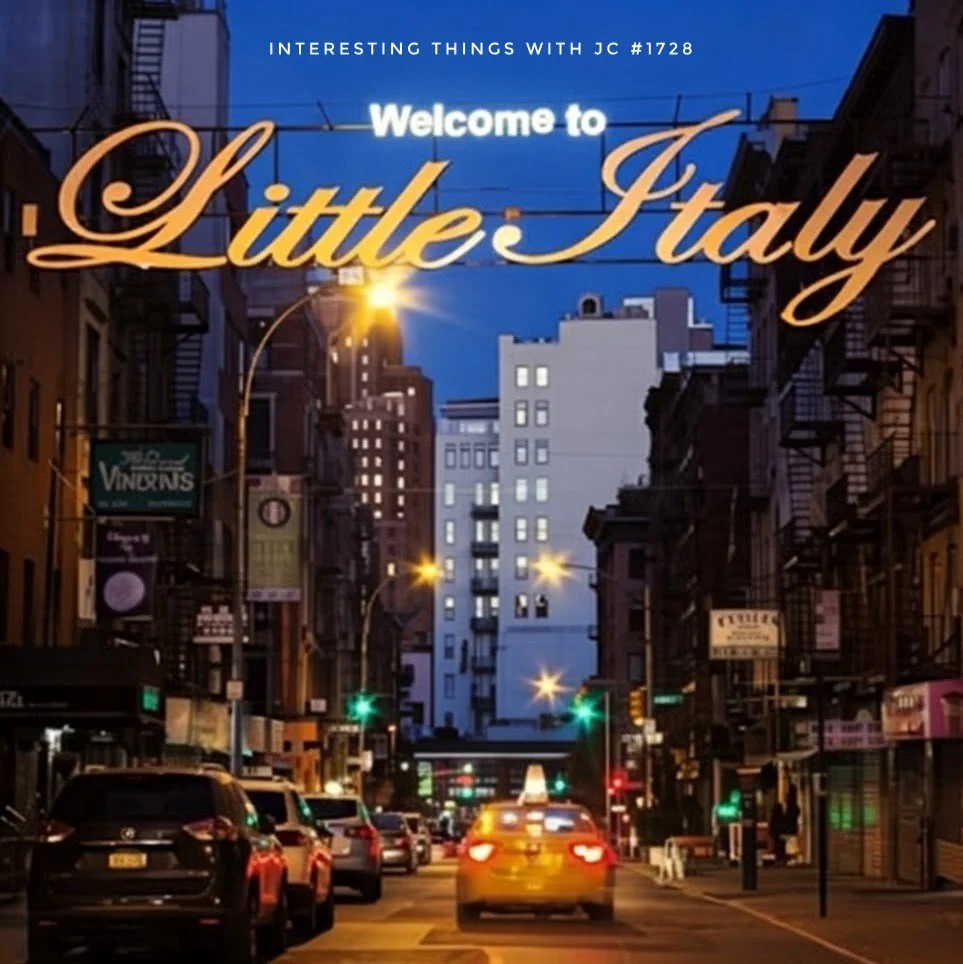
Podcast cover art for Interesting Things with JC #1728: "Little Italy." The image shows a dusk view down a narrow city street in New York City's Little Italy neighborhood. A large overhead sign reading "Welcome to Little Italy" spans the street in elegant gold script. Mid-rise brick buildings with fire escapes line both sides of the roadway. Parked cars fill the curbs, while a yellow taxi drives through the center beneath glowing streetlights and traffic signals. The deep blue evening sky contrasts with the warm amber street lighting, creating a welcoming urban atmosphere. Small white text at the top reads, "Interesting Things with JC #1728."
Transcript
Interesting Things with JC #1728:
“Little Italy”
Some of the men who dug New York's subway tunnels couldn't yet speak English. Many had arrived only months earlier with little more than a suitcase, a few possessions, and the hope that America could offer their families a better future. At the end of each day, they returned to neighborhoods where familiar voices, familiar food, and familiar churches reminded them of home. Those neighborhoods became known as Little Italy.
Little Italy wasn't built by architects or city planners. It was built by immigrants.
Between the 1880s and the early 1920s, more than four million Italians came to the United States. Most left villages in southern Italy and Sicily where opportunity had become scarce. They crossed the Atlantic believing that through hard work they could build a life their children might never have known otherwise.
America was expanding rapidly, and Italian immigrants often found the hardest jobs waiting for them. They dug tunnels beneath growing cities, laid railroad tracks, worked the docks and steel mills, and helped build the roads, bridges, apartment buildings, and subways that still define New York today. Their labor became part of the foundation of one of the world's greatest cities.
Life wasn't always easy. Italian immigrants often faced prejudice because of their language, their Catholic faith, and their customs. Good jobs were difficult to find, wages were low, and discrimination was common. Yet they responded by building close-knit communities where neighbors helped neighbors, families looked after one another, and opportunity was shared whenever possible.
Those communities became Little Italy.
There, newcomers found more than a place to live. They found grocery stores carrying familiar foods, churches filled with familiar traditions, family businesses, and people who understood the challenges of beginning again. Mutual aid societies helped families through illness, injury, and hardship years before government safety nets existed. These neighborhoods became places where new Americans found stability while building new lives.
Food eventually became Little Italy's most visible gift to America. Recipes carried across the Atlantic evolved with local ingredients, creating traditions that were uniquely Italian American while honoring generations of family cooking. Bread, pasta, pastries, espresso, and pizza gradually became part of everyday American life.
But Little Italy was always about more than food.
Annual celebrations like New York's Feast of San Gennaro brought neighborhoods together in expressions of faith, gratitude, and community. These traditions reminded each generation where they came from while celebrating the opportunities they had found in their adopted country.
As the years passed, the immigrants who had arrived with almost nothing put down permanent roots. They learned English, became American citizens, voted, opened businesses, served in America's armed forces, and raised children who embraced the opportunities their parents had crossed an ocean to find. They didn't come here to recreate Italy. They came here to build a future in America.
As families prospered, many moved beyond the old neighborhoods. Some Little Italys became smaller, while others nearly disappeared. Yet their influence only continued to grow.
Walk through New York today and you'll still find their fingerprints everywhere. Beneath your feet are subway tunnels they helped dig. Around you are churches they built, streets they paved, businesses they opened, and neighborhoods they transformed. They didn't simply live in New York. They helped build New York.
They built New York alongside millions of other Americans: Irish, Jewish, German, Slavic, Chinese, and so many more, each adding another stone to the foundation of a growing nation.
Little Italy endures because it tells the story of people who arrived with little, believed deeply in the promise of America, and answered that promise with hard work, loyalty, and determination. They never forgot where they came from, but they were equally proud of the country they chose to call home. Their greatest legacy wasn't preserving Italy inside America. It was helping build America itself.
These are interesting things, with JC.
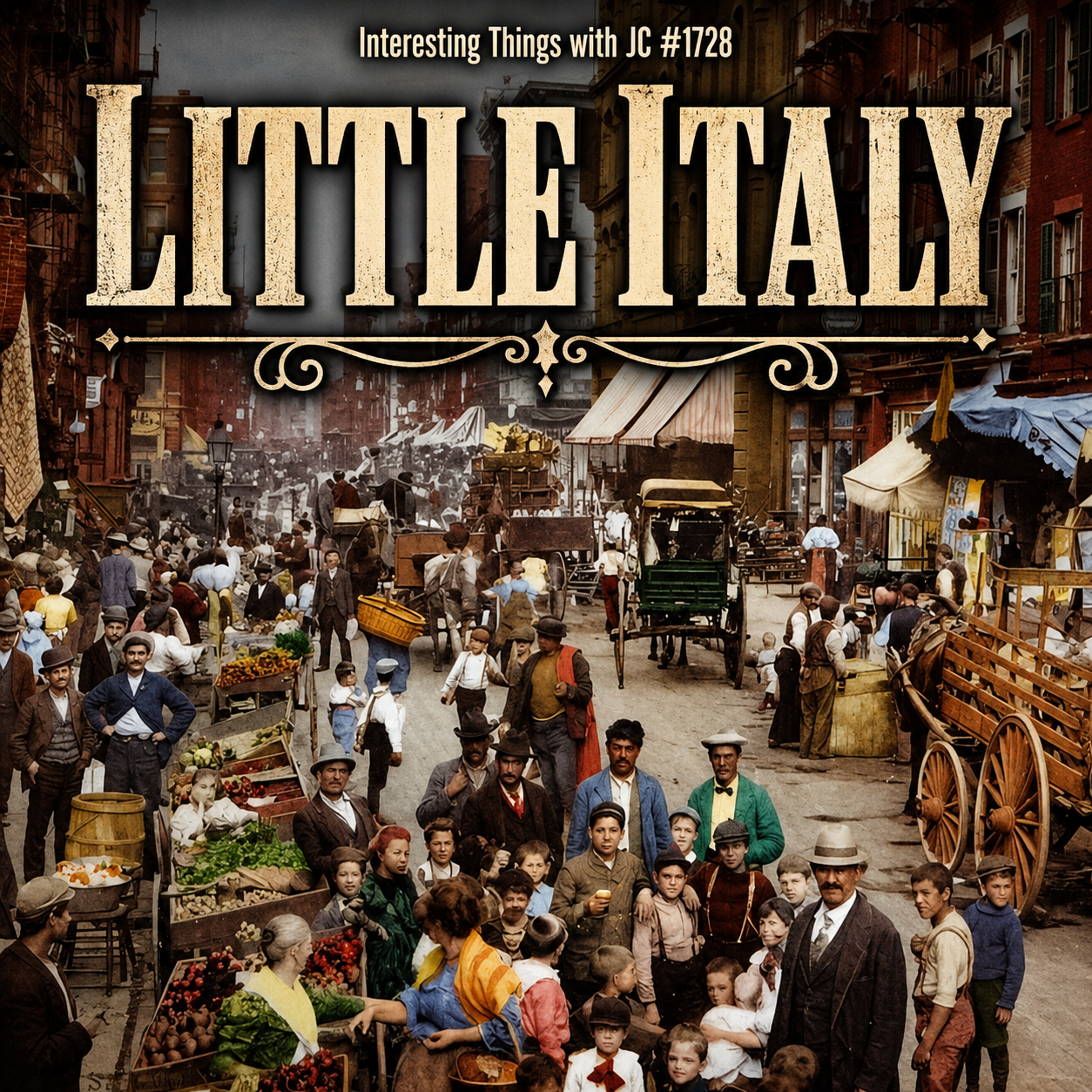
Podcast cover art for Interesting Things with JC #1728: "Little Italy." The image depicts a busy early 20th-century street market in New York City's Little Italy. Large distressed cream-colored letters spelling "LITTLE ITALY" dominate the top half of the cover, with smaller text above reading, "Interesting Things with JC #1728." Below, a crowded neighborhood street is filled with Italian immigrant families, produce vendors, horse-drawn wagons, handcarts, and period storefronts. Fresh vegetables, fruit, and barrels line the sidewalks as men, women, and children in early 1900s clothing gather throughout the marketplace. Brick tenement buildings with fire escapes rise on both sides of the street, creating a dense urban setting that reflects the vibrant daily life of one of America's best-known immigrant communities.
Student Worksheet
Purpose: Listen to the podcast first. Then complete the activities using evidence from the transcript. If audio is unavailable, read the transcript before beginning.
Student Name: ____________________________
Date: ____________________________
Class: ____________________________
Learning Target
I can explain why Little Italy developed, describe the experiences of Italian immigrants, and evaluate their contributions to American society using evidence from the podcast.
Instructions
Listen to the episode or carefully read the transcript.
Answer all questions using complete sentences.
Support your responses with evidence from the transcript whenever possible.
Complete all sections independently before discussing answers with classmates.
Part A – Comprehension
Why did millions of Italians leave Italy between the 1880s and the early 1920s?
Name three occupations commonly held by Italian immigrants after arriving in America.
What purposes did Little Italy neighborhoods serve for new immigrants?
What were mutual aid societies, and why were they important?
According to the podcast, why was Little Italy about more than food?
What happened to many Little Italy neighborhoods as later generations became more successful?
Part B – Vocabulary in Context
Define each term in your own words and explain how it relates to the episode.
Immigrant
Definition:
Connection:
Assimilation
Definition:
Connection:
Infrastructure
Definition:
Connection:
Mutual Aid Society
Definition:
Connection:
Heritage
Definition:
Connection:
Part C – Analysis
Answer each question using complete sentences.
Why do you think immigrant communities often settled together instead of spreading throughout a city?
How did discrimination influence the development of Little Italy?
What examples from the podcast show that Italian immigrants helped build America's infrastructure?
How did preserving Italian traditions strengthen families while helping them become Americans?
Why does the narrator describe Little Italy as "something larger than one neighborhood"?
Part D – Critical Thinking
Imagine you arrived in a country where you did not speak the language.
What challenges would you expect during your first year?
What kinds of community support would help you succeed?
How would you balance preserving your traditions while adapting to your new home?
Part E – Evidence Hunt
Locate evidence from the transcript supporting each statement.
Italian immigrants contributed to public infrastructure.
Evidence:
Little Italy helped preserve cultural traditions.
Evidence:
Italian Americans became active participants in American society.
Evidence:
Part F – Reflection
In one well-developed paragraph (8–10 sentences), explain why Little Italy remains historically important even though many of the original neighborhoods have become smaller. Include evidence from the podcast to support your response.
Challenge Activity (Advanced)
Research one Italian American who made significant contributions in one of the following fields:
Science
Medicine
Engineering
Military
Government
Business
Arts
Sports
Prepare a one-page summary explaining:
Who they were.
Their accomplishments.
How their work reflects the values discussed in the podcast.
Why their contributions remain important today.
Difficulty Scaling
Level 1: Complete Parts A and B.
Level 2: Complete Parts A–D.
Level 3: Complete the entire worksheet, including the reflection and challenge activity.
Student Output Expectations
Students should demonstrate:
Accurate historical understanding.
Appropriate use of vocabulary.
Evidence-based reasoning.
Clear written communication.
Respectful discussion of immigration and cultural history.
Academic Integrity Guidance
Complete your responses using your own words. Use the podcast and transcript as supporting evidence, but do not copy passages directly unless instructed to quote them. When using additional research for the challenge activity, properly cite all sources.
Teacher Guide
Quick Start
Begin class by playing the complete Interesting Things with JC #1728: Little Italy episode. Encourage students to listen for examples of perseverance, community building, and contributions to American society. If audio is unavailable, distribute the transcript and conduct a guided reading before beginning discussion and worksheet activities.
Pacing Guide (Audio-First)
Bell Ringer – 5 minutes
Podcast Listening – 12–15 minutes
Guided Discussion – 10 minutes
Worksheet Completion – 20–25 minutes
Review and Reflection – 10 minutes
Exit Ticket – 3–5 minutes
Bell Ringer
Display the following prompt:
"What makes a neighborhood feel like home?"
Have students write three characteristics that create a sense of belonging. Invite volunteers to share responses before introducing Little Italy.
Audio Guidance
Encourage students to identify examples of:
Push and pull factors of immigration.
Community support systems.
Cultural preservation.
Economic contributions.
Civic participation.
Students should record at least five specific examples while listening.
Audio Fallback
If audio cannot be played:
Assign silent reading of the transcript.
Read selected passages aloud.
Discuss vocabulary before beginning worksheet activities.
Continue with the same lesson objectives.
Time on Task
Direct Instruction: 15 minutes
Independent Work: 25 minutes
Collaborative Discussion: 15 minutes
Assessment and Closure: 5 minutes
Materials
Podcast audio or transcript
Student worksheet
Pens or pencils
Notebook paper
Internet-enabled devices (optional for extension activity)
Vocabulary Strategy
Introduce vocabulary before listening. Ask students to identify each word in context during the podcast and discuss how its meaning contributes to understanding the immigrant experience.
Common Misconceptions
All Italian immigrants arrived wealthy.
Little Italy existed only in New York City.
Immigration ended after arriving in America.
Assimilation required abandoning cultural traditions.
Italian American culture is defined only by food.
Discussion Prompts
Why were immigrant neighborhoods important during this period?
How did mutual aid societies strengthen communities?
Why were Italian immigrants willing to endure dangerous work?
How did later generations expand opportunities beyond Little Italy?
What evidence demonstrates that immigrants shaped American cities?
How can preserving heritage strengthen rather than divide a community?
Formative Checkpoints
Students correctly identify push and pull factors.
Students explain the role of community institutions.
Students support answers with evidence from the transcript.
Students distinguish between preserving culture and assimilation.
Differentiation
For Emerging Learners
Provide vocabulary cards.
Allow partner discussions before writing.
Use guided notes during the podcast.
For Advanced Learners
Compare Italian immigration with another immigrant group.
Analyze primary-source photographs of historic Little Italy neighborhoods.
Research immigration statistics and demographic changes over time.
Assessment Differentiation
Students may demonstrate understanding through:
Written responses.
Oral presentations.
Graphic organizers.
Historical timelines.
Multimedia projects.
Time Flexibility
One 60-minute class period.
Two 45-minute class periods.
Extended project over one week with research activities.
Substitute Readiness
This lesson may be taught directly from the transcript if podcast audio is unavailable. All worksheet activities remain aligned with the lesson objectives.
Engagement Strategy
Ask students to imagine arriving in a new country with limited resources. Throughout the lesson, return to this perspective to encourage empathy while maintaining historical accuracy.
Extensions
Create a map of historic Little Italy neighborhoods in the United States.
Research the construction of New York City's subway system.
Compare Feast of San Gennaro traditions with another cultural festival.
Interview a family member about immigration or migration experiences.
Cross-Curricular Connections
History: Industrialization and immigration.
Geography: Migration patterns.
Economics: Entrepreneurship and labor markets.
English Language Arts: Narrative analysis.
Civics: Citizenship and civic participation.
SEL Connection
Students develop empathy, perspective-taking, appreciation for cultural diversity, and respect for the experiences of immigrant families while recognizing the value of perseverance and community support.
Skill Value Emphasis
This lesson reinforces:
Historical analysis.
Evidence evaluation.
Critical thinking.
Communication.
Cultural literacy.
Civic understanding.
Collaboration.
Problem solving.
Answer Key
Worksheet Part A
Limited opportunity, poverty, and hopes for a better future in America.
Tunnel construction, railroad work, steel mills, docks, bridge construction, building trades (any three).
Community support, familiar language, churches, businesses, housing, cultural preservation.
Organizations that provided financial and social assistance during hardship.
It preserved faith, family, traditions, language, and community—not just cuisine.
Many families moved into other neighborhoods and suburbs as opportunities increased.
Vocabulary
Responses should accurately reflect lesson definitions while demonstrating understanding in context.
Analysis
Responses should reference evidence from the transcript and demonstrate historical reasoning rather than opinion alone.
Quiz
Instructions: Select the best answer for each question. Use the podcast and your notes to support your thinking. (Answers are intentionally omitted.)
Why did many Italians immigrate to the United States between the 1880s and the early 1920s?
A. To escape a military draft
B. To seek greater economic opportunity for their families
C. To establish new colonies for Italy
D. To attend American universities
Which of the following best describes the primary purpose of Little Italy?
A. A government-sponsored housing project
B. A tourist attraction created for visitors
C. A community where immigrants found support, familiar culture, and opportunity
D. A business district reserved for Italian-owned companies
According to the podcast, which industry employed many Italian immigrants?
A. Aviation manufacturing
B. Computer programming
C. Subway and railroad construction
D. Motion picture production
What role did mutual aid societies serve within Little Italy?
A. They recruited workers for factories.
B. They organized political campaigns.
C. They provided financial and social assistance during hardship.
D. They operated public schools.
Which statement best summarizes the central message of the episode?
A. Little Italy remained unchanged for more than a century.
B. Italian immigrants preserved their heritage while helping build the United States.
C. Italian immigration ended because cities became overcrowded.
D. Italian Americans contributed primarily through restaurants and festivals.
Assessment
Performance Task
Using evidence from the podcast and transcript, demonstrate your understanding of how Italian immigrants contributed to American society while preserving their cultural heritage.
Open-Ended Question 1
Explain why Little Italy neighborhoods became essential to newly arrived Italian immigrants. Include at least three examples from the podcast to support your answer.
Open-Ended Question 2
The episode concludes that Italian immigrants "helped build America." Evaluate this statement using specific historical examples discussed in the episode. Explain why these contributions continue to matter today.
3–2–1 Reflection Rubric
3 Things I Learned
2 Ideas That Changed My Thinking
1 Question I Still Have
Assessment Rubric
Historical Understanding:
Exceeds – Accurate and detailed | Meets – Accurate | Developing – Partial
Use of Evidence:
Exceeds – Multiple examples | Meets – Two examples | Developing – Limited evidence
Critical Thinking:
Exceeds – Insightful analysis | Meets – Clear analysis | Developing – Limited analysis
Communication:
Exceeds – Clear and organized | Meets – Mostly clear | Developing – Needs improvement
Exit Ticket
Before leaving class, answer the following in two or three complete sentences:
How did Little Italy help immigrants become Americans without requiring them to abandon their cultural identity?
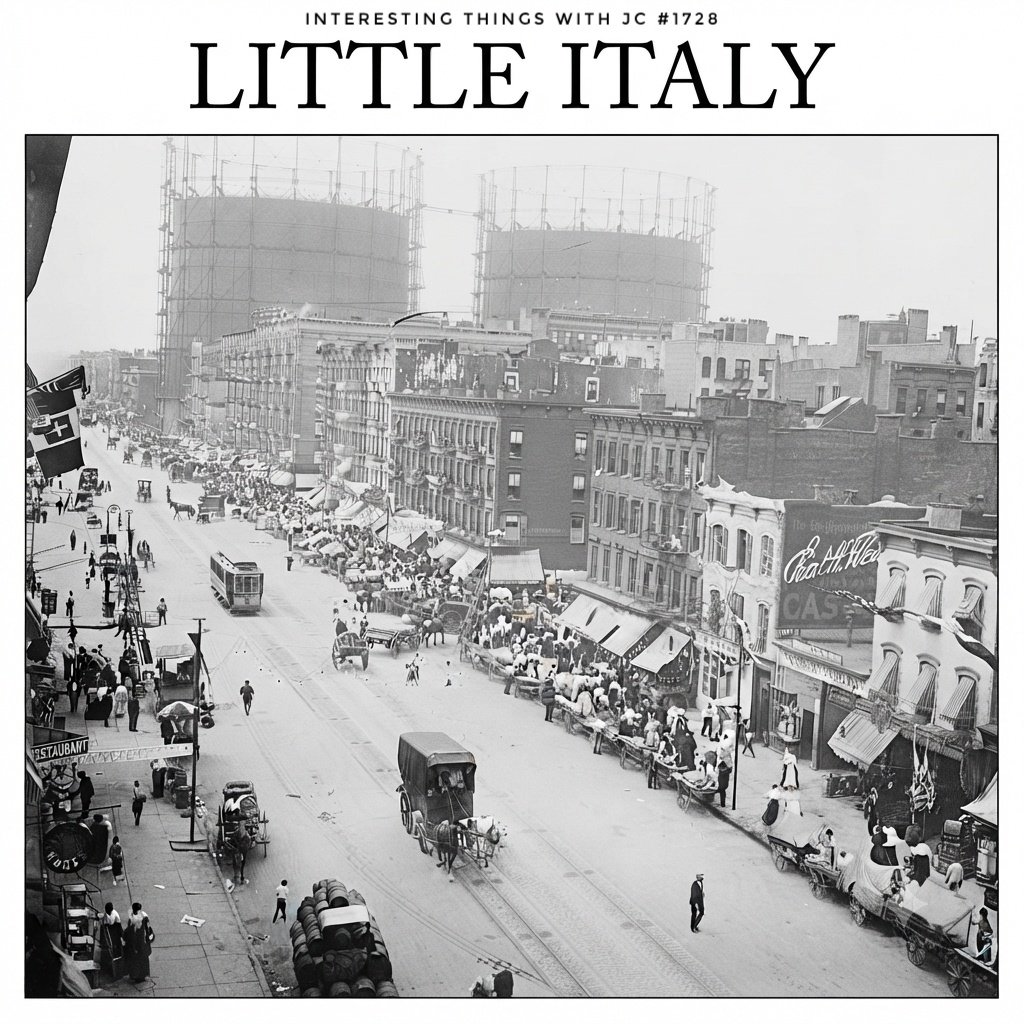
Podcast cover art for Interesting Things with JC #1728: "Little Italy." The cover features a historic black-and-white photograph of New York City's Little Italy in the early 20th century. Centered at the top are the words "Interesting Things with JC #1728," with the title "LITTLE ITALY" displayed prominently beneath in large black serif lettering. The elevated viewpoint looks down a wide city street lined with five- and six-story brick tenement buildings, storefronts, and sidewalk produce markets crowded with shoppers. Horse-drawn wagons, an early automobile, streetcar tracks, and pedestrians fill the roadway, illustrating the neighborhood's busy commercial life. Two large cylindrical gas storage tanks under construction rise above the surrounding buildings in the background, highlighting the rapid industrial growth of New York during the era. The image conveys the energy and density of an immigrant neighborhood that became an important center of Italian American life.
Standards Alignment
Instructional Alignment Summary
Grade Band: Grades 9–12, Introductory College, Homeschool, Lifelong Learning
Primary Disciplines: United States History, Civics, Geography, Cultural Studies, English Language Arts
Primary Learning Outcomes: Historical analysis, evidence evaluation, civic understanding, communication, critical thinking, and career readiness.
NGSS – Science & Engineering Practices (Applicable Cross-Disciplinary Practice)
Standard: SEP 8 – Obtaining, Evaluating, and Communicating Information
Lesson Connection: Students obtain historical information from the podcast and transcript, evaluate the reliability of evidence, and communicate conclusions through discussion, written responses, and assessments.
Student Performance
Identify historical evidence from the transcript.
Evaluate the significance of historical examples.
Communicate evidence-based conclusions in writing and discussion.
Evidence of Mastery
Student Worksheet (Parts C–F)
Class Discussion
Reflection Paragraph
Open-Ended Assessment
Justification
Historical inquiry relies on the same evidence evaluation and communication skills emphasized within the Science and Engineering Practices framework.
Common Core State Standards – Reading (History/Social Studies)
CCSS.ELA-LITERACY.RH.9-10.1
Cite specific textual evidence to support analysis of primary and secondary sources.
Lesson Connection
Students support conclusions using evidence from the podcast transcript when explaining immigration, discrimination, community development, and Italian American contributions.
Measured Skill
Evidence-based historical reasoning
Assessment Evidence
Student Worksheet
Reflection
Assessment Questions
CCSS.ELA-LITERACY.RH.9-10.2
Determine the central ideas of a source and provide an accurate summary.
Lesson Connection
Students summarize why Little Italy developed, explain its historical significance, and distinguish between supporting details and central themes.
Measured Skill
Historical summarization
Identification of central ideas
Assessment Evidence
Comprehension Questions
Reflection
Quiz
CCSS.ELA-LITERACY.RH.11-12.6
Evaluate authors' perspectives and historical viewpoints.
Lesson Connection
Students analyze how the podcast presents the immigrant experience while distinguishing historical facts from broader historical interpretation.
Measured Skill
Source analysis
Historical perspective
Assessment Evidence
Discussion
Reflection
Open-Ended Assessment
Common Core State Standards – Writing
CCSS.ELA-LITERACY.WHST.9-10.2
Write informative/explanatory texts to examine historical topics using evidence.
Lesson Connection
Students compose organized written responses explaining the historical importance of Little Italy using evidence from the lesson.
Measured Skill
Informational writing
Organization
Evidence integration
Assessment Evidence
Reflection Paragraph
Assessment Responses
CCSS.ELA-LITERACY.WHST.11-12.9
Draw evidence from informational texts to support analysis and research.
Lesson Connection
Students use the transcript and optional research sources to support conclusions regarding immigration and Italian American history.
Measured Skill
Research
Evidence synthesis
Assessment Evidence
Extension Activity
Reflection
Assessment
Common Core State Standards – Speaking & Listening
CCSS.ELA-LITERACY.SL.9-10.1
Initiate and participate effectively in collaborative discussions.
Lesson Connection
Students engage in structured discussions about immigration, community identity, civic participation, and historical contributions.
Measured Skill
Academic discussion
Listening
Evidence-based communication
Assessment Evidence
Guided Discussion
Bell Ringer
Teacher Observation
CCSS.ELA-LITERACY.SL.11-12.4
Present information clearly with appropriate evidence and organization.
Lesson Connection
Students communicate historical conclusions orally during discussion or extension presentations.
Measured Skill
Oral communication
Presentation skills
Assessment Evidence
Extension Presentation
Classroom Discussion
C3 Framework for Social Studies
D2.His.1.9-12
Evaluate how historical events and developments were shaped by unique circumstances.
Lesson Connection
Students examine why Italian immigration increased during industrialization and how economic conditions influenced migration.
Measured Skill
Historical reasoning
Cause-and-effect analysis
Assessment Evidence
Worksheet Analysis
Open-Ended Assessment
D2.His.14.9-12
Analyze multiple and complex causes and effects of events in the past.
Lesson Connection
Students analyze how immigration affected American cities, labor, infrastructure, and cultural development.
Measured Skill
Multi-causal historical analysis
Assessment Evidence
Reflection
Assessment
D2.Civ.4.9-12
Explain how individuals influence civic and political institutions.
Lesson Connection
Students evaluate how Italian Americans contributed through military service, voting, entrepreneurship, education, and public service.
Measured Skill
Civic understanding
Historical citizenship
Assessment Evidence
Discussion
Reflection
Assessment
ISTE Standards for Students
ISTE Standard 3 – Knowledge Constructor
Lesson Connection
Students gather, evaluate, and synthesize historical information from the podcast, transcript, and extension research.
Measured Skill
Information literacy
Digital research
Evidence evaluation
Assessment Evidence
Extension Research Project
Reflection
Classroom Discussion
Career Readiness Competencies
Analytical Thinking
Students evaluate historical evidence and develop logical conclusions supported by facts.
Communication
Students clearly explain historical concepts through writing, discussion, and presentations.
Problem Solving
Students examine how immigrant communities addressed economic hardship, discrimination, and social challenges.
Adaptability
Students recognize how immigrant families adjusted to new environments while preserving important traditions.
Professional Judgment
Students distinguish factual historical evidence from opinion and communicate conclusions responsibly.
Homeschool / Lifelong Learning Alignment
Independent Learning
Students independently complete historical analysis using both the transcript and supplemental research.
Information Literacy
Students evaluate historical information from multiple reliable sources and distinguish evidence from unsupported claims.
Real-World Application
Students connect historical immigration patterns with modern communities, workforce development, entrepreneurship, and civic engagement.
Self-Directed Inquiry
Extension activities encourage independent exploration of local immigration history, family heritage, or Italian American contributions.
Transferable Life Skills
Students strengthen historical reasoning, analytical thinking, communication, research, empathy, cultural literacy, and evidence-based decision-making through authentic historical inquiry.
Show Notes
This lesson explores the history of Little Italy as a reflection of the broader Italian immigrant experience in the United States. Students examine the challenges immigrants faced, the communities they built, and the lasting influence of Italian Americans on American infrastructure, business, culture, and civic life. Through historical analysis, discussion, and evidence-based writing, learners discover that Little Italy represents more than a neighborhood, it symbolizes perseverance, opportunity, and the enduring contributions of immigrant families to the American story.
References
New York City Council. (n.d.). Italian American Caucus. https://council.nyc.gov/caucuses/italian-caucus/
New York Yearly Meeting's Young Adult Friends. (n.d.). Formation of an Italian Caucus. https://nyyrc.com/news/formation-of-an-italian-caucus/
Italo Americano. (n.d.). Italian laborers. https://italoamericano.org/italian-laborers/
The Nelson-Atkins Museum of Art. (n.d.). Steel workers on Empire State Building (Italian and Slavic). https://art.nelson-atkins.org/objects/48627/steel-workers-on-empire-state-building-italian-and-slavic
Library of Congress. (n.d.). Immigration and relocation in U.S. history. https://www.loc.gov/classroom-materials/immigration/
The Statue of Liberty–Ellis Island Foundation. (n.d.). Ellis Island history. https://www.libertyellisfoundation.org/ellis-island-history
The National Italian American Foundation. (n.d.). Italian American history and culture. https://www.niaf.org
U.S. Census Bureau. (n.d.). The foreign-born population in the United States. https://www.census.gov/topics/population/foreign-born.html
History.com Editors. (2024). Ellis Island. https://www.history.com/topics/immigration/ellis-island