1729: "Project Skif: Russia's Seabed Nuclear Silos"
Interesting Things with JC #1729: "Project Skif: Russia's Seabed Nuclear Silos"
Intelligence reports suggest Russia may be testing nuclear missile launchers designed to wait for years on the Arctic seabed.
Curriculum - Episode Anchor
Episode Title: Project Skif: Russia’s Seabed Nuclear Silos
Episode Number: 1729
Host: JC
Audience: Grades 9–12, introductory college, homeschool, and lifelong learners
Subject Area: World history, physical science, engineering, international security, media literacy, and civics
Recommended Length: 55–75 minutes
Instructional Approach: Audio-first inquiry using evidence classification, systems analysis, and responsible discussion of nuclear deterrence
Lesson Overview
Objectives: Students will:
Describe the traditional nuclear triad and explain how a seabed launch system would differ from its three established platforms.
Distinguish confirmed facts, attributed intelligence assessments, public statements, and unresolved claims in reporting about Project Skif.
Explain how pressure, corrosion, communications, concealment, maintenance, and verification affect the feasibility of a seabed missile system.
Construct an evidence-based judgment about why an alleged system can influence strategic planning even when its operational status is uncertain.
Essential Question: How should analysts evaluate a strategically important weapons claim when the available evidence is incomplete, classified, or indirect?
Success Criteria: Students can accurately summarize the alleged system, classify at least four claims by evidence level, explain two engineering challenges, and defend a conclusion using relevant evidence and calibrated language.
Student Relevance: Students regularly encounter claims based on anonymous sources, intelligence reporting, satellite observations, and partial technical evidence. This lesson develops the ability to separate what is known from what is inferred.
Real-World Connection: Governments, journalists, engineers, treaty specialists, and military analysts must make responsible decisions without possessing perfect information.
Workforce Reality: Careers involving intelligence, engineering, journalism, diplomacy, emergency planning, cybersecurity, and public policy require disciplined source evaluation, careful communication, and professional judgment.
Key Vocabulary
Nuclear triad(NOO-klee-er TRY-ad): A deterrence structure based on land-based missiles, strategic bombers, and submarine-launched ballistic missiles.
Nuclear deterrence(NOO-klee-er dih-TUR-ents): The attempt to prevent attack by maintaining a credible ability to retaliate.
Ballistic missile(buh-LIS-tik MIS-ul): A missile that follows a powered ascent followed largely by an unpowered trajectory toward its target.
Seabed(SEE-bed): The ocean floor, including the sediment and rock beneath marine waters.
Launch container(lawnch kuhn-TAY-ner): A protective structure designed to store and potentially release a missile.
Second-strike capability(SEK-und strike kay-puh-BIL-uh-tee): The ability to retaliate after absorbing an initial attack.
Attribution(at-rih-BYOO-shun): Identification of the person, organization, document, or evidence supporting a claim.
Corroboration(kuh-rob-uh-RAY-shun): Independent evidence that strengthens or confirms a claim.
Arms control(armz kuhn-TROHL): Agreements and verification practices intended to limit, regulate, or reduce weapons.
Operational(op-uh-RAY-shuh-nuhl): Fully deployed, functional, and ready for intended use rather than merely proposed or tested.
Narrative Core
Open: Nuclear deterrence has traditionally depended on three launch environments: underground land sites, aircraft, and submarines. Project Skif raises the reported possibility of placing a missile system directly on the ocean floor.
Info: German public broadcasters WDR and NDR reported in May 2026 that intelligence services from several NATO countries were monitoring activity associated with a possible Russian seabed missile program. The reporting linked the alleged project to the names Skif and Skythen and to operations involving specialized Russian vessels.
Details: The concept reportedly uses a protected container placed on the Arctic seabed. Analysts have associated the proposed system with a modified Sineva submarine-launched ballistic missile, although public technical evidence remains limited. Such a system could be difficult to locate, but it would face major engineering problems involving pressure, corrosion, secure communications, power, sediment, maintenance, launch reliability, and treaty verification.
Reflection: The central analytical issue is not whether every reported detail is true. It is how decision-makers should assess an allegation whose consequences could be serious but whose evidence remains incomplete. Students must distinguish demonstrated capability from development, testing, deployment, and speculation.
Closing: These are interesting things, with JC.
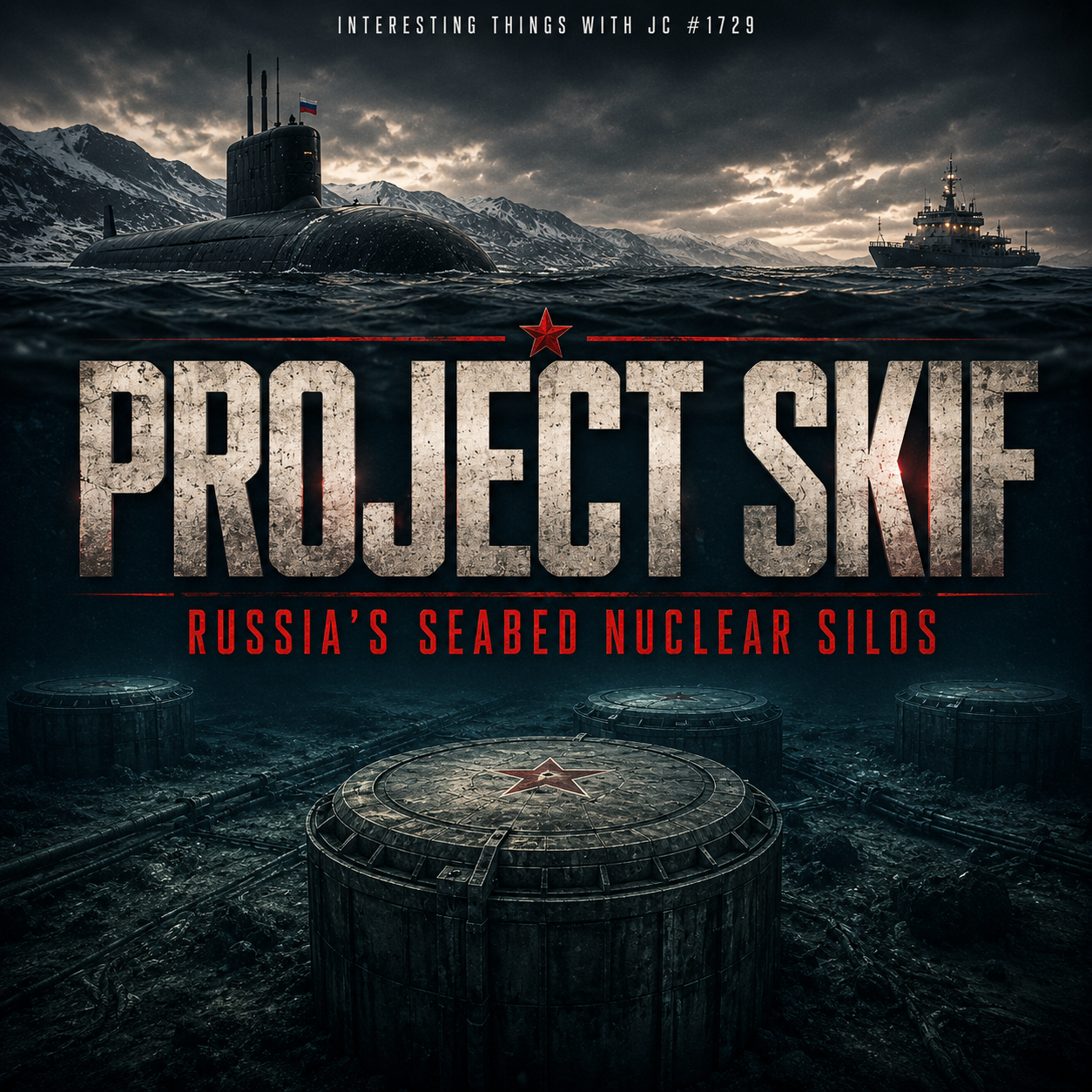
Square podcast cover for Interesting Things with JC #1729. At the top, small white text reads, "Interesting Things with JC #1729." A dark, stormy Arctic seascape fills the image. A large Russian submarine surfaces in rough water beneath heavy clouds, while a military support ship sits on the horizon to the right with snow-covered mountains in the background. Below the waterline, the ocean floor reveals several massive circular missile silo structures connected by pipelines, suggesting an underwater military installation. Dominating the center is the large distressed title, "PROJECT SKIF," with the subtitle, "Russia's Seabed Nuclear Silos," in bold red text beneath it. The overall color palette is dark blue, gray, black, and muted red, creating a dramatic Cold War atmosphere.
Transcript
Interesting Things with JC #1729:
Project Skif: Russia’s Seabed Nuclear Silos
For more than half a century, the balance of nuclear deterrence has rested on three kinds of launch platforms: land-based missile silos, strategic bombers, and ballistic missile submarines. According to a recent investigation by Germany's WDR and NDR, citing intelligence assessments from several NATO countries, Russia may be working to add a fourth.
The reported program is called Project Skif, or Skythen, after the ancient Scythians. Instead of carrying missiles aboard submarines, the concept places them inside armored launch containers anchored to the Arctic seabed, where they could remain undetected for years until activated by command.
The idea reaches back to the Cold War. Both the United States and the Soviet Union examined the military value of seabed missile systems. A launcher resting hundreds of meters below the surface would be difficult to detect, difficult to target, and free from the expense of keeping a submarine and its crew at sea. The prospect of nuclear weapons hidden on the ocean floor became serious enough that it helped produce the 1971 Seabed Arms Control Treaty, which prohibited placing nuclear weapons on the seabed outside a nation's territorial waters.
Intelligence assessments now suggest Russia has revived that concept. The launch container is believed to carry a modified version of the R-29RMU Sineva submarine-launched ballistic missile. Western intelligence has also closely followed the heavy-lift vessel Zvezdochka and the experimental submarine Sarov, both thought to be involved in testing or deploying the system in Arctic waters.
Much about Project Skif remains uncertain. There is no public evidence that operational weapons have already been emplaced on the seabed, and many technical details remain classified or are based on intelligence reporting rather than official confirmation. Even so, in 2017, former Russian Aerospace Forces commander Viktor Bondarev publicly referred to Skif missiles as part of Russia's strategic arsenal.
If those assessments prove correct, Project Skif does not change what a nuclear missile can do. It changes where one can wait. A Cold War concept once set aside may now be returning to one of the most inaccessible places on Earth, where the ocean itself becomes part of the launch system.
These are interesting things, with JC.
Student Worksheet
Student Output: Answer in complete sentences. Cite the transcript by paragraph number or by quoting no more than one brief phrase. Label uncertain claims with language such as “reported,” “alleged,” “assessed,” or “not publicly confirmed.”
Academic Integrity Guidance: Complete the reasoning independently unless collaboration is assigned. Do not present an allegation as confirmed merely because it appears in a published report.
Comprehension
What three platforms form the traditional nuclear triad?
How would the reported Project Skif concept differ from a ballistic missile submarine?
What treaty is discussed, and what category of activity does it restrict?
Which missile, vessel, and submarine are associated with the reported project?
What does the transcript say about public evidence of operational deployment?
Analysis
Classify each statement as confirmed public fact, attributed report, analytical inference, or unresolved claim:
The Seabed Arms Control Treaty was concluded in 1971.
WDR and NDR reported that NATO-country intelligence services were monitoring the alleged program.
Operational Skif missiles are currently deployed across the Arctic seabed.
A stationary seabed system might reduce dependence on continuously crewed submarines.
Identify two possible strategic advantages and two engineering disadvantages of a seabed launch container.
Explain why the words development, testing, deployment, and operational should not be treated as synonyms.
Does a difficult-to-detect weapon automatically create more stable deterrence? Present one reason supporting that position and one reason challenging it.
What additional evidence would most strengthen or weaken the claim that an operational system exists?
Reflection
11. In 100–150 words, explain how uncertainty should affect the way journalists, officials, and citizens discuss Project Skif.
Difficulty Scaling
Foundational: Complete Questions 1–7 using sentence starters supplied by the teacher.
Core: Complete all questions and cite three transcript details.
Advanced: Complete all questions and add a 200-word source reliability memorandum comparing the treaty record, investigative reporting, and later secondary coverage.
Teacher Guide
Quick Start: Begin by playing or reading the complete podcast transcript without first explaining Project Skif. Ask students to record three claims they consider well supported and three that require verification.
Pacing Guide:
Podcast first listen — 5 minutes: Listen without interruption and identify the main claim.
Evidence-marking listen — 7 minutes: Replay or reread while students mark facts, attributed reports, inferences, and uncertainties.
Vocabulary and concept check — 8 minutes: Review the nuclear triad, deterrence, operational status, attribution, and corroboration.
Worksheet investigation — 15–20 minutes: Students complete comprehension and evidence-classification tasks.
Structured discussion — 12–15 minutes: Examine engineering feasibility, treaty questions, and uncertainty.
Assessment or exit ticket — 8–15 minutes: Complete the selected written task.
Bell Ringer: “What makes a claim credible when direct evidence is unavailable to the public?” Students list three credibility indicators and one warning sign.
Audio Guidance: On the first listen, students should focus on the story’s central concept. On the second listen, they should mark phrases such as “according to,” “believed,” “thought to be,” “suggest,” and “no public evidence.”
Audio Fallback: Read the transcript aloud or assign paired reading. Preserve the audio-first sequence by asking students to listen to the teacher or partner before independently annotating the text.
Time on Task: Standard lesson: 60 minutes. Extended source analysis: 75 minutes. Condensed version: 40 minutes.
Materials:
Episode audio or transcript
Student worksheet
Four-color highlighters or annotation symbols
Evidence classification chart
Optional map of the Arctic and Barents/White Sea region
Vocabulary Prep: Ask students to sort the terms into three groups: weapons systems, evidence evaluation, and international regulation.
Misconceptions:
The reported existence of a program does not establish operational deployment.
A seabed container is not the same thing as a crewed ballistic missile submarine.
“Nuclear-capable” does not prove that a nuclear warhead is installed.
Difficult detection does not guarantee reliable communications or launch performance.
The Seabed Arms Control Treaty does not simply prohibit every military object on every part of the ocean floor.
Discussion Prompts:
Which sentence in the transcript most clearly communicates uncertainty?
Why might ambiguity itself have strategic value?
What technical requirement would be hardest to maintain for years without servicing?
How can intelligence reporting be significant without being independently verifiable?
What responsibilities do journalists have when reporting classified assessments?
Formative Checkpoints:
After the first listen, students state the main claim without overstating certainty.
During annotation, students correctly classify at least four of six sample claims.
Before discussion, students explain the difference between testing and deployment.
During closure, students cite one fact and one unresolved issue.
Differentiation:
Provide sentence frames: “The source confirms ___, but it does not confirm ___.”
Allow students to use a visual claim-evidence-reasoning organizer.
Preteach the nuclear triad using a three-column diagram.
Permit oral responses or speech-to-text for students with writing accommodations.
Pair advanced readers with primary treaty language and require clause interpretation.
Assessment Differentiation: Accept a written response, recorded oral analysis, annotated evidence map, or claim-evidence-reasoning chart, provided the student demonstrates the same evidence and reasoning outcomes.
Time Flexibility: For a 40-minute lesson, assign Worksheet Questions 1–8 and use the exit ticket. For a 75-minute lesson, add the advanced source memorandum.
Substitute Readiness: Play or read the transcript, have students complete Questions 1–8, conduct a five-minute partner comparison, and collect the exit ticket. No specialized content lecture is required.
Engagement Strategy: Use an “evidence confidence line.” Students position claims from low to high confidence and must justify placement using source type, attribution, corroboration, and specificity.
Extensions:
Create a systems diagram showing command, communication, power, container, missile, and environmental dependencies.
Compare a mobile submarine with a stationary seabed container using reliability, concealment, cost, maintenance, and verification criteria.
Research how remote undersea infrastructure is monitored without discussing operational evasion techniques.
Write a neutral 150-word news brief that preserves uncertainty.
Cross-Curricular Connections:
Physics: Water pressure, buoyancy, material stress, and launch environments.
Chemistry: Saltwater corrosion and long-term material degradation.
Engineering: Reliability, redundancy, maintenance, power, and communications.
History: Cold War weapons development and arms-control negotiations.
Civics: Treaty interpretation, national responsibility, and verification.
Media Literacy: Attribution, anonymous sourcing, corroboration, and calibrated language.
SEL: Students practice discussing high-consequence topics without sensationalism, recognizing uncertainty, listening to opposing interpretations, and separating emotional reaction from evidence-based judgment.
Skill Emphasis: Analytical thinking, disciplined communication, problem solving, adaptability, source evaluation, and professional judgment.
Answer Key:
Land-based missile silos, strategic bombers, and ballistic missile submarines.
The alleged system would place a protected launch container on the seabed rather than carry missiles inside a crewed, mobile submarine.
The 1971 Seabed Arms Control Treaty; it restricts emplacement of nuclear weapons and other weapons of mass destruction on the seabed beyond the treaty’s coastal-zone boundary.
The R-29RMU Sineva missile, the vessel Zvezdochka, and the experimental submarine Sarov.
The transcript states that no public evidence establishes that operational weapons have already been placed on the seabed.
Treaty date: confirmed public fact. WDR/NDR intelligence reporting: attributed report. Current operational deployment: unresolved claim. Reduced submarine dependence: analytical inference.
Possible advantages include concealment, survivability, reduced need for crews at sea, and possible cost savings. Disadvantages include corrosion, pressure, communications, power supply, maintenance, sediment, verification, and launch reliability.
Development means designing a capability; testing means evaluating components or prototypes; deployment means placing systems in intended positions; operational means ready and authorized for use.
Answers will vary. Strong responses address survivability as a possible stabilizing factor and ambiguity, command risk, arms-racing pressure, or miscalculation as possible destabilizing factors.
Strong evidence could include independently verified imagery, official records, test data, treaty inspection findings, multiple independent intelligence assessments, or physical recovery. Evidence disproving feasibility, misidentifying vessels, or showing nonweapon purposes could weaken the claim.
Responses should use calibrated language, distinguish evidence levels, avoid claiming certainty, and explain why serious allegations still deserve careful investigation.
Quiz Key: 1-B, 2-C, 3-A, 4-D, 5-B.
Quiz
Which platform is not traditionally part of the nuclear triad?
A. Strategic bomber
B. Seabed launch container
C. Land-based missile silo
D. Ballistic missile submarine
What is the most accurate description of Project Skif based on the transcript?
A. A publicly demonstrated network of operational Arctic missiles
B. A civilian ocean-mapping project
C. A reported Russian concept involving seabed missile containers
D. A replacement for every submarine in Russia’s navy
Why is the word operational important?
A. It indicates that a system is functional and ready for intended use.
B. It means that an idea has been mentioned in public.
C. It means that engineers have drawn a preliminary design.
D. It means that a vessel entered Arctic waters.
Which issue would be a direct engineering challenge for a long-duration seabed container?
A. Airport runway length
B. Desert dust
C. Highway traffic
D. Corrosion and underwater pressure
Which statement best reflects responsible evidence evaluation?
A. Every intelligence assessment should be dismissed because it is classified.
B. Reports should be evaluated by attribution, corroboration, specificity, and acknowledged uncertainty.
C. A public statement proves every technical detail of a weapons system.
D. Repetition across secondary websites automatically confirms a claim.
Assessment
Open-Ended Questions
Using evidence from the transcript, evaluate the statement: “Project Skif has already created a fourth operational branch of the nuclear deterrence system.” Your response must distinguish fact, attribution, inference, and unresolved claims.
Analyze the alleged system as an engineering and strategic system. Explain how at least three technical requirements could affect concealment, reliability, command control, or treaty verification.
3–2–1 Rubric
3 — Proficient: Makes an accurate, qualified claim; uses at least three relevant details; distinguishes evidence levels; explains technical or strategic relationships; and communicates clearly.
2 — Developing: Makes a generally accurate claim and includes some evidence, but qualification, explanation, or evidence classification is incomplete.
1 — Beginning: Makes an unsupported or overstated claim, confuses reported information with confirmed fact, or provides little relevant reasoning.
Exit Ticket
Write one fact that is publicly verifiable.
Write one important claim that remains unresolved.
Name one additional source or form of evidence needed for a more confident conclusion.
Standards Alignment
NGSS Science and Engineering Practices
NGSS SEP 4 — Analyzing and Interpreting Data: Students classify transcript claims and compare the evidentiary value of treaty records, public statements, investigative reporting, and technical observations. Measurable outcome: Students accurately categorize at least four claims by evidence level. Justification: Worksheet Questions 6 and 10 require systematic interpretation of incomplete information.
NGSS SEP 7 — Engaging in Argument from Evidence: Students construct a qualified judgment about the alleged system’s status and strategic significance. Measurable outcome: Students support an argument with at least three relevant details while acknowledging limitations. Justification: Assessment Question 1 directly measures evidence-based argumentation.
CCSS Reading
CCSS.ELA-LITERACY.RH.11-12.1 — Cite specific textual evidence to support analysis of primary and secondary sources: Students cite transcript paragraphs when distinguishing confirmed facts from attributed assessments. Measurable outcome: Students use three accurate textual references in worksheet or assessment responses. Justification: The evidence-classification activity requires direct support rather than unsupported opinion.
CCSS.ELA-LITERACY.RH.11-12.6 — Evaluate authors’ differing points of view on the same historical event or issue: Students examine how broadcasters, intelligence sources, officials, and treaty records may present different levels of certainty. Measurable outcome: Students explain how source position affects wording and confidence. Justification: Discussion Prompts 2 and 4 focus on perspective and source limitations.
CCSS.ELA-LITERACY.RH.11-12.7 — Integrate and evaluate multiple sources of information presented in diverse formats and media: Students combine podcast audio, transcript language, maps, treaty information, and optional technical diagrams. Measurable outcome: Students synthesize information from at least two formats into one supported conclusion. Justification: The lesson begins with audio and moves to textual and visual evidence.
CCSS Writing
CCSS.ELA-LITERACY.WHST.11-12.1 — Write arguments focused on discipline-specific content: Students evaluate whether the evidence supports describing Project Skif as operational. Measurable outcome: Students produce a claim, evidence, counterpoint, and reasoned conclusion. Justification: Assessment Question 1 is a discipline-specific analytical argument.
CCSS.ELA-LITERACY.WHST.11-12.9 — Draw evidence from informational texts to support analysis, reflection, and research: Students use precise transcript language and external records rather than relying on general impressions. Measurable outcome: Students connect cited evidence to a defensible inference. Justification: Worksheet Questions 6–11 and both assessment questions require evidence transfer.
CCSS Speaking and Listening
CCSS.ELA-LITERACY.SL.11-12.1 — Initiate and participate effectively in collaborative discussions: Students discuss technical feasibility, strategic consequences, and evidence confidence while responding to competing interpretations. Measurable outcome: Students contribute one evidence-based claim and one respectful response to a peer. Justification: The structured discussion and confidence-line activity require collaborative reasoning.
C3 Framework
C3 D3.1.9-12 — Gather relevant information from multiple sources while using origin, authority, structure, context, and corroborative value to guide selection: Students assess investigative reporting, official treaty records, attributed intelligence, and public statements. Measurable outcome: Students rank sources by relevance and evidentiary strength. Justification: Worksheet Question 10 and the advanced source memorandum directly assess source selection.
C3 D4.1.9-12 — Construct arguments using precise and knowledgeable claims with evidence from multiple sources: Students defend a conclusion about the significance and status of the alleged system. Measurable outcome: Students produce a qualified argument supported by multiple forms of evidence. Justification: The open-ended assessment requires a precise claim and explicit acknowledgment of uncertainty.
ISTE Standards
ISTE 1.3.b — Knowledge Constructor: Evaluate the accuracy, perspective, credibility, and relevance of information, media, data, or other resources: Students evaluate how sourcing and wording affect the credibility of Project Skif claims. Measurable outcome: Students identify at least two credibility indicators and two limitations. Justification: The bell ringer, transcript annotation, and evidence chart directly measure digital information literacy.
Career Readiness Competencies
CR-AT.1 — Analytical Thinking: Students decompose a complex report into facts, assumptions, technical requirements, and unresolved questions. Measurable outcome: Students complete a four-category evidence analysis with at least 80% accuracy. Justification: This skill is practiced in Worksheet Question 6.
CR-CM.1 — Communication: Students use precise, neutral, and calibrated language when discussing high-consequence claims. Measurable outcome: Students consistently label allegations and uncertainty without sensational wording. Justification: The reflection prompt and news-brief extension require professional communication.
CR-PS.1 — Problem Solving: Students identify engineering obstacles and propose evidence needed to evaluate system feasibility. Measurable outcome: Students explain three technical dependencies and their consequences. Justification: Assessment Question 2 measures systems-based problem solving.
CR-AD.1 — Adaptability: Students revise conclusions when presented with evidence of differing quality or confidence. Measurable outcome: Students explain what new evidence would raise or lower their confidence. Justification: Worksheet Question 10 requires conditional reasoning.
CR-PJ.1 — Professional Judgment: Students avoid treating incomplete intelligence as either proven fact or meaningless speculation. Measurable outcome: Students produce a proportionate conclusion that matches the strength of available evidence. Justification: Assessment Question 1 requires balanced judgment under uncertainty.
Homeschool / Lifelong Learning Alignment
HLL-IL.1 — Independent Learning: Learners independently annotate, classify, and summarize an unfamiliar technical issue. Measurable outcome: Learners complete the evidence chart without direct content instruction. Justification: The audio-first quick start supports independent discovery.
HLL-INF.1 — Information Literacy: Learners distinguish primary records, attributed reporting, secondary repetition, and unsupported assertions. Measurable outcome: Learners explain why repeated reporting does not necessarily equal independent corroboration. Justification: The source memorandum and quiz assess this distinction.
HLL-RWA.1 — Real-World Application: Learners apply evidence standards to contemporary reporting and public decision-making. Measurable outcome: Learners produce a neutral briefing suitable for a general audience. Justification: The news-brief extension transfers classroom reasoning to practical communication.
HLL-SDI.1 — Self-Directed Inquiry: Learners formulate follow-up questions and identify appropriate evidence sources. Measurable outcome: Learners name at least three realistic forms of corroborating evidence. Justification: Worksheet Question 10 and the exit ticket require inquiry planning.
HLL-TLS.1 — Transferable Life Skills: Learners practice critical thinking, disciplined communication, uncertainty management, and responsible judgment. Measurable outcome: Learners apply the same evidence framework to a separate current-events claim. Justification: The analytical method is transferable beyond military or historical content.
Show Notes
Project Skif introduces students to a reported proposal for placing protected missile containers on the Arctic seabed, potentially adding a new location to the traditional land-air-sea structure of nuclear deterrence. The lesson matters because public understanding of classified or partly verified programs depends on careful distinctions among evidence, attribution, inference, testing, deployment, and operational status. Through podcast listening, technical systems analysis, treaty context, and source evaluation, students build practical skills for examining consequential claims without sensationalism or premature certainty.
References
Arms Control Association. (n.d.). Seabed Arms Control Treaty. https://www.armscontrol.org/treaties/seabed-arms-control-treaty
Flade, F., & Kempmann, A. (2026, May 21). Geheimprojekt „Skythen“: Russische Atomraketen am Meeresgrund? Tagesschau. https://www.tagesschau.de/investigativ/ndr-wdr/russland-militaer-geheimprojekt-ruestung-100.html
GlobalSecurity.org. (2019, October 31). R-29RMU/RSM-54 Sineva/SS-N-23 Skiff. https://www.globalsecurity.org/wmd/world/russia/r29rmu.htm
International Consortium of Investigative Journalists. (2025, December 4). About the Damascus Dossier investigation. https://www.icij.org/investigations/damascus-dossier/about-damascus-dossier-syria-investigation/
The Maritime Executive. (2026, May 25). Russia may have revived the idea of a seabed ballistic missile launcher. https://maritime-executive.com/article/russia-may-have-revived-the-idea-of-a-seabed-ballistic-missile-launcher
Popilnichenko, K. (2026, May 21). Russia allegedly developing secret project to plant nuclear missiles on the Arctic Ocean seabed. UNITED24 Media. https://united24media.com/world/russia-allegedly-developing-secret-project-to-plant-nuclear-missiles-on-the-arctic-ocean-seabed-19067
Russian Strategic Nuclear Forces. (2007, July 24). R-29RM Sineva missile officially accepted for service. https://russianforces.org/blog/2007/07/r29rm_sineva_missile_officiall.shtml
United Nations. (1971). Treaty on the prohibition of the emplacement of nuclear weapons and other weapons of mass destruction on the sea-bed and the ocean floor and in the subsoil thereof. United Nations Treaty Collection. https://treaties.un.org/pages/showDetails.aspx?objid=080000028010aa4c
United Nations. (1974). Treaty on the prohibition of the emplacement of nuclear weapons and other weapons of mass destruction on the sea-bed and the ocean floor and in the subsoil thereof (United Nations Treaty Series, Vol. 955, No. 13678). https://treaties.un.org/doc/Publication/UNTS/Volume%20955/volume-955-I-13678-English.pdf
Vaskov, M. (2026, May 22). Russia’s secret “Skythen” project would station nuclear missiles on seabed, German media report. Euromaidan Press. https://euromaidanpress.com/2026/05/22/russias-secret-skythen-project-would-station-nuclear-missiles-on-seabed-german-media-report/