1730: "Weed Zappers"
Interesting Things with JC #1730: "Weed Zappers"
Herbicide-resistant weeds are surviving the chemicals meant to kill them, so some farmers are now sending 15,000 volts through individual plants to destroy them from stem to root as agriculture adapts to evolution.
Episode Anchor
Episode Title: Weed Zappers
Episode Number: 1730
Host: JC
Audience: Grades 9–12, introductory college, homeschool, and lifelong learners
Subject Area: Biology, agriculture, environmental science, engineering, technology, and career readiness
Suggested Lesson Length: 55–75 minutes
Instructional Format: Audio-first inquiry lesson with a transcript-based fallback
Lesson Overview
Lesson Summary: Students investigate how herbicide-resistant weeds develop through natural selection and how farmers respond with electrical, mechanical, chemical, biological, and digital technologies. The lesson uses the Weed Zapper as a case study in adaptation, engineering design, agricultural decision-making, and integrated weed management.
Learning Objectives:
Explain how repeated herbicide use can act as a selection pressure that increases the proportion of resistant weeds in a population.
Describe how an electrical weed-control machine transfers current through exposed weeds.
Compare electrical weed control with herbicides, cultivation, crop rotation, cover crops, mowing, and AI-guided laser systems.
Evaluate why farmers often combine several weed-management methods instead of relying on one permanent solution.
Essential Question: How do biological adaptation and technological innovation continually reshape the way farmers manage weeds?
Success Criteria: Students will be successful when they can:
Use the terms variation, selection pressure, resistance, adaptation, and integrated weed management accurately.
Construct a cause-and-effect explanation of herbicide resistance.
Identify at least two advantages and two limitations of electrical weed control.
Recommend a multi-method weed-management strategy supported by evidence from the episode.
Student Relevance Statement: The food, fibers, oils, and animal feed used in everyday life depend on farmers controlling plants that compete with crops. Weed resistance demonstrates that decisions made repeatedly can alter future biological and economic conditions.
Real-World Connection: Farmers must decide how to control weeds while balancing effectiveness, crop safety, equipment cost, labor, field conditions, environmental effects, and the possibility that weeds will adapt. Electrical weed control is one option within a larger integrated strategy, not a universal replacement for every other method.
Workforce Reality: Agricultural technology careers combine biology, electrical systems, machinery operation, data analysis, safety, maintenance, agronomy, and professional judgment. These jobs require disciplined training because high-voltage equipment, moving machinery, crops, soil conditions, and business costs must be managed responsibly.
Core Scientific Understanding: Herbicide resistance does not occur because an individual weed decides to change. Resistant traits already present through genetic variation can become more common when repeated herbicide applications kill susceptible plants while resistant survivors reproduce. Palmer amaranth and waterhemp are particularly capable of accumulating resistance to multiple herbicide groups.
Key Vocabulary
Adaptation(ad-ap-TAY-shun): A heritable characteristic, or the population-level result of natural selection, that improves survival or reproduction under particular conditions.
Canopy(KAN-uh-pee): The upper layer formed by the leaves and stems of plants growing in a field.
Electrical current(ih-LEK-trih-kul KUR-ent): The movement of electric charge through a conducting pathway.
Electrode(ih-LEK-trohd): A conductive component through which electrical current enters or leaves a material.
Herbicide(HER-bih-side): A substance used to kill or suppress unwanted plants.
Herbicide resistance(HER-bih-side ree-ZIS-tuns): The inherited ability of a weed population to survive a herbicide treatment that previously controlled it.
Integrated weed management(IN-tuh-gray-tid weed MAN-ij-ment): The coordinated use of multiple weed-control practices to reduce dependence on any single method.
Natural selection(NATCH-er-ul suh-LEK-shun): The process through which individuals with advantageous heritable traits survive and reproduce more successfully, making those traits more common over generations.
Selection pressure(suh-LEK-shun PRESH-er): An environmental factor that affects which organisms are more likely to survive and reproduce.
Voltage(VOHL-tij): Electric potential difference that can drive current through a circuit or conductive material.
Narrative Core
Open: Farmers once appeared to have a dependable chemical answer to unwanted plants. Herbicides removed weeds and gave crops greater access to sunlight, water, nutrients, and space. Over time, however, some weeds survived.
Info: Repeated herbicide use created a selection pressure. Susceptible weeds were killed, while plants carrying resistance traits had a greater chance to reproduce. Across generations, those traits became more common.
Details: The Weed Zapper approaches the problem physically rather than chemically. Electrodes contact weeds extending above the crop canopy, allowing electrical current to travel through plant tissue. Field research indicates that electrocution can suppress waterhemp, although effectiveness depends on growth stage, contact, machine settings, field conditions, and repeat treatment.
Electrical weed control is part of a broader set of tools. Farmers may rotate crops, vary herbicide sites of action, cultivate soil, remove weeds, use cover crops, prevent seed production, or employ camera-guided equipment. Commercial laser systems now use computer vision to distinguish crops from weeds and direct laser energy toward weed growth points.
Reflection: Every control method can introduce new costs, limitations, safety requirements, or biological responses. Responsible management therefore depends on observation, evidence, adaptation, and the disciplined use of multiple methods.
Closing: These are interesting things, with JC.
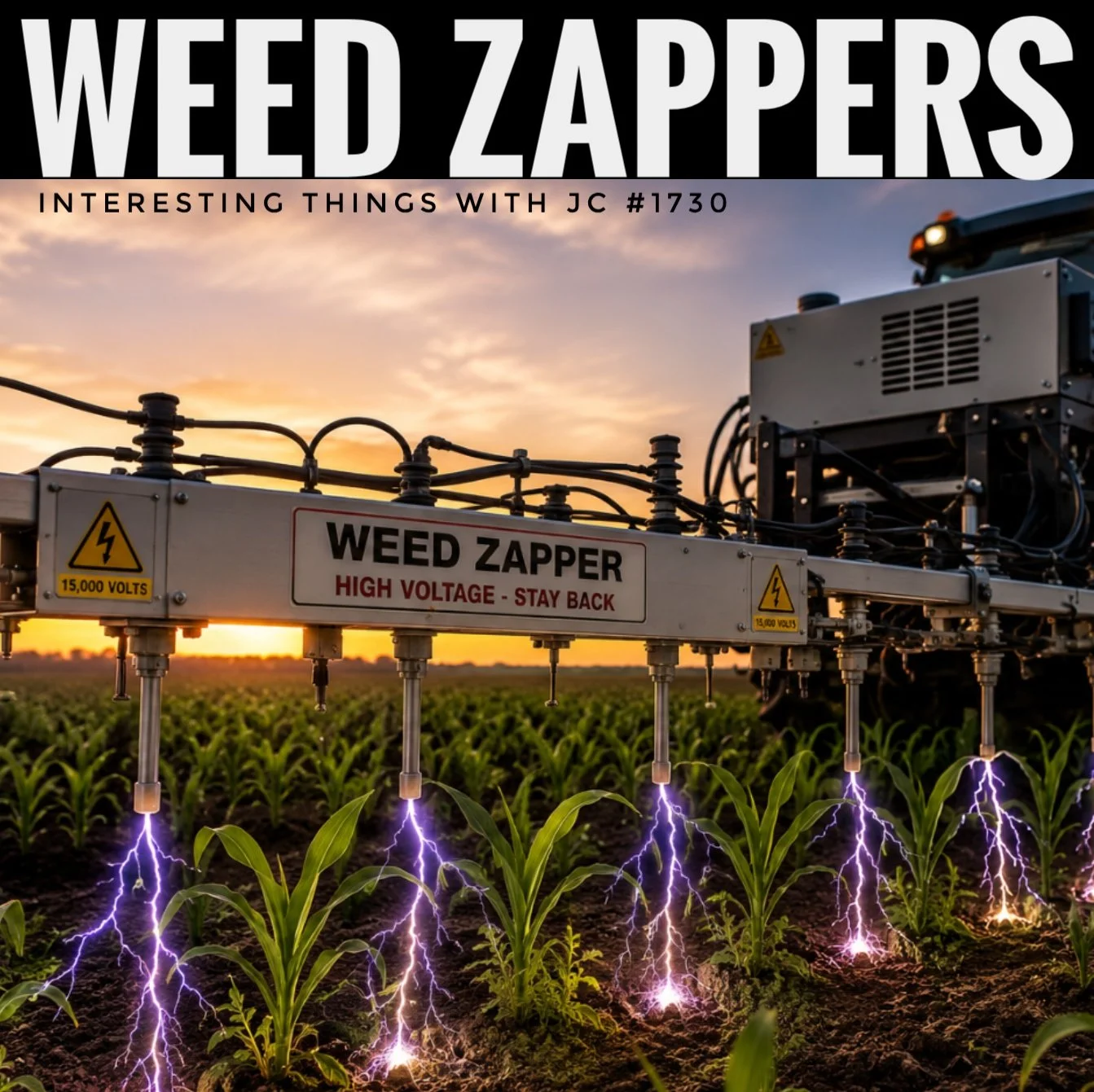
Promotional image for “Weed Zappers,” episode 1730 of Interesting Things with JC. A large agricultural weed-control machine moves through rows of young crops at sunset. Its metal frame carries high-voltage warning signs, and several downward-facing electrodes appear to send purple electrical arcs into weeds between the crop plants. Large white text at the top reads “WEED ZAPPERS,” with the episode title beneath it.
Transcript
Interesting Things with JC #1730:
"Weed Zappers"
For generations, farmers fought weeds with chemistry. Herbicides transformed agriculture by clearing fields of unwanted plants and giving crops room to grow. Then the weeds began to fight back.
Some of today's toughest weeds, including Palmer amaranth and waterhemp, have evolved resistance to multiple herbicides. A few survivors passed their genes to the next generation, and over time those resistant plants spread across millions of acres. The question for farmers became simple: if chemicals no longer work, what comes next?
One answer is 15,000 volts.
The machine is called the Weed Zapper. As it moves through a field, long electrodes brush against weeds growing above the crop canopy. The moment they make contact, a high-voltage electrical current travels through the plant and into the ground.
Unlike mowing, which leaves the roots alive, electricity follows the weed from the top of the stem all the way into its root system. The goal is to destroy the entire plant, not just the part you can see.
It sounds like a brand-new idea, but it's actually more than a century old. Early inventors experimented with electrical weed control, but the equipment was too bulky and inefficient for practical farming. Modern generators, insulation, and electronic controls finally made the concept workable.
The timing couldn't be better. Herbicide resistance is simply evolution at work. The same chemicals used year after year favored the few weeds that could survive them, and those survivors became the next generation.
That's why many farmers are no longer looking for a single miracle solution. They rotate crops, vary herbicides, cultivate the soil, plant cover crops, and now, in some fields, they add electricity to the toolbox. Others are even using AI-guided lasers that identify and destroy individual weeds without spraying an entire field.
The Weed Zapper isn't really the story. The story is that every solution changes the problem. As weeds adapt, farming adapts with them, and one of the oldest forces in nature has become one of agriculture's newest tools.
These are interesting things, with JC.
Student Worksheet
Name: ______________________________
Date: ______________________________
Class: ______________________________
Listening Instructions: During the first audio play, listen for the central problem, the proposed technology, and the broader lesson. During the second play or transcript review, record evidence explaining how biological adaptation and agricultural innovation are connected.
Part A—Comprehension:
What agricultural problem led farmers to consider electrical weed control?
Name the two weeds identified in the episode as examples of herbicide resistance.
What part of the Weed Zapper makes contact with weeds?
Why must targeted weeds generally extend above the crop canopy?
According to the episode, how does electrical control differ from mowing?
Why did early electrical weed-control ideas fail to become widely practical?
Identify four weed-management practices mentioned in the transcript.
What is the central message of the statement, “Every solution changes the problem”?
Part B—Cause-and-Effect Analysis:
9. Complete the sequence using one or two sentences for each step:
A weed population contains genetic variation.
A herbicide is applied repeatedly.
Resistance becomes more common in later generations.
Explain why the phrase “weeds began to fight back” is useful storytelling but not a literal scientific description.
Use evidence from the transcript to explain how a herbicide can become a selection pressure.
Why is resistance a population-level change across generations rather than an intentional change by one plant?
Part C—Technology Comparison: Complete each row with concise evidence.
MethodHow It WorksOne Potential AdvantageOne Limitation or TradeoffHerbicideElectrical controlCultivationCover cropsAI-guided lasers
Part D—Evidence Evaluation:
Which statement from the episode is the main claim?
A. Electricity is always better than herbicides.
B. Farmers should stop using all chemical controls.
C. Changing biological problems often require changing combinations of solutions.
D. Mowing is the most effective way to destroy resistant weeds.
Quote or paraphrase two details that support your answer to Question 13.
Identify one technical claim from the episode that a farmer should verify before purchasing or operating an electrical weed-control system.
What additional evidence would help determine whether a Weed Zapper is appropriate for a specific farm?
Part E—Applied Decision-Making:
Scenario: A soybean farmer has patches of waterhemp that survive a commonly used herbicide and grow above the crop canopy. Recommend a three-part management plan for the current season and the next planting cycle.
For each recommendation, explain:
What problem it addresses.
What evidence supports it.
What limitation the farmer must monitor.
Explain why using the same successful method every year could eventually become less effective or create a different problem.
Part F—Reflection:
Describe another situation in agriculture, medicine, engineering, business, or daily life in which solving one problem can change the conditions and produce a new problem.
What does this episode suggest about adaptability and professional judgment?
Which matters more in long-term problem solving: finding the strongest single solution or building a flexible system? Defend your response with evidence.
Student Output Expectations:
Questions 1–8: One complete sentence each.
Questions 9–16: Two to four complete sentences each.
Questions 17–19: One organized paragraph of 150–250 words.
Questions 20–22: One reflective paragraph of 100–150 words.
Use at least five vocabulary terms accurately.
Support analytical claims with details from the audio or transcript.
Difficulty Scaling:
Foundational: Complete Questions 1–14 and use the transcript while responding.
On-Level: Complete all questions and the comparison table.
Advanced: Complete all questions and add a 200-word cost-benefit argument comparing electrical and laser weed control.
Introductory College: Complete all questions, identify two assumptions in the episode, and propose a small field trial with variables, controls, and measurable outcomes.
Academic Integrity Guidance: Write responses in your own words. Direct quotations must be placed in quotation marks. Distinguish information stated in the episode from your own inference. Do not invent data, field results, costs, or safety specifications.
Teacher Guide
Quick Start: Begin by playing the podcast without distributing the transcript. Ask students to listen for three items: the biological problem, the technological response, and the lesson’s larger claim. Conduct a brief retrieval check, replay the audio, and then distribute the transcript and worksheet.
Pacing Guide—Audio First:
0–5 minutes: Bell ringer and prediction.
5–9 minutes: First uninterrupted audio play.
9–14 minutes: Individual recall notes and partner comparison.
14–18 minutes: Second audio play with focused listening prompts.
18–28 minutes: Vocabulary and natural-selection explanation.
28–42 minutes: Worksheet comprehension and analysis.
42–55 minutes: Technology comparison and group discussion.
55–65 minutes: Applied farm-management scenario.
65–72 minutes: Open-ended assessment or extension.
72–75 minutes: Exit ticket.
Bell Ringer: Display the question: “What happens when a control method kills most—but not all—members of a population?” Students write a two-sentence prediction before hearing the episode.
Audio Guidance: On the first play, students should not attempt to record every detail. They should identify the episode’s problem-solution structure. On the second play, students should listen for cause-and-effect language, comparison statements, and references to multiple weed-management methods.
Audio Fallback: When audio is unavailable, the teacher reads the transcript aloud while students keep their copies face down. Students then read it independently and annotate:
One statement about biology.
One statement about engineering.
One statement about decision-making.
One claim that requires supporting evidence.
Time on Task: The core lesson requires approximately 55 minutes. The complete lesson with assessment and extension requires 70–75 minutes.
Materials:
Episode audio or teacher read-aloud copy.
Printed or digital transcript.
Student worksheet.
Board or shared display.
Optional diagrams of a crop canopy, electrical circuit, and natural selection.
Optional calculators or spreadsheets for an advanced cost-benefit extension.
Safety Notice: This lesson does not involve constructing or operating electrical weed-control equipment. High-voltage agricultural machinery should be operated only by trained personnel following manufacturer requirements, farm safety procedures, and applicable regulations.
Vocabulary Preparation: Before the second listening, review variation, selection pressure, resistance, and adaptation. Ask students to place the terms in a logical sequence explaining how a population changes.
Scientific Explanation Model:
Variation exists before treatment.
The herbicide does not create a purposeful need for resistance.
Treatment kills a greater proportion of susceptible weeds.
Resistant survivors produce offspring.
The frequency of resistance traits increases over generations.
Continued reliance on the same treatment can make the population more difficult to control.
Common Misconceptions:
Misconception: Individual weeds intentionally develop resistance because they need it.
Correction: Selection acts on heritable variation already present or arising through mutation; populations change over generations.Misconception: Every plant that survives must be genetically resistant.
Correction: Survival can also result from poor coverage, incorrect timing, weather, application error, plant size, or other conditions.Misconception: Electricity automatically kills every contacted weed.
Correction: Performance varies with plant growth stage, contact quality, machine operation, field conditions, and repeat passes. University of Minnesota Extension reported 82% visual waterhemp control in one discussed study after two electrocution passes, not universal control.Misconception: A new technology removes the need for management judgment.
Correction: New equipment introduces operational, economic, safety, timing, and maintenance decisions.Misconception: Integrated weed management means avoiding herbicides entirely.
Correction: It means combining appropriate practices so that the system does not depend excessively on one control method.
Discussion Prompts:
Why does the episode begin with chemistry and end with adaptation?
What makes the Weed Zapper both an old idea and a modern technology?
Why is weed height relative to the crop canopy important?
What information is missing from the episode that a purchasing decision would require?
How might cost, field size, crop type, weather, labor, and safety influence a farmer’s choice?
Is a method still valuable when it does not provide complete control? Explain.
How can farmers reduce the chance that one control method will dominate their entire management system?
What does the episode mean by “the Weed Zapper isn’t really the story”?
Formative Checkpoints:
After the first audio play, students state the problem and solution in one sentence.
After vocabulary instruction, students arrange five terms into a correct causal chain.
During worksheet completion, students underline evidence and circle inferences.
Before discussion, students identify one benefit and one limitation of electrical control.
Before the exit ticket, students explain why integrated management can be more durable than repeated reliance on one method.
Engagement Strategy: Assign each small group a role:
Agronomist: Evaluates weed biology and crop effects.
Engineer: Evaluates machine function and operating constraints.
Farm Manager: Evaluates cost, timing, labor, and productivity.
Safety Lead: Identifies training, equipment, and operational risks.
Evidence Reviewer: Separates supported claims from assumptions.
Each group must produce one recommendation that all roles can defend.
Differentiation:
Provide a partially completed cause-and-effect chain for students who need additional structure.
Allow students to replay the audio or use a teacher-read version.
Preteach vocabulary with simple examples before introducing agricultural applications.
Permit oral responses for selected reflection questions.
Pair emerging readers with a partner for transcript annotation.
Provide sentence frames: “Repeated herbicide use favors weeds that ___ because ___.”
Challenge advanced learners to distinguish efficacy, efficiency, cost, and sustainability.
Assessment Differentiation:
Students requiring support may answer one open-ended question using a graphic organizer.
On-level students complete both questions in paragraph form.
Advanced students must incorporate a counterargument and identify missing evidence.
College learners must evaluate source quality and propose measurable field-trial criteria.
Time Flexibility:
30-minute version: Play audio, teach vocabulary, complete Questions 1–12, and use the exit ticket.
55-minute version: Complete the core pacing sequence through the applied scenario.
75-minute version: Add discussion, assessment, and group recommendations.
Two-day version: Day one focuses on biology and comprehension; day two focuses on technology evaluation and decision-making.
Substitute Readiness: Provide the substitute with the transcript, worksheet, answer key, and pacing guide. The lesson can be completed without specialized agricultural knowledge by using the scientific explanation model and misconceptions list.
Extensions:
Design a controlled field experiment comparing one electrical pass, two electrical passes, and no electrical treatment.
Create a flowchart showing how weeds enter, survive, reproduce, and spread within a farm.
Research how seed-bank management affects long-term weed populations.
Compare electrical control with robotic cultivation, targeted spraying, flame weeding, and laser weeding.
Develop a maintenance and safety checklist for a hypothetical agricultural technology company.
Create a five-year integrated weed-management schedule that avoids repeating the same program annually.
Cross-Curricular Connections:
Biology: Natural selection, heredity, adaptation, and population change.
Physics: Voltage, current, conductivity, resistance, and energy transfer.
Agricultural Science: Crop competition, weed life cycles, seed production, and field management.
Engineering: Design constraints, system reliability, insulation, control systems, and testing.
Economics: Equipment investment, operating cost, labor, yield protection, and marginal benefit.
Computer Science: Computer vision, classification models, sensors, and automated decision systems.
English Language Arts: Evidence-based explanation, technical vocabulary, and argument writing.
Career Education: Safety, training, collaboration, adaptability, and professional judgment.
SEL Connection: Students practice intellectual humility by recognizing that no solution is perfect. They build responsible decision-making skills by comparing evidence, risks, uncertainty, and consequences rather than reacting to a technology as automatically good or bad.
Skill Value Emphasis: The lesson develops analytical thinking, communication, evidence evaluation, systems thinking, problem solving, adaptability, and disciplined decision-making. Students learn that responsible professionals verify claims, monitor results, and revise plans when conditions change.
Answer Key - Student Worksheet
1. What agricultural problem led farmers to consider electrical weed control?
Some weed populations developed resistance to herbicides that had previously controlled them, so farmers needed additional control methods.
2. Name the two weeds identified in the episode as examples of herbicide resistance.
Palmer amaranth and waterhemp.
3. What part of the Weed Zapper makes contact with weeds?
Long electrodes make contact with weeds growing above the crop canopy.
4. Why must targeted weeds generally extend above the crop canopy?
The weeds must be tall enough for the electrodes to contact them without damaging or contacting the shorter crop plants.
5. According to the episode, how does electrical control differ from mowing?
Mowing removes the visible portion of a weed but may leave the roots alive. Electrical control is intended to send current through the plant and damage the entire plant, including its root system.
6. Why did early electrical weed-control ideas fail to become widely practical?
The equipment was too bulky, inefficient, and difficult to use in practical farming conditions.
7. Identify four weed-management practices mentioned in the transcript.
Accept any four:
Rotating crops
Varying herbicides
Cultivating the soil
Planting cover crops
Using electrical weed control
Using AI-guided lasers
8. What is the central meaning of the statement, “Every solution changes the problem”?
A solution can alter biological, technical, or economic conditions. As conditions change, farmers must adjust their methods.
9. Complete the cause-and-effect sequence.
Susceptible weeds are killed while resistant weeds survive. The surviving weeds reproduce and pass resistance traits to the next generation.
10. Why is “weeds began to fight back” useful storytelling but not a literal scientific description?
The phrase personifies weeds. Weeds do not consciously fight back. Resistance spreads because weeds with heritable resistance traits are more likely to survive and reproduce.
11. How can a herbicide act as a selection pressure?
A herbicide kills a greater proportion of susceptible weeds. Resistant weeds are more likely to survive, reproduce, and pass their traits to later generations.
12. Why is herbicide resistance a population-level change?
An individual weed does not intentionally change its genes. Over several generations, inherited resistance traits become more common within the population.
13. Which statement best expresses the main claim of the episode?
Correct Answer: C. Changing biological problems often require changing combinations of solutions.
14. Provide two details that support the main claim.
Accept any two:
Some weeds evolved resistance to herbicides.
Farmers began combining crop rotation, cultivation, cover crops, herbicide variation, and electricity.
Older electrical weed-control ideas became practical because technology improved.
AI-guided lasers are now being used as another weed-control method.
15. Identify one technical claim that should be verified before purchasing or operating an electrical weed-control system.
Acceptable responses include:
The stated operating voltage
The machine’s effectiveness
Whether it destroys the root system
Suitable crop and weed height
Required operating speed
Equipment cost
Safety requirements
Field-condition limitations
16. What additional evidence would help determine whether a Weed Zapper is suitable for a farm?
Strong responses may include:
Replicated field-trial results
Weed species and growth stage
Crop-injury data
Soil and weather conditions
Operating and fuel costs
Labor requirements
Maintenance needs
Safety requirements
Effects on seed production
Long-term effectiveness
17. Recommend a three-part management plan for resistant waterhemp.
A strong response should include:
An immediate method to control weeds above the canopy
Removal or destruction of surviving weeds before seed production
A future plan that rotates crops, changes herbicide sites of action, or adds nonchemical controls
18. Explain the purpose, evidence, and limitation of each recommendation.
Responses should identify:
The specific problem each method addresses
Evidence from the episode or lesson
A realistic limitation, such as cost, timing, safety, labor, crop injury, weather, or incomplete control
19. Why could using the same successful method every year become less effective?
Repeated use may favor weeds that survive that method. It may also create new costs, operational problems, or environmental limitations.
20. Describe another situation in which solving one problem creates a new problem.
Answers will vary. Acceptable examples may come from medicine, engineering, business, agriculture, or daily life. The response must clearly explain how the original solution changed conditions.
21. What does the episode suggest about adaptability and professional judgment?
Successful professionals observe results, evaluate evidence, recognize limitations, follow safety requirements, and revise plans when conditions change.
22. Which is more effective for long-term problem solving: one strong solution or a flexible system?
Answers may vary. Strong responses should argue that a flexible system is usually more durable because it reduces dependence on one method and allows adjustment when conditions change.
Technology Comparison Table—Sample Answers
MethodHow It WorksPotential AdvantageLimitation or TradeoffHerbicideUses chemicals to suppress or kill weedsCan treat large areas efficientlyWeeds may evolve resistance; timing and application restrictions applyElectrical controlSends electrical current through contacted weedsProvides a nonchemical control optionRequires direct contact, specialized equipment, energy, and safety trainingCultivationMechanically uproots or disrupts weedsReduces reliance on herbicidesMay disturb soil, miss weeds, or damage cropsCover cropsCompete with weeds for light, water, nutrients, and spaceCan suppress weeds while supporting soil managementResults depend on species, establishment, weather, and termination timingAI-guided lasersUses cameras and computer vision to identify and target individual weedsCan control weeds without spraying an entire fieldEquipment may be expensive, complex, and maintenance-intensive
Quiz Answer Key
C — Resistant individuals survive and reproduce more successfully than susceptible individuals.
A — Their height allows the electrodes to contact them selectively.
B — Combining multiple appropriate practices reduces reliance on one method.
C — Improvements in generators, insulation, and electronic controls made the technology more practical.
B — Adaptable systems are important because solutions can change the problems they address.
Open-Ended Assessment Guidance
Question 1—Herbicide Resistance
A complete response should explain that:
Genetic variation exists within a weed population.
Some weeds possess heritable resistance traits.
Herbicide application creates a selection pressure.
Susceptible weeds are more likely to die.
Resistant weeds are more likely to survive and reproduce.
Resistance becomes more common across generations.
The population adapts over time.
Question 2—Weed Zapper Recommendation
A complete response should evaluate:
Weed species and growth stage
Weed height relative to the crop canopy
Expected control effectiveness
Crop safety
Field and weather conditions
Equipment cost
Fuel or energy use
Labor and maintenance
Operator training
High-voltage safety
The need for additional weed-management methods
Evidence that should be collected before purchasing
Exit Ticket Answer Key
1. Why is herbicide resistance an example of evolution?
Heritable resistance traits become more common in a weed population because resistant plants survive and reproduce.
2. Name one benefit and one limitation of electrical weed control.
Example benefit: It provides a nonchemical way to control weeds above the crop canopy.
Example limitation: It requires specialized equipment, direct plant contact, and trained operators.
3. Why should farmers use a diversified weed-management system?
Using several methods reduces dependence on one control strategy and helps farmers respond when weeds, field conditions, or technology change.
Quiz
Which process best explains why herbicide resistance becomes more common in a weed population?
A. Individual plants decide to produce protective genes.
B. Herbicides teach every surviving plant how to resist treatment.
C. Resistant individuals survive and reproduce more successfully than susceptible individuals.
D. Electrical machines transfer resistance from crops to weeds.
Why are weeds above the crop canopy suitable targets for the Weed Zapper?
A. Their height allows the electrodes to contact them selectively.
B. Taller weeds no longer contain living roots.
C. Crop leaves prevent all electricity from reaching the ground.
D. Herbicide resistance occurs only in tall plants.
Which statement best describes integrated weed management?
A. Replacing every control method with electricity.
B. Combining multiple appropriate practices to reduce reliance on one method.
C. Applying the same herbicide at a higher rate every year.
D. Allowing resistant weeds to reproduce before treatment.
Why did electrical weed control become more practical in modern agriculture?
A. Weeds stopped evolving resistance.
B. Crops began growing without soil.
C. Improvements in generators, insulation, and control systems reduced earlier limitations.
D. Modern farms no longer require safety training.
What is the broadest lesson communicated by the episode?
A. Every new technology permanently solves the problem it targets.
B. Adaptable systems are important because solutions can change the problems they address.
C. Mechanical control should replace all biological knowledge.
D. Farmers should select technologies based only on novelty.
Assessment
Open-Ended Question 1: Explain how repeated herbicide use can change a weed population over several generations. Your response must accurately use variation, selection pressure, survival, reproduction, resistance, and adaptation.
Open-Ended Question 2: A farmer is considering a Weed Zapper for herbicide-resistant waterhemp. Write a recommendation that evaluates biological effectiveness, crop and weed height, operating conditions, safety, cost, labor, and the value of combining methods. State what additional evidence should be collected before a decision.
3–2–1 Rubric:
3—Proficient
Accurately explains population-level resistance and the technology’s basic mechanism
Uses multiple relevant details and connects evidence logically to the claim
Provides a realistic, organized recommendation that addresses benefits, limitations, safety, and integrated management
2—Developing
Shows partial understanding with one minor error or omissionUses some evidence, but reasoning is incomplete or weakly connected
Provides a generally relevant recommendation but overlooks important constraints
1—Beginning
Contains major misconceptions about evolution or electrical control
Gives little evidence or relies primarily on unsupported opinion
Recommendation is unclear, unrealistic, incomplete, or unrelated
Exit Ticket:
In one sentence, explain why herbicide resistance is an example of evolution.
Name one potential benefit and one limitation of electrical weed control.
Identify one reason farmers should use a diversified weed-management system.
Standards Alignment
NGSS—HS-LS4-4: Biological Evolution: Unity and Diversity—Construct an explanation based on evidence for how natural selection leads to adaptation of populations.
Direct Connection: Students explain how repeated herbicide exposure favors weeds with heritable resistance traits.
Measurable Outcome: Students construct a six-step evidence-based explanation of resistance across generations.
Lesson Evidence: Objectives 1 and 4; Worksheet Questions 9–12; Assessment Question 1.
Justification: The lesson directly applies natural selection to a documented agricultural population change.
NGSS—HS-LS4-2: Biological Evolution: Unity and Diversity—Construct an explanation based on evidence that evolution primarily results from reproductive potential, inherited variation, competition, and differential survival and reproduction.
Direct Connection: Students distinguish inherited variation from intentional individual change.
Measurable Outcome: Students identify variation, selection, survival, and reproduction in the herbicide-resistance sequence.
Lesson Evidence: Vocabulary; Teacher misconception correction; Worksheet Questions 9–12.
Justification: Herbicide treatment provides a concrete setting for explaining differential survival and reproduction.
NGSS Science and Engineering Practice—Constructing Explanations and Designing Solutions.
Direct Connection: Students explain resistance and recommend a multi-method management strategy.
Measurable Outcome: Students produce a recommendation addressing effectiveness, constraints, risks, and evidence needs.
Lesson Evidence: Worksheet Questions 17–19; Assessment Question 2.
Justification: Students move from scientific explanation to a defensible solution under real-world constraints.
CCSS Reading—CCSS.ELA-LITERACY.RST.11-12.1: Cite specific textual evidence to support analysis of science and technical texts.
Direct Connection: Students quote or paraphrase transcript evidence supporting the episode’s main claim.
Measurable Outcome: Students provide at least two accurate supporting details.
Lesson Evidence: Worksheet Questions 13–16.
Justification: The lesson requires students to separate a central claim, supporting evidence, and information requiring verification. This literacy standard is explicitly connected to high-school biological evolution performance expectations.
CCSS Reading—CCSS.ELA-LITERACY.RST.11-12.2: Determine central ideas or conclusions of a text and summarize complex concepts accurately.
Direct Connection: Students identify the broader meaning of “Every solution changes the problem.”
Measurable Outcome: Students state the episode’s central idea without introducing unsupported conclusions.
Lesson Evidence: Worksheet Questions 8, 13, and 14; Quiz Question 5.
Justification: Successful completion depends on recognizing that the episode is about adaptive systems, not merely one machine.
CCSS Writing—CCSS.ELA-LITERACY.WHST.11-12.2: Write informative and explanatory texts, including scientific procedures and technical processes.
Direct Connection: Students write a structured explanation of resistance and electrical weed control.
Measurable Outcome: Students accurately explain a biological process using domain vocabulary and causal organization.
Lesson Evidence: Worksheet Questions 9–12; Assessment Question 1.
Justification: The required response explains both a scientific mechanism and a technical process.
CCSS Writing—CCSS.ELA-LITERACY.WHST.11-12.9: Draw evidence from informational texts to support analysis, reflection, and research.
Direct Connection: Students support management recommendations with transcript details and verified background evidence.
Measurable Outcome: Students distinguish sourced facts, reasonable inferences, and missing information.
Lesson Evidence: Worksheet Questions 14–19; Assessment Question 2.
Justification: The student product requires evidence-based judgment rather than unsupported preference.
CCSS Speaking and Listening—CCSS.ELA-LITERACY.SL.11-12.1: Initiate and participate effectively in collaborative discussions.
Direct Connection: Students participate in role-based groups representing agronomy, engineering, management, safety, and evidence review.
Measurable Outcome: Each student contributes discipline-specific reasoning and responds to competing considerations.
Lesson Evidence: Teacher Guide engagement strategy and discussion prompts.
Justification: The group recommendation requires collaborative synthesis rather than parallel individual answers.
CCSS Speaking and Listening—CCSS.ELA-LITERACY.SL.11-12.4: Present claims and findings in a focused, coherent manner with relevant evidence and valid reasoning.
Direct Connection: Groups present and defend their weed-management recommendations.
Measurable Outcome: Students communicate one clear claim, at least two supporting reasons, and one limitation.
Lesson Evidence: Group recommendation and formative checkpoints.
Justification: Students must make technical reasoning understandable to listeners with different professional roles. The standard is also identified in NGSS high-school evolution connections.
C3 Framework—D2.Eco.2.9-12: Use marginal benefits and marginal costs to construct an argument for or against an approach or solution to an economic issue.
Direct Connection: Students compare the costs, labor, risks, and benefits of herbicides, electrical treatment, cultivation, cover crops, and lasers.
Measurable Outcome: Students defend or reject a technology choice using at least three decision criteria.
Lesson Evidence: Worksheet comparison table; Questions 16–19; Assessment Question 2.
Justification: Farm weed control is both a biological and economic decision involving limited resources and competing alternatives.
C3 Framework—D3.1.9-12: Gather relevant information from multiple sources while using origin, authority, structure, context, and corroborative value to guide selection.
Direct Connection: Students identify claims requiring verification and specify what additional field, cost, safety, and performance evidence is needed.
Measurable Outcome: Students list at least four relevant evidence categories and explain why each matters.
Lesson Evidence: Worksheet Questions 15–16; College-level scaling task.
Justification: The activity builds disciplined inquiry before a high-cost operational decision.
ISTE Standards for Students—1.3 Knowledge Constructor.
Direct Connection: Students evaluate the accuracy, validity, origin, bias, and relevance of digital or technical information about agricultural technologies.
Measurable Outcome: Students curate credible evidence and separate manufacturer claims from independent field evidence.
Lesson Evidence: Evidence-evaluation questions and advanced research extension.
Justification: The standard calls for critical curation and evaluation of digital content, which directly supports technology comparison.
ISTE Standards for Students—1.5 Computational Thinker.
Direct Connection: Students examine how camera systems and computer-vision models classify crops and weeds before a laser is directed.
Measurable Outcome: Students diagram the input-process-output sequence of an AI-guided weeding system and identify one possible classification error.
Lesson Evidence: Cross-curricular computer science connection and laser-weeding extension.
Justification: Students analyze how data, models, automation, and constraints contribute to solving an agricultural problem.
Career Readiness Competencies—Analytical Thinking, Communication, Problem Solving, Adaptability, and Professional Judgment.
Direct Connection: Students evaluate a changing biological problem through multiple professional perspectives.
Measurable Outcomes:
Analytical Thinking: Compare five weed-control methods using consistent criteria.
Communication: Present a recommendation with a claim, evidence, reasoning, and limitation.
Problem Solving: Design a multi-method plan for resistant waterhemp.
Adaptability: Revise a strategy when repeated treatment becomes less effective.
Professional Judgment: Consider safety, training, cost, uncertainty, and missing evidence before recommending equipment.
Lesson Evidence: Role-based discussion, Worksheet Questions 17–22, and Assessment Question 2.
Justification: Agricultural decisions require technical competence combined with responsible action under changing conditions.
Homeschool / Lifelong Learning Alignment—Independent Learning, Information Literacy, Real-World Application, Self-Directed Inquiry, and Transferable Life Skills.
Direct Connection: Learners can complete the lesson independently using the audio, transcript, worksheet, answer key, and extension options.
Measurable Outcomes:
Independent Learning: Summarize the episode and check responses against the answer key.
Information Literacy: Identify claims that require external verification.
Real-World Application: Recommend a practical management plan for a farm scenario.
Self-Directed Inquiry: Select and investigate one additional weed-control technology.
Transferable Life Skills: Apply the principle of diversified problem solving to another field or personal decision.
Lesson Evidence: Student Worksheet Parts D–F and research extensions.
Justification: The lesson supports self-paced inquiry while connecting biology, technology, evidence, safety, and decision-making to practical life.
Show Notes
Weed Zappers explores how herbicide-resistant weeds have turned a familiar farm-management problem into a lesson about evolution, engineering, and adaptability. Students examine how repeated selection pressures can change weed populations and how electrical machinery, crop rotation, cultivation, cover crops, herbicide variation, and AI-guided lasers can become parts of a broader management system. The episode matters in the classroom because it connects natural selection to a real agricultural challenge while emphasizing evidence, safety, professional judgment, and the responsibility to adapt when an established solution stops working.
References
Carbon Robotics. (n.d.). LaserWeeder. https://carbonrobotics.com/laserweeder/
Heap, I. (n.d.). The International Herbicide-Resistant Weed Database. https://www.weedscience.org/
Iowa State University Extension and Outreach. (2025). Palmer amaranth: ID, biology and management. https://crops.extension.iastate.edu/encyclopedia/palmer-amaranth-id-biology-and-management
Minnesota Department of Agriculture. (n.d.). Palmer amaranth: Herbicide resistance. https://www.mda.state.mn.us/palmer-amaranth-herbicide-resistance
National Invasive Species Information Center. (n.d.). Palmer amaranth (Amaranthus palmeri). https://www.invasivespeciesinfo.gov/terrestrial/plants/palmer-amaranth
New Mexico State University. (n.d.). Palmer amaranth biology and management. https://pubs.nmsu.edu/_a/A617/
United States Department of Agriculture, National Agricultural Library. (2020–2023). Documenting herbicide-resistant Palmer amaranth and waterhemp and identifying the parameters influencing spread. https://www.nal.usda.gov/research-tools/food-safety-research-projects/documenting-herbicide-resistant-palmer-amaranth-and-waterhemp-and-identifying-parameters-influencing-spread
University of Minnesota Extension. (2025, February 13). Strategic Farming: Let's talk crops—Focused non-chemical weed control. https://blog-crop-news.extension.umn.edu/2025/02/strategic-farming-lets-talk-crops_13.html
Ward, S. M., Webster, T. M., & Steckel, L. E. (2013). Palmer amaranth: A review. Weed Technology, 27(1), 12–27. https://doi.org/10.1614/WT-D-12-00113.1
Weed Zapper. (n.d.). The Weed Zapper. https://theweedzapper.com/