1731: "Mac's Drive-In”
Interesting Things with JC #1731: "Mac's Drive-In”
A drive-in restaurant has kept the same carhop service, horseshoe counter, and frosted root beer tradition alive since 1961, even after moving the entire building to a new location in 1967. While thousands of independent drive-ins disappeared, Mac's kept serving customers much the same way it always had.
Curriculum - Episode Anchor
Episode Title: Mac's Drive-In
Episode Number: 1731
Host: JC
Audience: Grades 9–12, Introductory College, Homeschool, Lifelong Learners
Subject Area: American History, Business History, Cultural Geography, Entrepreneurship
Lesson Overview
Objectives:
Explain how locally owned businesses preserve community history.
Analyze how transportation and economic changes affected independent restaurants in the United States.
Evaluate why preserving everyday traditions contributes to historical understanding.
Connect local history to broader themes in American culture and entrepreneurship.
Essential Question:
How can a small local business become an important part of American history?
Success Criteria:
Students will:
Describe the historical significance of Mac's Drive-In.
Explain why many drive-ins disappeared after the 1960s.
Identify how Mac's adapted while maintaining its traditions.
Support conclusions using evidence from the podcast.
Student Relevance:
Students encounter local businesses every day. This lesson demonstrates how ordinary places often reflect larger historical, economic, and cultural changes.
Real-World Connection:
Historic preservation extends beyond famous landmarks. Small businesses frequently preserve traditions, architecture, customer service practices, and community identity.
Workforce Reality:
Long-term business success often depends on understanding customer loyalty, adapting carefully to change, and maintaining consistent quality.
Key Vocabulary
Drive-In(DRYV in) — A restaurant where customers order and eat from their vehicles.
Carhop(CAR hop) — A restaurant employee who delivers food directly to parked vehicles.
Seasonal Business(SEE-zuh-nuhl BIZ-niss) — A business that operates only during part of the year.
Independent Business(in-duh-PEN-duhnt BIZ-niss) — A locally owned company that is not part of a national chain.
Interstate Highway System(IN-ter-state HIGH-way SIS-tum) — The nationwide network of highways that changed American travel beginning in the 1950s.
Preservation(prez-er-VAY-shun) — Protecting historical places, traditions, or objects for future generations.
Richardson Root Beer(RICH-ard-sun Root Beer) — Root beer prepared from Baldwin-Richardson syrup, a longstanding tradition at Mac's.
Heritage(HAIR-ih-tij) — Traditions and history passed from one generation to another.
Narrative Core
Open
Many restaurants succeed by constantly changing. Others succeed because they remain familiar. Mac's Drive-In in Waterloo, New York, represents one of the few remaining examples of a traditional American drive-in that has continued operating while preserving its original experience.
Info
Opened in 1961 by Gerry and Cathy MacDougal, Mac's began during the height of America's drive-in era. Families gathered after sporting events, teenagers met friends during summer evenings, and roadside restaurants became gathering places for local communities.
Details
As interstate highways expanded and national fast-food chains spread across the country, thousands of locally owned drive-ins disappeared. Rather than modernizing into something entirely different, Mac's focused on maintaining the customer experience that people remembered.
In 1967, the owners relocated the entire restaurant to a new location along the Waterloo-Geneva Road. Instead of redesigning the business, they preserved the horseshoe counter, continued offering carhop service, retained their familiar menu, and continued serving Richardson Root Beer in frosted mugs.
Today, Mac's remains a seasonal restaurant, generally operating from spring until around Labor Day. Customers still pay by cash or check, reinforcing an experience that has changed remarkably little over more than six decades.
Reflection
Mac's demonstrates that history is often preserved through everyday routines rather than major historical events. The restaurant serves not only food but also a living example of mid-twentieth-century American roadside culture.
Closing
These are interesting things, with JC.
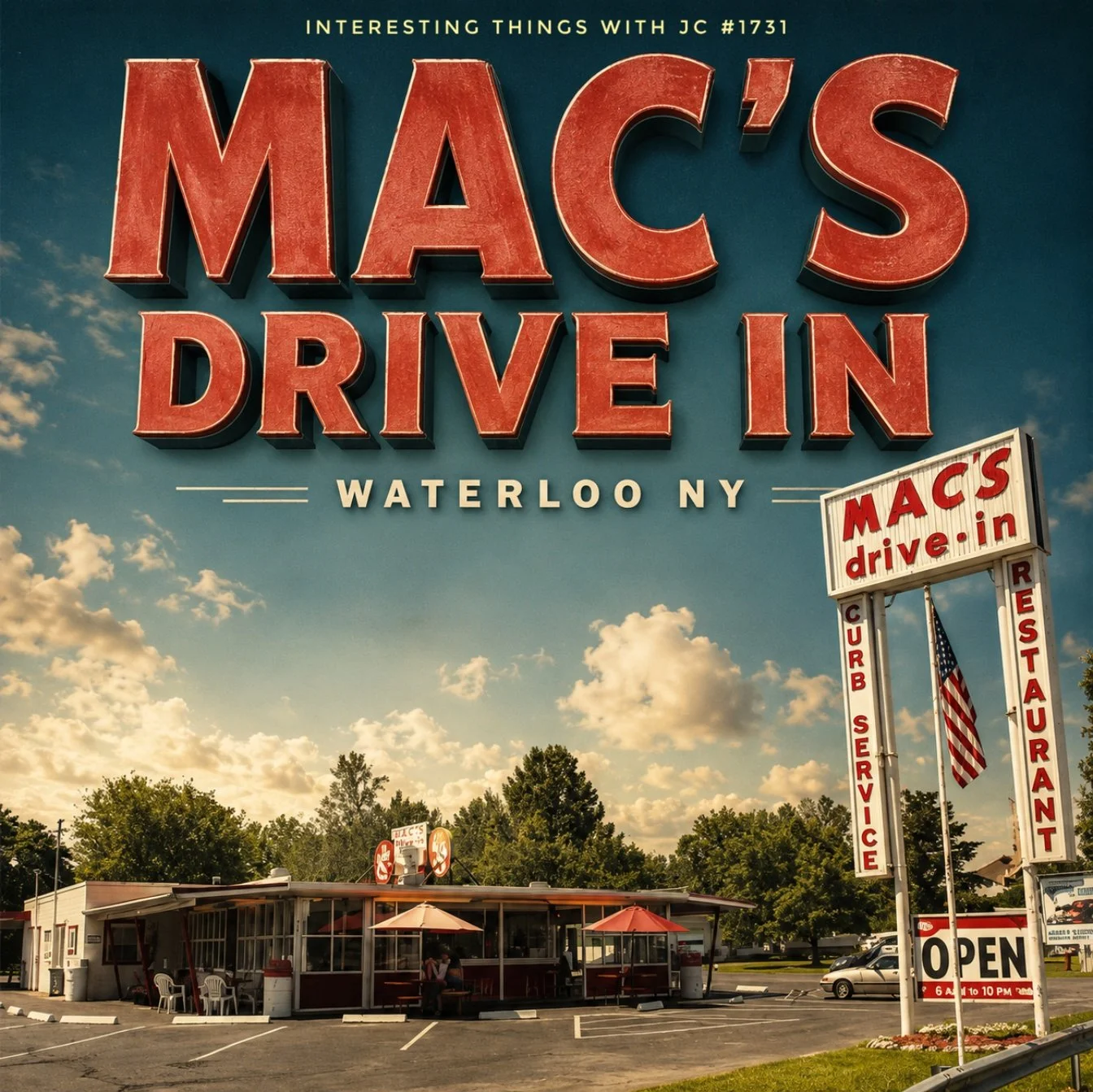
Promotional image for Interesting Things with JC Episode #1731 about Mac's Drive-In in Waterloo, New York. Large red text reading "MAC'S DRIVE IN" appears above a photograph of the restaurant. A vintage roadside sign on the right reads "Mac's drive-in," "Curb Service," "Restaurant," and "Open." The single-story drive-in restaurant is shown with parking spaces, outdoor umbrellas, and a blue sky with scattered clouds.
Transcript
Interesting Things with JC #1731:
"Mac's Drive-In"
Some restaurants survive because they reinvent themselves. Others survive because they refuse to.
On U.S. Routes 5 and 20 in Waterloo, New York, Mac's Drive-In has been serving customers since 1961. Pull into a parking space, and a carhop still comes to your window. Inside, there's the same horseshoe counter that's greeted generations of travelers. In many ways, it's the kind of place America used to have in nearly every town.
But that's exactly the point.
When Gerry and Cathy MacDougal opened Mac's in 1961, drive-ins were everywhere. Families gathered there after baseball games, teenagers cruised in on summer nights, and a burger and a root beer float were as much a part of the season as county fairs and fireworks. Then the country changed. Interstate travel, fast-food chains, and changing habits slowly pushed thousands of independent drive-ins out of business.
Mac's found a different way to survive.
In 1967, instead of rebuilding, the owners did something few businesses would ever attempt. They moved the entire restaurant to a new location along the Waterloo-Geneva Road. The building changed addresses, but almost nothing else changed with it. The carhops stayed. The familiar menu stayed. Even the Richardson Root Beer, made from Baldwin-Richardson syrup and served in frosted mugs, remained part of the experience.
Today, Mac's is still seasonal, opening each spring and closing around Labor Day. It's still cash or check. You can still order a cheeseburger, fresh-cut fries, or a root beer float much the way your grandparents might have decades ago.
What's remarkable isn't that an old restaurant is still in business. It's that Mac's preserved an ordinary American experience while so many others disappeared. It never became a museum, and it never tried to become a nostalgic attraction. It simply kept serving lunch the way it always had, until one generation after another realized there weren't many places left that still could.
These are interesting things, with JC.
Student Worksheet
Directions: Listen to the podcast first. If audio is unavailable, read the transcript. Answer each question using complete sentences and evidence from the episode.
Part A – Comprehension
In what year did Mac's Drive-In first open?
Who founded Mac's Drive-In?
What happened to the restaurant in 1967?
What two payment methods does Mac's still accept?
What traditional service is still offered to customers?
During what part of the year is Mac's generally open?
What type of root beer is highlighted in the episode?
According to the episode, what larger changes contributed to the decline of independent drive-ins?
Part B – Analysis
Why does the narrator argue that Mac's preserved more than just a restaurant?
Explain how the Interstate Highway System affected many small roadside businesses.
Why might maintaining familiar traditions become a competitive advantage?
Compare Mac's approach to business with that of a modern fast-food chain.
What does the statement "Sometimes history isn't found behind glass" mean in the context of this episode?
Part C – Reflection
Write one paragraph answering the following:
Should communities invest time and effort in preserving ordinary local businesses? Why or why not? Support your opinion with evidence from the episode and at least one real-world example.
Difficulty Scaling
Level 1
Complete the comprehension questions.
Level 2
Complete Parts A and B using evidence from the transcript.
Level 3
Complete all sections and research another historic roadside restaurant that has remained in operation for at least fifty years. Compare it to Mac's.
Student Output Expectations
Students should demonstrate:
Accurate recall of factual information.
Evidence-based historical reasoning.
Connections between local history and national trends.
Clear written communication.
Academic Integrity Guidance
Answer in your own words except when quoting the transcript.
Cite evidence from the episode when appropriate.
Distinguish observations from personal opinions.
Teacher Guide
Quick Start:
Begin by asking students whether they have ever eaten at a locally owned restaurant that has existed for decades. Discuss what makes those places memorable before playing the podcast.
Pacing Guide (Audio-First)
Bell Ringer – 5 minutes
Vocabulary Preview – 5 minutes
Podcast Listening – 6–7 minutes
Guided Discussion – 10 minutes
Student Worksheet – 20 minutes
Review – 5 minutes
Exit Ticket – 3 minutes
Bell Ringer
Ask students:
"What businesses in your community have existed for decades? Why do people continue supporting them?"
Allow students to share examples before introducing Mac's Drive-In.
Audio Guidance
Students should listen without taking notes the first time.
During the second listening (or while reviewing the transcript), students should identify:
Historical facts
Business decisions
Examples of preservation
Economic changes
Supporting evidence
Audio Fallback
If audio is unavailable:
Read the transcript aloud.
Assign paired reading.
Conduct a teacher-led discussion using the transcript.
Estimated Time on Task
One class period (50–60 minutes)
Can expand to two periods with extension activities.
Materials
Podcast audio
Transcript
Student worksheet
Map of New York State
Map showing U.S. Routes 5 and 20
Whiteboard or projector
Vocabulary Preparation
Review:
Drive-in
Carhop
Interstate
Preservation
Heritage
Independent business
Have students predict each word's meaning before listening.
Common Misconceptions
Old businesses automatically become museums.
Every drive-in disappeared because of poor management.
Historic preservation only applies to famous buildings.
National chains always provide a better customer experience.
Clarify that changing transportation patterns, consumer habits, and competition all influenced the decline of independent drive-ins.
Discussion Prompts
Why would moving an entire restaurant be worth the effort?
What traditions at Mac's seem most important?
Why do customers continue returning?
How can small businesses preserve community identity?
Should every historic business be preserved?
Formative Checkpoints
After listening, students should be able to:
Explain why Mac's is historically significant.
Describe one business decision that contributed to its survival.
Identify one national trend that affected drive-ins.
Differentiation
Support
Provide vocabulary definitions.
Use guided notes.
Allow partner discussion before written responses.
Extension
Research another surviving American drive-in.
Compare seasonal businesses with year-round businesses.
Investigate how highway construction affected local economies.
Assessment Differentiation
Students may demonstrate learning through:
Essay
Presentation
Infographic
Timeline
Recorded oral response
Time Flexibility
45-minute abbreviated lesson
Standard 55-minute lesson
Two-day expanded research lesson
Substitute Readiness
The lesson can be completed using only:
Transcript
Worksheet
Discussion questions
No specialized background knowledge is required.
Engagement Strategy
Ask students to imagine they own a sixty-year-old restaurant.
Should they modernize everything—or preserve traditions?
Students defend their decisions using evidence from the episode.
Cross-Curricular Connections
U.S. History
Economics
Business
Marketing
Geography
Hospitality Management
SEL Connection
Students explore how traditions strengthen communities, encourage intergenerational connections, and foster appreciation for local heritage.
Skill Emphasis
Students practice:
Historical thinking
Evidence evaluation
Listening comprehension
Written communication
Critical analysis
Decision-making
Economic reasoning
Answer Key
Comprehension
1961
Gerry and Cathy MacDougal
The restaurant was moved to a new location.
Cash and check
Carhop service
Spring through approximately Labor Day
Richardson Root Beer made from Baldwin-Richardson syrup
Interstate travel, fast-food chains, and changing consumer habits
Analysis (Sample Responses)
It preserved a traditional American roadside dining experience.
Highways diverted travelers away from older local routes.
Consistency built customer loyalty and preserved identity.
Mac's emphasizes tradition; chains emphasize standardization and expansion.
Everyday places can become important historical resources because they preserve lived experiences.
Quiz
Directions: Choose the best answer for each question. (Do not reveal answers until after completion.)
Which year did Mac's Drive-In first open?
A. 1955
B. 1958
C. 1961
D. 1967
What major event occurred in 1967?
A. Mac's became part of a national chain.
B. The restaurant permanently closed.
C. The entire restaurant was moved to a new location.
D. Carhop service ended.
Which traditional feature has remained part of the Mac's experience?
A. Self-service ordering kiosks
B. Drive-through lanes
C. Carhop service
D. Mobile app ordering
According to the episode, what contributed to the decline of many independent drive-ins?
A. Television advertising
B. Interstate travel, fast-food chains, and changing habits
C. Rising fuel prices
D. Food shortages
What is the central idea of the episode?
A. Every business must modernize to survive.
B. Historic buildings should always become museums.
C. Ordinary businesses can preserve important pieces of American history.
D. Fast-food chains replaced every local restaurant.
Assessment
Open-Ended Questions
Explain how Mac's Drive-In demonstrates that history can be preserved through everyday experiences. Use at least three examples from the episode.
Evaluate the owners' decision to preserve Mac's traditions instead of completely modernizing the business. What advantages and challenges might this decision create?
3–2–1 Rubric
3 – Exceeds Expectations
Uses multiple pieces of evidence from the episode.
Demonstrates historical reasoning and critical thinking.
Communicates ideas clearly with well-supported conclusions.
2 – Meets Expectations
Uses appropriate evidence.
Explains historical significance with adequate detail.
Shows understanding of the lesson objectives.
1 – Developing
Includes limited evidence.
Responses lack explanation or supporting details.
Demonstrates partial understanding of the concepts.
Exit Ticket
Before leaving class, answer in two or three sentences:
What ordinary place in your own community could someday become an important part of local history, and why?
Standards Alignment
NGSS Science & Engineering Practices
SEP 8 – Obtaining, Evaluating, and Communicating Information
Students analyze information presented in the podcast and communicate evidence-based conclusions.
Measurable Outcome: Students support written responses using historical evidence.
Alignment: Student Worksheet, Discussion, Assessment.
CCSS Reading
CCSS.ELA-LITERACY.RH.9-10.2
Determine the central ideas of a primary or secondary source.
Students identify the central historical message of the episode.
Alignment: Worksheet, Quiz, Assessment.
CCSS.ELA-LITERACY.RH.11-12.1
Cite specific textual evidence to support analysis.
Students reference details from the transcript during written responses.
Alignment: Worksheet and Assessment.
CCSS Writing
CCSS.ELA-LITERACY.WHST.9-10.1
Write arguments focused on discipline-specific content.
Students defend positions regarding historic preservation using evidence.
Alignment: Reflection and Assessment.
CCSS.ELA-LITERACY.WHST.11-12.2
Write informative texts examining historical topics.
Students explain relationships between transportation, economics, and preservation.
Alignment: Student Reflection.
CCSS Speaking & Listening
CCSS.ELA-LITERACY.SL.9-10.1
Initiate and participate effectively in collaborative discussions.
Students participate in guided classroom discussions.
Alignment: Teacher Guide Discussion Prompts.
C3 Framework
D2.His.1.9-12
Evaluate how historical events and developments were shaped by unique circumstances.
Students examine why Mac's survived while similar businesses disappeared.
Alignment: Analysis Questions.
D2.Geo.5.9-12
Evaluate relationships between human settlement and transportation.
Students analyze the influence of U.S. Routes 5 and 20 and the Interstate Highway System.
Alignment: Narrative Core and Worksheet.
ISTE Standards
ISTE 1.3 Knowledge Constructor
Students critically evaluate information from multiple sources.
Measurable Outcome: Students compare the podcast with additional historical research during extension activities.
Alignment: Extension Activity.
Career Readiness Competencies
Analytical Thinking
Evaluate business decisions using historical evidence.
Communication
Present written and oral arguments supported by facts.
Problem Solving
Assess how changing transportation patterns affected local businesses.
Adaptability
Compare business adaptation strategies across different economic environments.
Professional Judgment
Evaluate long-term business decisions involving tradition and innovation.
Homeschool / Lifelong Learning Alignment
Independent Learning
Students independently analyze historical narratives.
Information Literacy
Students distinguish evidence from opinion.
Real-World Application
Students connect local businesses with national historical trends.
Self-Directed Inquiry
Students investigate comparable historic businesses.
Transferable Life Skills
Students strengthen observation, communication, historical reasoning, and civic awareness.
Show Notes
Mac's Drive-In demonstrates that history is often preserved through ordinary places rather than famous landmarks. By examining one family-owned restaurant that has maintained its traditions for more than six decades, students explore how transportation, economics, entrepreneurship, and community identity intersect. The lesson encourages learners to recognize that local history can reveal broader national stories while emphasizing the importance of preserving authentic experiences for future generations.
References
Baldwin Richardson Foods. (n.d.). Our Heritage.https://brfoods.com/our-heritage/
National Park Service. (n.d.). Route 5 and Route 20 Scenic Byway.https://www.nps.gov
Smithsonian Institution. (n.d.). Food History.https://americanhistory.si.edu/explore/stories/food-history
U.S. Department of Transportation, Federal Highway Administration. (n.d.). Dwight D. Eisenhower National System of Interstate and Defense Highways.https://highways.dot.gov/highway-history/interstate-system
Visit Finger Lakes. (n.d.). Waterloo, New York.https://www.visitfingerlakes.com/