Interesting Things with JC #1732: "Sir Bryan Thwaites - The Man Who Changed How We Learn Mathematics"
A Cambridge mathematician leaves a prestigious research career to redesign how mathematics is taught, replacing outdated classroom methods with ideas like vectors, matrices, and graph theory that spread through schools across Britain and shaped how millions of students would learn for generations.
Curriculum - Episode Anchor
Episode Title: Sir Bryan Thwaites - The Man Who Changed How We Learn Mathematics
Episode Number: 1732
Host: JC
Audience: Grades 9–12, Introductory College, Homeschool Learners, Lifelong Learners
Subject Area: Mathematics Education • Educational History • Leadership • Curriculum Development
Lesson Overview
Objectives:
Explain who Sir Bryan Thwaites was and why he became influential in mathematics education.
Analyze why educational systems sometimes require reform as society changes.
Evaluate how curriculum decisions influence generations of learners.
Connect educational leadership with innovation, public service, and long-term societal impact.
Essential Question:
How can one educator influence millions of students without most of them ever knowing their name?
Success Criteria:
Students will be able to:
Describe Bryan Thwaites' career path.
Explain the purpose of the School Mathematics Project.
Identify examples of modern mathematical topics introduced through curriculum reform.
Evaluate the lasting impact of educational leadership using evidence from the episode.
Student Relevance Statement:
Every student experiences a curriculum designed by someone. This lesson helps students recognize that education itself evolves and that thoughtful leaders can shape learning for generations.
Real-World Connection:
Modern careers in engineering, computer science, economics, medicine, and technology rely on mathematical concepts that became common through curriculum modernization efforts such as the School Mathematics Project.
Workforce Reality:
Today's workforce increasingly values adaptability, analytical thinking, systems thinking, and continuous learning. Educational reform helps prepare future professionals for industries that change rapidly.
Key Vocabulary
Aerodynamics(air-oh-dye-nam-iks) — The study of how air moves around objects, especially aircraft.
Curriculum(kuh-rik-yuh-lum) — The organized body of knowledge and skills taught in schools.
Theoretical Mechanics(thee-uh-ret-ih-kul muh-kan-iks) — A branch of mathematics and physics that studies motion and forces using mathematical principles.
School Mathematics Project (SMP)(school math-uh-mat-iks proj-ekt) — A British initiative that modernized mathematics education beginning in the early 1960s.
Set Theory(set thee-uh-ree) — A branch of mathematics dealing with collections of objects called sets.
Vectors(vek-terz) — Mathematical quantities that have both magnitude and direction.
Matrices(may-truh-seez) — Rectangular arrays of numbers used to solve complex mathematical problems.
Graph Theory(graf thee-uh-ree) — The mathematical study of networks and relationships between connected points.
Educational Reform(ed-yoo-kay-shun-ul ree-form) — Planned improvements to educational systems, curriculum, or teaching methods.
Philanthropy(fih-lan-thruh-pee) — The act of supporting charitable or educational causes through donations or service.
Narrative Core
Open
History often celebrates the people who make groundbreaking discoveries. Less often does it remember the people who make it possible for future generations to understand those discoveries.
Sir Bryan Thwaites belongs to that second group.
His greatest contribution was not solving a famous equation—it was changing how millions of students learned mathematics.
Info
After earning first-class honors at the University of Cambridge during World War II, Bryan Thwaites appeared destined for a distinguished research career in aerodynamics. Britain had produced another exceptional mathematician whose future seemed certain.
Yet Thwaites chose a different direction.
Returning to Winchester College as a mathematics teacher in 1951, he observed that classrooms were preparing students for a past that no longer existed. Scientific progress, engineering, and technology were advancing rapidly, but mathematics instruction remained rooted in older traditions.
Details
By the early 1960s, as Professor of Theoretical Mechanics at the University of Southampton, Thwaites brought together educators with a bold question:
"If mathematics education were designed for the future instead of the past, what would it look like?"
The answer became the School Mathematics Project.
Rather than simply teaching students procedures to memorize, the project emphasized mathematical thinking and conceptual understanding. Subjects that had previously been reserved for universities—including set theory, vectors, matrices, graph theory, and modern algebraic concepts—began appearing in secondary school classrooms.
This transformation occurred during a period when nations around the world were reconsidering science and mathematics education following the launch of Sputnik. Governments recognized that preparing future scientists, engineers, and innovators required stronger mathematical foundations.
The School Mathematics Project developed new textbooks, teacher resources, and examination standards. Over time, its influence spread throughout Britain, fundamentally reshaping mathematics education for millions of students.
Reflection
Bryan Thwaites demonstrates that leadership often happens quietly.
He did not seek recognition through celebrity or fame. Instead, he invested in improving systems that would continue serving students long after his own teaching career ended.
His work reminds us that lasting influence is sometimes measured not by personal achievements, but by the opportunities created for others.
Closing
These are interesting things, with JC.
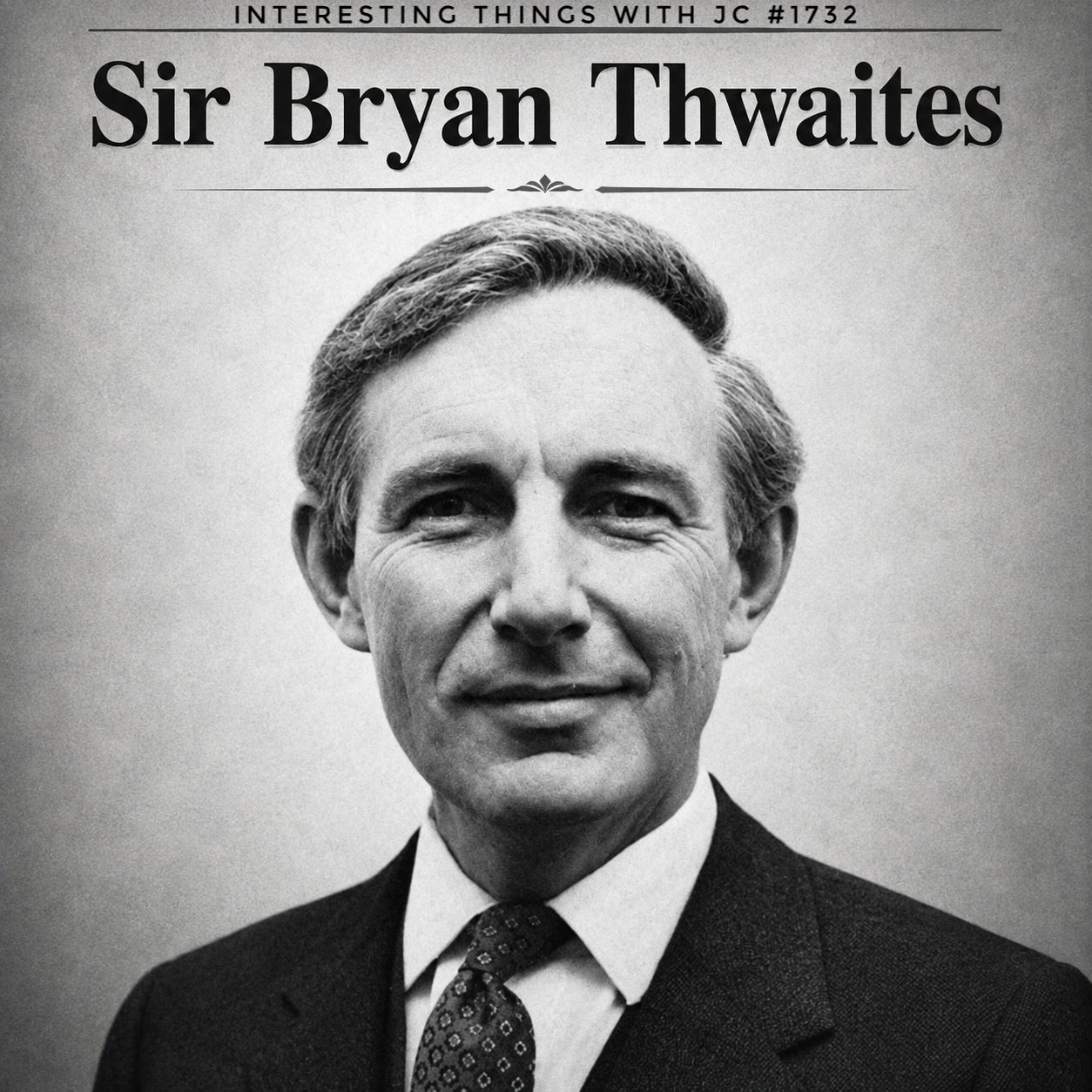
Black-and-white portrait of Sir Bryan Thwaites wearing a dark suit, white shirt, and patterned tie, facing the camera with a neutral expression. The image is centered beneath the title "Sir Bryan Thwaites," with "Interesting Things with JC #1732" displayed across the top on a light gray background.
Transcript
Interesting Things with JC #1732:
Sir Bryan Thwaites
The Man Who Changed How We Learn Mathematics
Sir Bryan Thwaites kept walking away from the careers most people spend their lives trying to reach.
After graduating with first-class honors from Cambridge during the Second World War, he began a promising career in aerodynamics. His future looked certain. Britain had another brilliant young mathematician headed for research.
But Thwaites became convinced he could make a greater difference somewhere else.
In 1951, he returned to Winchester College as a mathematics teacher, where he noticed something that troubled him. Students were being prepared for a world that no longer existed. Science and technology were changing rapidly, but much of the mathematics curriculum had barely changed at all.
A decade later, as Professor of Theoretical Mechanics at the University of Southampton, he gathered teachers to ask a simple question: if mathematics education were designed for the future instead of the past, what would it look like?
That question became the School Mathematics Project.
The timing was remarkable. Only a few years after Sputnik shocked the world, Britain was rethinking how it prepared future scientists and engineers. Under Thwaites' leadership, the School Mathematics Project introduced ideas like set theory, vectors, matrices, graph theory, and modern mathematical thinking into classrooms across Britain. New textbooks followed. New examinations followed. Before long, millions of students were learning mathematics in ways that would have been unfamiliar just a generation earlier.
Most people know the names of great mathematicians because of the problems they solved.
Bryan Thwaites may have left his greatest mark by changing how other people learned to solve theirs.
He became Principal of Westfield College, University of London, served in public healthcare, was knighted for his contributions to education and medicine, and continued supporting young people through philanthropy. Yet the work that shaped the lives of the greatest number of people happened, one classroom at a time.
Tomorrow, somewhere in Britain, a student will open a mathematics textbook without giving a thought to the man who helped decide what belonged inside it. That's often how lasting influence works. The people who shape the future are rarely the people we remember.
These are interesting things, with JC.
Student Worksheet
Directions
Listen to the episode before beginning. If audio is unavailable, carefully read the transcript. Answer each question using complete sentences and evidence from the episode.
Part A – Comprehension
What career did Bryan Thwaites leave to become a mathematics teacher?
What concern did he have about mathematics education in the early 1950s?
What question eventually led to the School Mathematics Project?
Name four mathematical topics introduced into schools through the School Mathematics Project.
Why did Britain become especially interested in improving mathematics education during this period?
Part B – Analysis
Why might teaching students "for the future instead of the past" be difficult?
What risks might educators face when proposing major curriculum changes?
Why do you think curriculum reform often receives less public attention than scientific discoveries?
Explain how Bryan Thwaites demonstrated leadership without seeking public recognition.
Part C – Reflection
Write one well-developed paragraph (150–200 words).
Prompt:
Think about a class you have taken. If you could redesign one part of that class to better prepare students for the future, what would you change and why?
Support your answer with examples from your own experience and ideas discussed in the episode.
Part D – Critical Thinking
Read the quotation below.
"Students were being prepared for a world that no longer existed."
Respond to the following:
What did Thwaites mean by this statement?
Can you identify a modern example where education is adapting to technological change?
Should schools focus more on facts or on learning how to think? Explain your reasoning.
Difficulty Scaling
Level 1
Complete Part A only.
Level 2
Complete Parts A and B.
Level 3
Complete all sections including the reflection.
Extension Challenge
Research one mathematics topic mentioned in the episode (set theory, vectors, matrices, or graph theory). Create a one-page explanation showing how that topic is used today in science, engineering, economics, medicine, or computer science.
Expected Student Output
Students should produce:
Five factual responses
Four analytical responses
One reflective paragraph
Three evidence-based critical thinking responses
(Optional) One-page research extension
Academic Integrity Guidance
Use your own words whenever possible.
Support answers with evidence from the episode.
Properly cite any outside research used in the extension activity.
Collaboration is encouraged during discussion but written responses should reflect individual understanding.
Teacher Guide
Quick Start
Begin class by playing the podcast episode in its entirety. Encourage students to listen for the reasons Bryan Thwaites chose education over research and how one individual influenced millions of learners through curriculum design.
If audio cannot be played, distribute the transcript and conduct a guided reading.
Pacing Guide (Audio-First)
5 minutes: Bell Ringer
7 minutes: Vocabulary preview
6 minutes: Podcast listening
8 minutes: Clarifying discussion
15 minutes: Student Worksheet Parts A and B
10 minutes: Reflection writing
8 minutes: Whole-class discussion
5 minutes: Exit Ticket
Total Time: Approximately 60 minutes
Bell Ringer
Display the following question before class begins:
Think of a school subject you study today. Who decided what should be included in that course?
Allow students two minutes to write an answer before beginning discussion.
Audio Guidance
Ask students to listen specifically for:
Why Thwaites changed careers
The problem he identified
The purpose of the School Mathematics Project
Examples of curriculum innovation
Evidence of long-term impact
Audio Fallback
If technology is unavailable:
Read the transcript aloud.
Pause after each paragraph for clarification.
Highlight unfamiliar vocabulary.
Proceed with the worksheet normally.
Time-on-Task
Listening: 10%
Guided discussion: 20%
Individual work: 45%
Reflection and assessment: 25%
Materials
Podcast audio or transcript
Student Worksheet
Writing materials
Whiteboard or projector
Optional internet access for extension research
Vocabulary Strategy
Before listening, preview:
Curriculum
Educational Reform
Set Theory
Vector
Matrix
Ask students to predict how each term might relate to education before revealing the episode.
Misconceptions
Misconception: Mathematics has always been taught the same way.
Clarification: Mathematics evolves as society's scientific and technological needs change.Misconception: Curriculum changes happen automatically.
Clarification: Curriculum reform requires educators, researchers, governments, and schools working together over many years.Misconception: Only famous scientists shape history.
Clarification: Educational leaders often influence millions of people through teaching and curriculum design rather than public recognition.Misconception: Modern mathematics is simply "harder."
Clarification: Modern mathematics emphasizes conceptual understanding and problem solving, not just increased difficulty.
Discussion Prompts
Why would someone leave a prestigious research career to become a teacher?
What qualities make an effective educational leader?
Should schools teach skills that prepare students for jobs that do not yet exist? Why or why not?
How might today's curriculum look different twenty years from now?
Why are many influential people unknown to the public?
Formative Checkpoints
Students accurately explain why Thwaites changed careers.
Students identify the purpose of the School Mathematics Project.
Students connect curriculum reform to societal and technological change.
Students support conclusions using evidence from the podcast.
Differentiation
Provide guided notes for developing readers.
Allow verbal responses before written work.
Pair students for collaborative discussion.
Offer graphic organizers to summarize the episode.
Encourage advanced learners to research additional curriculum reforms in other countries.
Assessment Differentiation
Oral responses may replace selected written answers.
Extended time as needed.
Reflection may be submitted as an audio recording or presentation.
Extension research may substitute for one analytical response.
Time Flexibility
30-minute lesson: Podcast, comprehension questions, exit ticket.
45-minute lesson: Add discussion and analysis.
60-minute lesson: Complete full worksheet and reflection.
90-minute lesson: Include extension research and student presentations.
Substitute Readiness
This lesson may be taught without prior content knowledge. Follow the pacing guide, play the podcast or use the transcript, facilitate discussion using the prompts provided, and collect worksheet responses.
Engagement Strategy
Conduct a "Curriculum Design Challenge." Small groups identify one school subject and propose one change that would better prepare students for the future. Groups justify their proposal using evidence from the episode.
Extensions
Research the history of the School Mathematics Project.
Compare mathematics education before and after the 1960s.
Investigate how computer science has influenced mathematics instruction.
Interview a mathematics teacher about changes they have witnessed in curriculum.
Cross-Curricular Connections
History: Cold War and the global impact of Sputnik.
Science: Mathematics as the language of scientific inquiry.
Engineering: Application of vectors and matrices.
Computer Science: Graph theory, algorithms, and data structures.
English Language Arts: Informational text analysis and evidence-based writing.
SEL Connection
Students consider how service, humility, and long-term thinking contribute to meaningful leadership. The lesson encourages appreciation for contributions that improve society without public recognition.
Skill Value Emphasis
Critical Thinking
Evidence Evaluation
Communication
Systems Thinking
Historical Analysis
Reflection
Problem Solving
Leadership
Adaptability
Answer Key
Worksheet Part A
Aerodynamics research.
Students were being prepared for an outdated world while science and technology were advancing rapidly.
"If mathematics education were designed for the future instead of the past, what would it look like?"
Set theory, vectors, matrices, graph theory (any four mentioned).
The Sputnik era prompted Britain to strengthen science and mathematics education.
Worksheet Part B
Accept thoughtful responses supported by evidence. Students should recognize:
Curriculum must adapt to societal change.
Educational reform often faces resistance.
Leadership can occur behind the scenes.
Long-term influence is often invisible.
Quiz
Choose the best answer. (Do not provide answers to students.)
Bryan Thwaites first built his career in:
A. Architecture
B. Aerodynamics
C. Medicine
D. EconomicsWhat concern motivated Thwaites to rethink mathematics education?
A. Schools had too many teachers.
B. Students disliked mathematics.
C. The curriculum no longer matched a changing world.
D. Universities had eliminated mathematics degrees.Which initiative resulted from his work?
A. Cambridge Science Initiative
B. National Engineering Project
C. School Mathematics Project
D. British Mathematics SocietyWhich topic was introduced into many classrooms through the School Mathematics Project?
A. Latin Grammar
B. Graph Theory
C. Astronomy
D. Music TheoryWhat is the central message of the episode?
A. Fame is the greatest measure of success.
B. Educational leadership can shape generations.
C. Mathematics has never changed.
D. Research is always more valuable than teaching.
Assessment
Open-Ended Questions
Explain how Bryan Thwaites demonstrated leadership through educational reform rather than scientific discovery. Use evidence from the episode.
Evaluate whether schools today should continue revising curricula to meet future societal needs. Support your position with examples.
3–2–1 Rubric
3 – Exceeds Expectations
Accurate understanding
Strong evidence
Clear reasoning
Insightful reflection
2 – Meets Expectations
Mostly accurate
Appropriate evidence
Logical explanation
Adequate reflection
1 – Developing
Limited understanding
Minimal evidence
Incomplete reasoning
Needs additional support
Exit Ticket
Answer in one or two sentences:
What is one lasting lesson you learned from Bryan Thwaites' life, and why do you believe it remains important today?
Standards Alignment
NGSS Science & Engineering Practice: SEP 8 – Obtaining, Evaluating, and Communicating Information
Connection: Students analyze a historical case study and communicate evidence-based conclusions about curriculum reform.
Measurable Outcome: Students cite evidence from the episode to explain educational change.
Justification: Supports evaluating information and communicating scientific and educational ideas.
CCSS.ELA-LITERACY.RI.11-12.2 – Determine Central Ideas
Connection: Students identify the episode's central themes and summarize supporting details.
Measurable Outcome: Students produce accurate summaries supported by evidence.
Justification: Directly aligns with comprehension and analysis activities.
CCSS.ELA-LITERACY.RI.11-12.3 – Analyze Events and Ideas
Connection: Students examine how Thwaites' decisions led to widespread curriculum reform.
Measurable Outcome: Students explain cause-and-effect relationships in historical developments.
Justification: Reinforces analytical reading skills.
CCSS.ELA-LITERACY.W.11-12.1 – Argument Writing
Connection: Reflection and assessment require students to defend positions using evidence.
Measurable Outcome: Students compose evidence-based written arguments.
Justification: Develops persuasive and analytical writing.
CCSS.ELA-LITERACY.SL.11-12.1 – Collaborative Discussions
Connection: Students participate in structured classroom discussions on educational change.
Measurable Outcome: Students contribute respectfully using evidence.
Justification: Encourages academic discourse and active listening.
C3 Framework D2.His.14.9-12 – Analyze Multiple Factors Influencing Historical Events
Connection: Students investigate how postwar science, Sputnik, and educational reform intersected.
Measurable Outcome: Students explain historical context influencing curriculum decisions.
Justification: Strengthens inquiry-based historical reasoning.
ISTE Standard 1.1 – Empowered Learner
Connection: Students reflect on how education evolves and identify personal learning goals.
Measurable Outcome: Students evaluate future learning needs.
Justification: Promotes self-directed learning.
Career Readiness – Analytical Thinking
Connection: Students evaluate complex educational problems and propose solutions.
Measurable Outcome: Students apply evidence to decision-making.
Justification: Mirrors workplace problem-solving.
Career Readiness – Communication
Connection: Written reflections and discussions require clear communication.
Measurable Outcome: Students present organized evidence-based ideas.
Justification: Essential professional competency.
Career Readiness – Professional Judgment
Connection: Students evaluate leadership decisions with long-term societal impact.
Measurable Outcome: Students justify conclusions using evidence.
Justification: Reinforces responsible decision-making.
Homeschool / Lifelong Learning Alignment – Independent Inquiry
Connection: Extension research encourages self-directed exploration.
Measurable Outcome: Students investigate additional historical or mathematical topics independently.
Justification: Supports lifelong curiosity and independent scholarship.
Homeschool / Lifelong Learning Alignment – Information Literacy
Connection: Students distinguish evidence from opinion while evaluating historical sources.
Measurable Outcome: Students identify reliable information and communicate findings accurately.
Justification: Builds transferable research skills.
Show Notes
This lesson explores how Sir Bryan Thwaites transformed mathematics education by recognizing that schools must evolve alongside society. Students discover that some of history's most influential figures are not remembered for public achievements but for improving the systems that shape future generations. Through discussion, analysis, and reflection, learners examine leadership, innovation, and the enduring impact of educational reform while considering how today's classrooms prepare tomorrow's workforce.
References
Bryan Thwaites. (n.d.). MacTutor History of Mathematics Archive. University of St Andrews School of Mathematics and Statistics. https://mathshistory.st-andrews.ac.uk/Biographies/Thwaites/
School Mathematics Project. (2020, January 3). Bringing the School Maths Project into the 21st century. University of Southampton. https://www.southampton.ac.uk/news/2020/01/bringing-maths-project-into-21st-century.page
School Mathematics Project. (n.d.). The School Mathematics Project. https://www.schoolmathsproject.org.uk/
The National Archives. (n.d.). Sputnik and the Cold War. https://www.nationalarchives.gov.uk/education/resources/cold-war/
Thwaites, B. (1967). The School Mathematics Project: Director's Report 1966–1967 (ERIC Document ED027196). ERIC. https://files.eric.ed.gov/fulltext/ED027196.pdf