Interesting Things with JC #1733: "Can Rams Get Brain Damage?"
Bighorn rams survive violent head-on crashes that would devastate most animals, yet their brains may still carry evidence of those impacts. Scientists are still trying to understand what they're seeing.
Curriculum - Episode Anchor
Episode Title: Can Rams Get Brain Damage?
Episode Number: 1733
Host: JC
Audience: Grades 9–12, Introductory College, Homeschool, Lifelong Learners
Subject Area: Biology, Anatomy & Physiology, Animal Adaptation, Neuroscience
Lesson Overview
Objectives:
Explain how bighorn sheep are anatomically adapted to survive repeated head impacts.
Distinguish between physical adaptations and complete immunity to injury.
Evaluate scientific evidence regarding traumatic brain injury (TBI) research in wild animals.
Describe how studies of animal physiology can contribute to advances in human medicine.
Essential Question:
How can animals evolve to withstand extreme physical impacts, and what can humans learn from those adaptations?
Success Criteria:
Identify at least three adaptations that reduce impact forces in rams.
Explain why protective adaptations do not necessarily eliminate injury.
Interpret the significance of hyperphosphorylated tau findings in scientific research.
Connect biological research to practical medical applications.
Student Relevance Statement:
Students encounter discussions about sports injuries, concussions, and brain health throughout their lives. Understanding how scientists study natural adaptations demonstrates how biology influences medicine, engineering, athletics, and public safety.
Real-World Connection:
Research into bighorn sheep and muskoxen may help improve football helmets, military protective equipment, automobile safety systems, and treatments for traumatic brain injuries.
Workforce Reality:
This lesson highlights careers including wildlife biology, veterinary medicine, neuroscience, biomedical engineering, biomechanics, emergency medicine, conservation science, and medical research.
Key Vocabulary
Adaptation(ad-ap-TAY-shun) — An inherited characteristic that improves survival or reproduction.
Keratin(KAIR-uh-tin) — A strong structural protein found in hair, nails, horns, and hooves.
Traumatic Brain Injury (TBI)(traw-MAT-ik brain IN-jur-ee) — Damage to the brain caused by an external force.
Concussion(kun-KUSH-un) — A mild traumatic brain injury affecting brain function after a blow or jolt.
Hyperphosphorylated Tau(HY-per-FOS-for-uh-lay-tid tow) — An abnormal form of the tau protein associated with certain brain injuries and neurodegenerative diseases.
Biomechanics(BY-oh-meh-KAN-iks) — The study of how living organisms move and respond to physical forces.
Evolution(ev-uh-LOO-shun) — The gradual change in inherited traits of populations over generations.
Force Distribution(FORSS dis-trih-BYOO-shun) — The spreading of impact energy across a larger area to reduce concentrated stress.
Narrative Core
Open:
Two bighorn rams charging toward one another and colliding headfirst is one of nature's most dramatic spectacles. The tremendous impact naturally raises an important question: how do they survive?
Info:
Bighorn sheep possess thick skulls, horns with living bone cores covered by keratin, exceptionally strong neck muscles, and skull structures that redirect impact forces away from the brain. Mature males weighing over 300 pounds repeatedly engage in these collisions during the breeding season.
Details:
Although these adaptations provide remarkable protection, research has found accumulations of hyperphosphorylated tau proteins in the brains of deceased bighorn sheep and muskoxen. Similar proteins are associated with traumatic brain injuries in humans. Scientists caution that these findings do not prove rams routinely suffer concussions but indicate that microscopic brain changes may occur after years of repeated impacts. Researchers continue studying what these findings mean and how these animals tolerate impacts better than humans.
Reflection:
Nature often evolves solutions that are highly effective without being perfect. Understanding the limits of biological adaptations helps scientists improve protective equipment and medical treatments while reminding us that surviving an injury is not the same as avoiding all damage.
Closing:
These are interesting things, with JC.
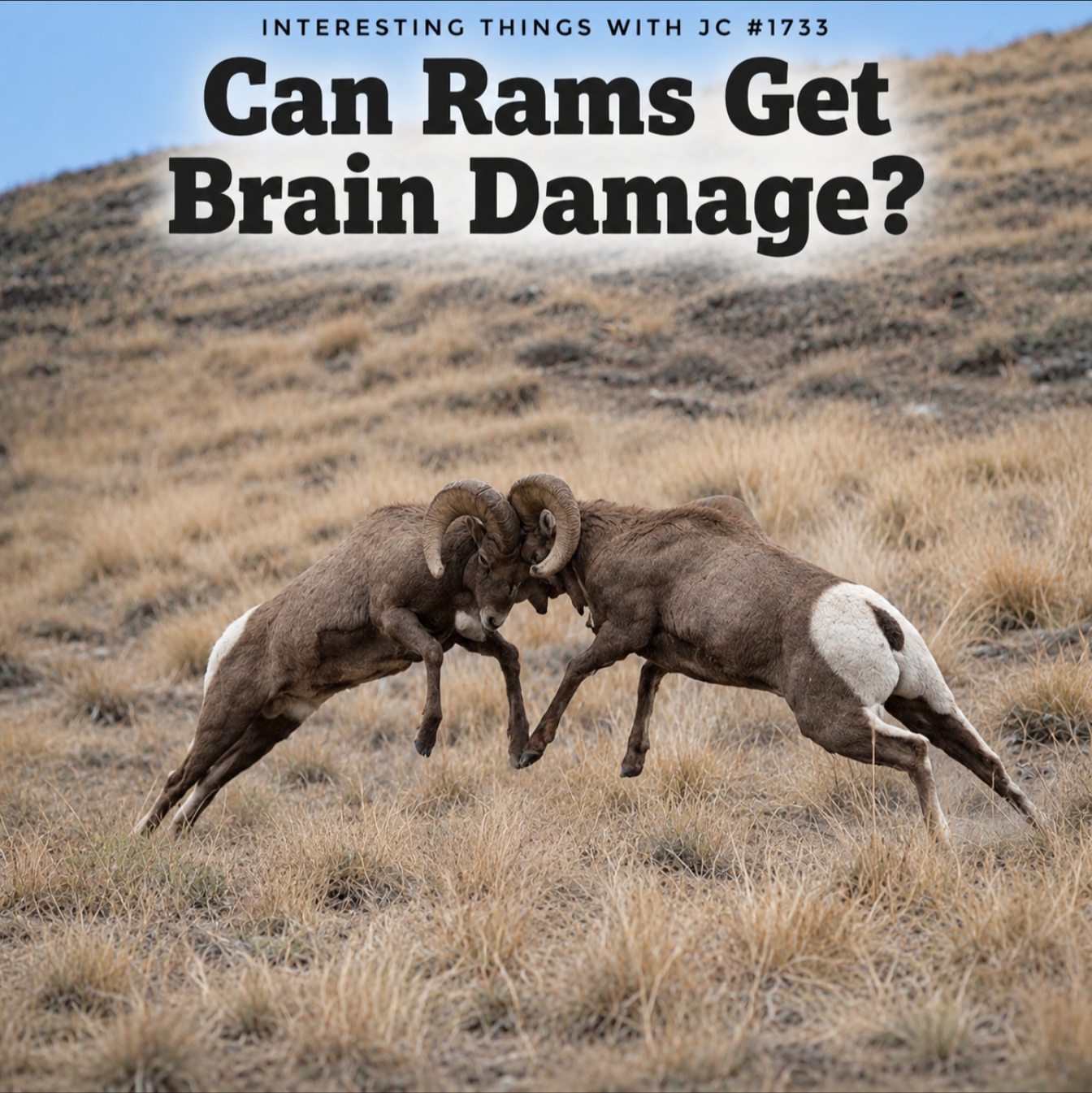
Promotional image for Interesting Things with JC #1733 titled "Can Rams Get Brain Damage?". Two adult bighorn rams are captured mid-collision on a dry, grassy mountainside, their curled horns locked together as both animals brace against the impact. Large black title text fills the upper half of the image, with the episode number displayed across the top against a blurred hillside and blue sky background.
Transcript
Interesting Things with JC #1733:
Can Rams Get Brain Damage?
If you've ever watched two bighorn rams slam into each other, it's hard to believe what you're seeing. They lower their heads, charge, and crash together with enough force to echo across a mountainside. You can't help but think, "How do they survive that?"
For a long time, most people figured they were built so well that those hits just didn't hurt them. They do have some incredible protection. Their skulls are thick. Their horns have a core of living bone covered with keratin, the same material that's in your fingernails. Their neck muscles are powerful, and the shape of the skull and horns helps spread and redirect the force instead of sending it straight to the brain.
A mature bighorn ram can weigh more than 300 pounds, or about 136 kilograms, and during the breeding season they may crash into each other over and over again. Their bodies are remarkably well designed for it.
But "well protected" doesn't mean "completely protected."
Researchers who examined the brains of bighorn sheep and muskoxen after they died found accumulations of hyperphosphorylated tau, an abnormal form of a protein that's also associated with traumatic brain injuries and certain brain diseases in humans.
That doesn't prove rams routinely get concussions or suffer the same diseases people do. It simply shows there may be microscopic changes in the brain after years of repeated impacts. What those changes actually mean is something scientists are still trying to understand.
That question has made these animals surprisingly valuable to medical research. If scientists can learn how sheep and muskoxen tolerate repeated blows to the head far better than we do, it could eventually help protect athletes, soldiers, crash victims, and anyone else at risk of traumatic brain injury.
The next time you see two rams collide, remember this: evolution didn't make them indestructible. It made them tough enough to survive, and sometimes that's an entirely different thing.
These are interesting things, with JC.
Student Worksheet
Directions: Listen to the podcast episode first. If audio is unavailable, read the transcript carefully before completing the worksheet. Support your answers with evidence from the episode.
Comprehension
What physical features help protect a bighorn ram's brain during collisions?
Approximately how much can a mature bighorn ram weigh?
What protein did researchers find in the brains of some bighorn sheep and muskoxen?
Does the research prove that rams regularly suffer concussions? Explain.
According to the episode, why are these animals valuable to medical researchers?
Analysis
Explain the difference between being well protected and being completely protected. Use examples from the episode.
Why do scientists avoid making conclusions that extend beyond the available evidence?
How does this episode demonstrate that evolution produces adaptations rather than perfection?
Describe one way studying wildlife can improve human health or safety.
Why is it important for scientists to continue researching the long-term effects of repeated head impacts?
Reflection
Choose one prompt.
Describe a technology that humans could improve by studying bighorn sheep.
Explain how this episode changed or reinforced your understanding of evolution.
Discuss why scientific discoveries often create more questions than answers.
Difficulty Scaling
Level 1: Complete the comprehension questions.
Level 2: Complete comprehension and analysis.
Level 3: Complete all sections and write a one-page explanation describing how adaptations solve biological challenges while still having limitations.
Student Output Expectations
Students should produce:
Complete written responses using scientific vocabulary.
Evidence from the episode.
Logical reasoning supported by examples.
Clear scientific explanations rather than opinions.
Academic Integrity Guidance
Use your own words unless directly quoting the transcript.
Support conclusions with evidence from the episode.
Distinguish observations from assumptions.
Cite additional sources if outside research is conducted.
Teacher Guide
Quick Start: Begin class by playing the podcast episode before introducing vocabulary or discussion. Students should first experience the story naturally before analyzing the science.
Pacing Guide (Audio-First):
Bell Ringer (5 minutes)
Vocabulary Preview (5 minutes)
Listen to Podcast (5 minutes)
Guided Discussion (10 minutes)
Student Worksheet (20 minutes)
Review and Reflection (10 minutes)
Exit Ticket (5 minutes)
Bell Ringer:
Display the question:
"How can two 300-pound animals repeatedly collide headfirst without immediately suffering serious injuries?"
Have students record an initial hypothesis before hearing the episode.
Audio Guidance:
Encourage students to identify:
Physical adaptations mentioned.
Scientific evidence presented.
Claims supported by research.
Questions scientists are still investigating.
Audio Fallback:
If audio is unavailable, students read the transcript silently or aloud in small groups before completing lesson activities.
Time-on-Task: Approximately 60 minutes (adjustable from 45–90 minutes).
Materials:
Podcast audio or transcript
Student worksheet
Projector or display
Whiteboard
Scientific diagram of a bighorn sheep skull (optional)
Colored pencils for annotation (optional)
Vocabulary Preparation:
Review:
Adaptation
Keratin
Tau protein
Concussion
Biomechanics
Have students predict how each term might appear in the lesson before listening.
Common Misconceptions
Bigger horns make animals immune to injury.
Evolution creates perfect organisms.
Tau protein automatically means a concussion occurred.
Animal research always produces immediate medical breakthroughs.
Discussion Prompts
Why doesn't evidence of tau protein automatically prove concussions?
How does careful scientific wording improve research quality?
What engineering ideas might come from studying ram skulls?
Why do biological adaptations often involve trade-offs?
How can wildlife research benefit people?
Formative Checkpoints
Students correctly identify at least three protective adaptations.
Students distinguish observation from conclusion.
Students accurately explain why more research is needed.
Students use scientific vocabulary appropriately.
Differentiation
Support
Provide vocabulary cards.
Allow paired discussion before written work.
Highlight evidence within the transcript.
Extension
Compare bighorn sheep with woodpeckers or muskoxen.
Research current helmet technologies inspired by biology.
Design an improved protective helmet using biomimicry principles.
Assessment Differentiation
Students may demonstrate understanding by:
Written responses
Oral presentation
Scientific infographic
Concept map
Short research summary
Time Flexibility
45-minute class: Audio, discussion, comprehension only.
60-minute class: Full worksheet.
90-minute class: Add extension research and presentations.
Substitute Readiness
This lesson is fully self-contained. A substitute can successfully teach it using only the transcript, worksheet, and pacing guide.
Engagement Strategy
Ask students to estimate the collision forces experienced by two charging rams before revealing that scientists continue to study how these animals tolerate such impacts.
Extensions
Investigate biomimicry in engineering.
Compare human concussion research with animal adaptations.
Explore wildlife biomechanics careers.
Cross-Curricular Connections
Biology
Physics
Engineering
Veterinary Medicine
Medical Research
Anatomy
Environmental Science
SEL Connection
Students practice intellectual humility by recognizing that science continually evolves as new evidence becomes available.
Skill Emphasis
Critical thinking
Scientific reasoning
Evidence evaluation
Data interpretation
Communication
Problem solving
Answer Key
Comprehension
Thick skull, horn structure, keratin covering, powerful neck muscles, skull shape that distributes force.
More than 300 pounds (approximately 136 kg).
Hyperphosphorylated tau.
No. The evidence shows microscopic brain changes but does not prove routine concussions.
Understanding how these animals tolerate repeated impacts may improve protection and treatment for traumatic brain injuries in humans.
Analysis (Sample Responses)
Protection reduces injury risk but cannot eliminate all possible damage.
Scientists avoid unsupported conclusions because evidence must match claims.
Evolution favors survival and reproduction, not perfection.
Improved helmets, vehicle safety systems, military protective equipment, or medical treatments.
Better understanding may reduce traumatic brain injuries in athletes, soldiers, crash victims, and others.
Quiz
Directions: Select the best answer for each question. (Do not reveal answers until after grading.)
Which structure is NOT mentioned as helping protect a ram's brain?
A. Thick skull
B. Powerful neck muscles
C. Flexible antlers
D. Horn shapeHyperphosphorylated tau is associated with:
A. Improved muscle growth
B. Brain injuries and certain neurological diseases
C. Increased bone density
D. Better balanceThe episode states that researchers studied:
A. Living animals during collisions
B. Fossil skulls
C. Brains after the animals died
D. Laboratory miceThe episode concludes that:
A. Rams never experience brain injuries.
B. Scientists have answered every question.
C. Evolution created completely indestructible animals.
D. Scientists are still studying the meaning of the findings.One possible benefit of this research is improving:
A. Crop production
B. Space exploration
C. Protection against traumatic brain injuries
D. Ocean navigation
Assessment
Open-Ended Questions
Explain how the anatomy of a bighorn ram reduces the risk of brain injury while also explaining why scientists conclude that these adaptations do not make the animal completely immune to injury. Support your response with evidence from the episode.
Scientific discoveries often lead to new questions rather than final answers. Using evidence from the episode, explain how research on bighorn sheep and muskoxen could influence future medical treatments and protective technologies for humans.
3–2–1 Rubric
3 – Exceeds Expectations
Accurately explains biological adaptations using appropriate scientific vocabulary.
Supports answers with multiple pieces of evidence from the episode.
Demonstrates clear understanding of scientific reasoning and limitations.
Makes meaningful real-world connections.
2 – Meets Expectations
Correctly identifies major concepts.
Uses some evidence from the episode.
Demonstrates basic understanding of the scientific findings.
Includes appropriate vocabulary with minor errors.
1 – Approaching Expectations
Provides incomplete or partially accurate explanations.
Uses little or no supporting evidence.
Demonstrates limited understanding of the concepts.
Vocabulary is inaccurate or missing.
Exit Ticket
Before leaving class, answer the following in one or two sentences:
What is one important lesson this episode teaches about the difference between surviving an impact and avoiding injury?
Standards Alignment
NGSS (Science & Engineering Practices)
HS-LS4-4 — Biological Evolution: Natural Selection
Connection: Students analyze how anatomical adaptations increase survival without eliminating biological limitations.
Measurable Skill: Explain how evolutionary adaptations improve survival rather than create perfect organisms.
Justification: Directly supports lesson objectives regarding evolutionary biology and adaptation.
HS-LS1-2 — Structure and Function
Connection: Students evaluate how skull anatomy, horn structure, and neck musculature relate to function.
Measurable Skill: Describe relationships between biological structure and physiological performance.
Justification: Reinforces anatomy-function relationships discussed throughout the episode.
CCSS Reading
CCSS.ELA-LITERACY.RST.11-12.1
Title: Cite Specific Textual Evidence
Connection: Students reference evidence from the transcript when answering worksheet and assessment questions.
Measurable Skill: Support scientific claims using textual evidence.
Justification: Encourages evidence-based reasoning.
CCSS.ELA-LITERACY.RST.11-12.2
Title: Determine Central Ideas
Connection: Students identify the main scientific conclusions and distinguish them from unsupported assumptions.
Measurable Skill: Summarize scientific information accurately.
Justification: Aligns with comprehension and analysis activities.
CCSS Writing
CCSS.ELA-LITERACY.WHST.11-12.2
Title: Informative/Explanatory Writing
Connection: Students explain scientific concepts using evidence and appropriate terminology.
Measurable Skill: Produce organized scientific explanations.
Justification: Supports written assessment responses.
CCSS.ELA-LITERACY.WHST.11-12.9
Title: Draw Evidence from Informational Texts
Connection: Students integrate transcript evidence into written responses.
Measurable Skill: Develop evidence-supported scientific arguments.
Justification: Reinforces analytical writing.
CCSS Speaking & Listening
CCSS.ELA-LITERACY.SL.11-12.1
Title: Collaborative Discussions
Connection: Students participate in guided classroom discussions about scientific evidence.
Measurable Skill: Communicate ideas while evaluating differing interpretations.
Justification: Supports collaborative scientific reasoning.
C3 Framework
D2.Eng.6.9-12 — Construct Arguments Using Evidence
Connection: Students distinguish observations from conclusions when evaluating scientific research.
Measurable Skill: Develop evidence-based explanations.
Justification: Mirrors authentic scientific inquiry.
ISTE Standards
ISTE 1.3 — Knowledge Constructor
Connection: Students critically evaluate scientific evidence presented in the podcast.
Measurable Skill: Assess the reliability and limitations of scientific information.
Justification: Encourages responsible information literacy.
Career Readiness Competencies
Analytical Thinking
Connection: Interpret biological evidence and distinguish facts from conclusions.
Outcome: Students evaluate research objectively.
Communication
Connection: Explain scientific concepts using precise terminology.
Outcome: Students communicate scientific reasoning clearly.
Problem Solving
Connection: Consider how biological adaptations inspire engineering solutions.
Outcome: Apply scientific knowledge to practical challenges.
Adaptability
Connection: Recognize that scientific understanding evolves with new evidence.
Outcome: Demonstrate flexibility in interpreting research.
Professional Judgment
Connection: Differentiate between supported conclusions and speculation.
Outcome: Practice evidence-based decision making.
Homeschool / Lifelong Learning Alignment
Independent Learning
Connection: Students independently analyze the transcript and complete written responses.
Outcome: Develop self-directed learning habits.
Information Literacy
Connection: Evaluate scientific claims using evidence presented in the lesson.
Outcome: Build critical evaluation skills.
Real-World Application
Connection: Relate wildlife research to medicine, engineering, and public safety.
Outcome: Understand interdisciplinary applications of biology.
Self-Directed Inquiry
Connection: Encourage additional research into biomimicry and neuroscience.
Outcome: Foster curiosity beyond the classroom.
Transferable Life Skills
Connection: Practice critical thinking, evidence evaluation, and scientific communication.
Outcome: Develop skills applicable across academic and professional settings.
Show Notes
This lesson explores one of nature's most remarkable adaptations: the ability of bighorn sheep to survive repeated head-on collisions. Students learn how anatomy, evolution, biomechanics, and neuroscience intersect while examining how scientific evidence is interpreted responsibly. By distinguishing between adaptation and immunity, learners gain a deeper appreciation for both the strengths and limitations of biological systems and discover how wildlife research may contribute to advances in medicine and engineering.
References
Ackermans, N. L., Varghese, M., Williams, T. M., et al. (2022). Evidence of traumatic brain injury in headbutting bovids. Acta Neuropathologica, 144, 5–26. https://pmc.ncbi.nlm.nih.gov/articles/PMC9217783/
National Institute of Neurological Disorders and Stroke. (2026). Traumatic brain injury (TBI).https://www.ninds.nih.gov/health-information/disorders/traumatic-brain-injury-tbi
National Institute of Neurological Disorders and Stroke. (n.d.). Focus on traumatic brain injury research.https://www.ninds.nih.gov/current-research/focus-disorders/focus-traumatic-brain-injury-research
National Park Service. (2025). Desert bighorn sheep. Colorado National Monument. https://www.nps.gov/colm/learn/nature/desert-bighorn.htm
National Park Service. (2025). Bighorn sheep. Yellowstone National Park. https://www.nps.gov/yell/learn/nature/bighorn-sheep.htm
National Park Service. (2025). Bighorn sheep ramming heads.https://www.nps.gov/subjects/sound/sounds-bighorn-ram.htm
Mayo Clinic. (n.d.). Traumatic brain injury: Symptoms and causes.https://www.mayoclinic.org/diseases-conditions/traumatic-brain-injury/symptoms-causes/syc-20378557
Mayo Clinic. (2024). Concussion: Symptoms and causes.https://www.mayoclinic.org/diseases-conditions/concussion/symptoms-causes/syc-20355594